In a forced-hot-water heating system, every room or “zone” — a section of the house with its own thermostat — gets its heat controlled by either a zone valve or a circulator pump. A zone valve is a motorized valve that opens when the thermostat calls for heat and closes when it’s satisfied; a power head is the actuator motor that sits on top of the valve body and does the actual opening and closing. On systems that use a single circulator, a switching relay (sometimes called a zone relay or switching relay board) is the brains between the thermostats and the zone valves — it reads the thermostat signal, opens the right valve, and fires the boiler and circulator at the correct moment. If you’ve got a zone that’s stuck cold, a boiler running nonstop, or a relay board that clicks like a metronome, this article will help you trace the fault to its source, confirm the diagnosis before ordering parts, and make a confident repair-or-replace call.
| EDITOR'S PICK[Azel SP-83 Three Zone Switching…](https://www.amazon.com/dp/B00GEJSLZC?tag=greenflower20-20) | Mid-tier[Upgrade SR501-4 Switching Relay](https://www.amazon.com/dp/B0FN442495?tag=greenflower20-20) | Budget pick[555-050RP Zone Valve Power Head…](https://www.amazon.com/dp/B0009XE3RY?tag=greenflower20-20) | |
|---|---|---|---|
| Type | Switching relay | Switching relay | Power head |
| Zones controlled | 3 | 1 | — |
| Voltage | — | 24V | 24V |
| Compatibility | Hydronic systems | Taco SR501 | Taco 556/570 series |
| Warranty | — | — | 3-year free replacement |
| Installation ease | — | — | Easy install |
| Price | $165.73 | $72.59 | $59.15 |
| See on Amazon → | See on Amazon → | See on Amazon → |
How the Pieces Work Together (and Where the Stress Lives)
Before diagnosing failures, it helps to understand the load each component actually carries.
A power head operates in a harsh thermal environment. It mounts directly to the valve body — which runs at system water temperature, typically 160–180°F for a residential baseboard system — and its internal wax motor or synchronous gear motor cycles every time the zone calls for heat. In a three-zone house where that zone runs six-hour days all winter, the power head might cycle 1,000–2,000 times per heating season. Multiply across a 7–10 year lifespan and you’re looking at 8,000–20,000 mechanical cycles before a failure is unsurprising.
A switching relay board like the Azel SP-83 carries a different stress profile. The physical switching elements — electromechanical relays — are rated for a finite number of contact operations, typically 100,000–300,000 cycles depending on the component spec. At first glance that sounds like forever, but relay contacts also degrade from resistive heating, voltage spikes (common in older systems without surge suppression), and the inductive loads of circulator pump motors. Contact pitting begins long before a relay stops switching entirely — which is why the failure mode you’ll hear from owners isn’t “the relay stopped working,” it’s “the relay started clicking.”
The clicking failure mode explained: A relay clicks because its coil is energizing and de-energizing rapidly, or because its contacts are chattering — making and breaking connection instead of holding cleanly. Owners of the Azel SP-83 consistently report this symptom appearing around year six of service, and reviewers of the SP-82 describe relay burnout disabling the pump output for an affected zone around year seven. This is not a defect — it’s a capacitor or contact reaching end-of-service-life on a predictable curve. ACHR News technician roundups have noted that relay board MTBF (mean time between failures) in residential hydronic applications clusters between five and nine years when boards are installed in boiler rooms with ambient temperatures above 90°F — which describes most mechanical rooms in the Northeast and Midwest.
By the Numbers
| Component | Typical Lifespan | Dominant Failure Mode | Usual Trigger |
|---|---|---|---|
| Zone valve power head | 8–15 years | Motor seizure / wax element failure | Thermal cycling fatigue |
| Electromechanical relay board | 5–10 years | Contact chatter / relay burnout | Age + inductive load spikes |
| Valve body (brass) | 20–40 years | Seat wear, seal leak | Scale / water chemistry |
Sources: Taco Comfort Solutions zone valve service documentation; Azel Technologies SP-8x product documentation; Contracting Business field notes compilation.
Power Head Failures: Diagnosis Before You Order
The most common power head failure is a motor that won’t open the valve — leaving one zone permanently cold while the rest of the system heats normally. Before condemning the power head, work through a fast three-step confirmation:
Step 1 — Check for 24VAC at the power head terminals. With the zone’s thermostat calling for heat, use a multimeter set to AC voltage and probe the two 24V terminals on the power head. If you’re reading 24VAC and the valve isn’t opening, the power head is the likely fault. If you’re reading zero volts, the problem is upstream — the thermostat, the relay board, or wiring.
Step 2 — Listen and feel. A healthy power head opening under 24VAC power will produce a faint hum or whir and the valve stem will move. A failed wax motor is completely silent. A seized gear motor may hum loudly and feel warm to the touch with no stem movement.
Step 3 — Mechanical free-check. Most power heads have a manual open lever or tab (check your model’s documentation — Taco 570-series heads have one; generic heads vary). With power off and system pressure normal, manually actuate the lever. If the valve body itself is seized or scaled internally, the lever will be stiff or immovable regardless of power head condition. A free-moving lever that won’t actuate electrically confirms the power head is the failed component.
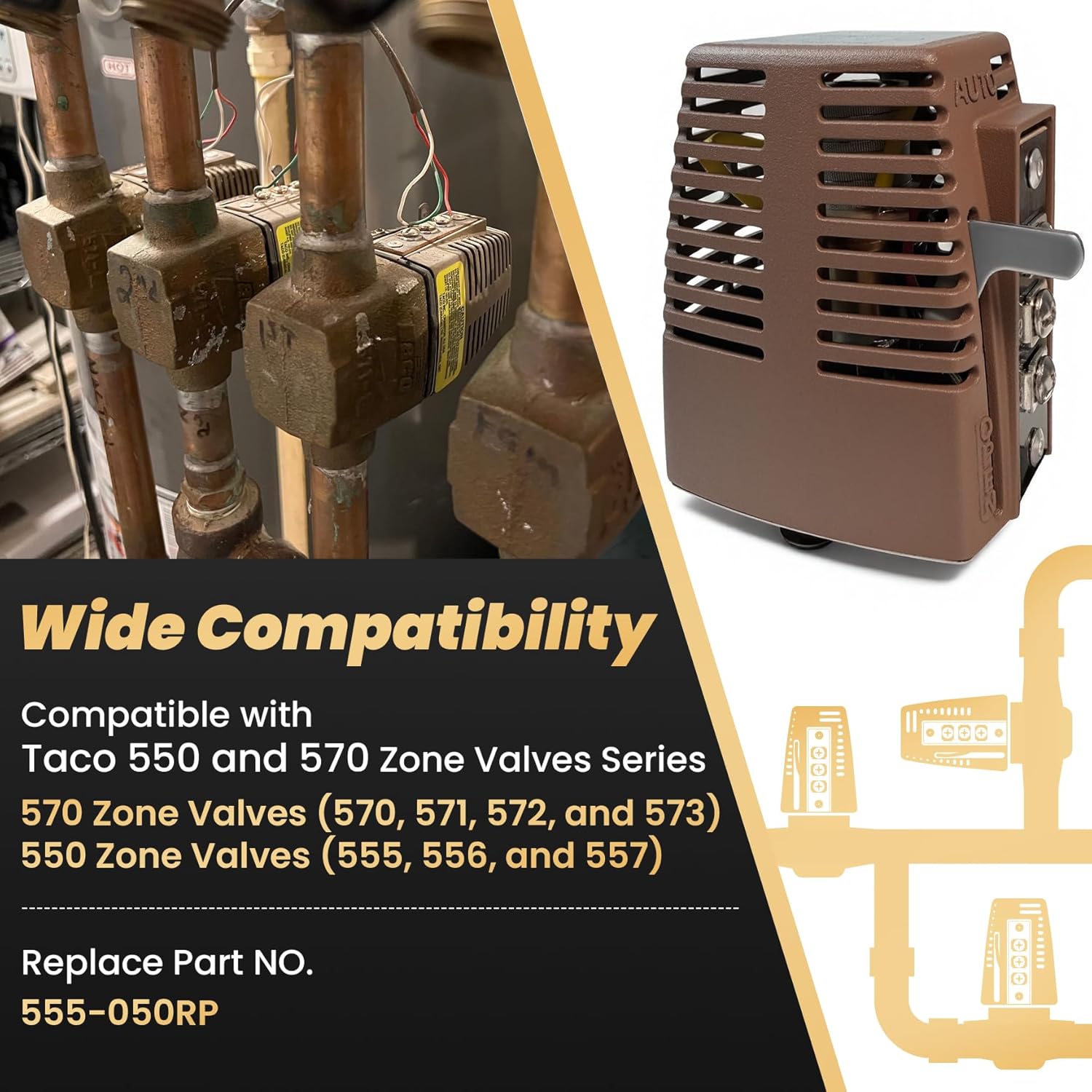
Reviewers of the Taco 555-050RP power head consistently describe it as a plug-in replacement for the Taco 556 and 570 head series — “super easy to install” in aggregated owner accounts — precisely because the mechanical interface, terminal count, and wire gauge requirements are unchanged from the original Taco head. That’s the value of staying within a known product family: no adapter plates, no wiring surprises.
Wiring documentation is non-negotiable. Across every major product category in zone control, the single most consistent practitioner advice is this: photograph every terminal before disconnecting a single wire. Power heads typically have only two or three conductors, but relay boards can have eight or more terminals with zone-specific wiring that varies from the diagram in the installation manual based on what the original installer actually did. Contracting Business field notes compilations repeatedly identify improper re-wiring after component swap as the leading cause of “new part, same problem” callback visits.
Switching Relay Failures: Repair Logic for the SP-83 and SR501-4
When a relay board fails, you face a different decision tree than a power head swap: can you replace just the failed relay, or does the board need to go?
Azel SP-83: Board-level replacement is usually the right call. The SP-83 is a solid-state / electromechanical hybrid board. The relays are through-hole components — technically de-solderable by a skilled technician — but Azel Technologies’ own product documentation does not support relay-level field repair, and the labor time to de-solder, source an exact-spec relay, and re-solder exceeds the board replacement cost in most service calls. Owners who report the incessant clicking failure at year six almost universally resolve it with a full board swap. The practical answer to “can I replace just one zone?” is: the relay component is theoretically replaceable if you have soldering skills and the correct relay spec, but the board replacement is the documented, warrantied path. Order the board.
SR501-4: True drop-in for the Taco SR501. Owners describe the SR501-4 as a Taco SR501 replacement that installs without rewiring — terminal-for-terminal compatibility, same form factor, same 24VAC control voltage. That said, “drop-in” should always be verified against your specific installed wiring before ordering: photograph your existing terminal connections, compare to the SR501-4 wiring diagram in the product documentation, and confirm zone count matches. The SR501-4 covers up to four zones; if your Taco SR501 installation used fewer than four zones, unused terminals simply remain empty.
Identifying relay failure vs. other board-level faults: If the clicking is happening with no thermostats calling — a board that cycles on its own — that points to a failed relay contact that’s welded closed (a known failure mode in contacts degraded by inductive voltage spikes). If the clicking happens only when a thermostat calls, it’s more likely a coil-related chatter. Either way, the diagnosis is the same for a practitioner without bench-level electronics equipment: the board is failing and needs replacement.
The Proactive Replacement Question
This comes up on every aging multi-zone system: if the board is eight years old and hasn’t failed yet, should you replace it before it does?
The honest answer depends on context. In a rental property or commercial building where a zone failure means a service call, a callback charge, and potentially a tenant complaint, replacing a relay board at the eight-to-nine year mark during a scheduled annual service visit is defensible preventive maintenance — especially if the board shows any signs of the early-stage clicking pattern. In an owner-occupied home where the homeowner is present and attentive, running to failure and replacing on symptom is equally rational. Per This Old House’s reference overview of hot-water heating systems, the rest of the hydronic system — cast iron sections, copper piping, baseboard elements — routinely outlasts three or four generations of zone control electronics. The control components are the consumable layer.
If X, then Y — the decision rules:
- If one zone is cold and 24VAC is present at the power head terminals → replace the power head only; leave the board.
- If the relay board is clicking with no thermostat calling → the relay contact is welded; replace the board.
- If the relay board is past eight years and showing intermittent zone behavior → replace the board at next scheduled maintenance rather than waiting for a mid-winter failure.
- If you’re replacing a Taco SR501 and want a documented drop-in → the SR501-4 is the path of least resistance; photograph terminals first.
- If you’re replacing an Azel SP-83 relay board → order the full board replacement; relay-level component repair is not a field-supported path.
Frequently Asked Questions
How do I know if my clicking noise is a relay going bad or something else in the boiler? Isolate the source physically. Relay clicks are rapid and rhythmic, originating from the relay board enclosure. Boiler-side clicking — gas valve solenoids, pressure-relief valve chatter, expansion tank issues — comes from the boiler or near-boiler piping. With the system running, place your hand near (not on) the relay board enclosure: if the clicking intensifies or is clearly localized there, it’s the relay. If the clicking continues with the relay board powered down (exercise caution; low-voltage control wiring only), the source is elsewhere.
Can I replace just one zone on an Azel SP-83 or do I have to swap the whole board? The individual relay components are theoretically de-solderable, but Azel does not document field relay replacement and the labor cost typically exceeds the board price. Swap the board.
Is the SR501-4 a true drop-in for a Taco SR501 without rewiring? Owners report terminal-for-terminal compatibility. Photograph your existing wiring before any disconnection and verify your zone count is within the SR501-4’s four-zone capacity. Within those parameters, no rewiring is required.
How do I test a zone valve power head to confirm it’s the failed component before ordering? Apply 24VAC directly to the power head terminals (with the zone calling or with a direct jumper from a 24VAC source, following appropriate safety precautions). If the valve doesn’t actuate with confirmed voltage present, the power head is the fault. If it actuates, the fault is upstream in the control circuit.
What’s the typical lifespan of a hydronic switching relay, and should I proactively replace at a certain age? Field data compiled by Contracting Business puts residential relay board service life at five to nine years in typical mechanical room conditions. Proactive replacement at eight years is reasonable for critical applications; run-to-failure is acceptable in owner-occupied homes with attentive occupants.
Do I need to drain the system to replace a zone valve power head? No. The power head mounts above the valve body and actuates the stem mechanically. Removing the power head does not open the valve body to the system. The valve body itself remains sealed during a head swap. You do not need to drain, depressurize, or refill the system to replace a power head — it’s one of the few hydronic repairs that requires no fluid handling at all.