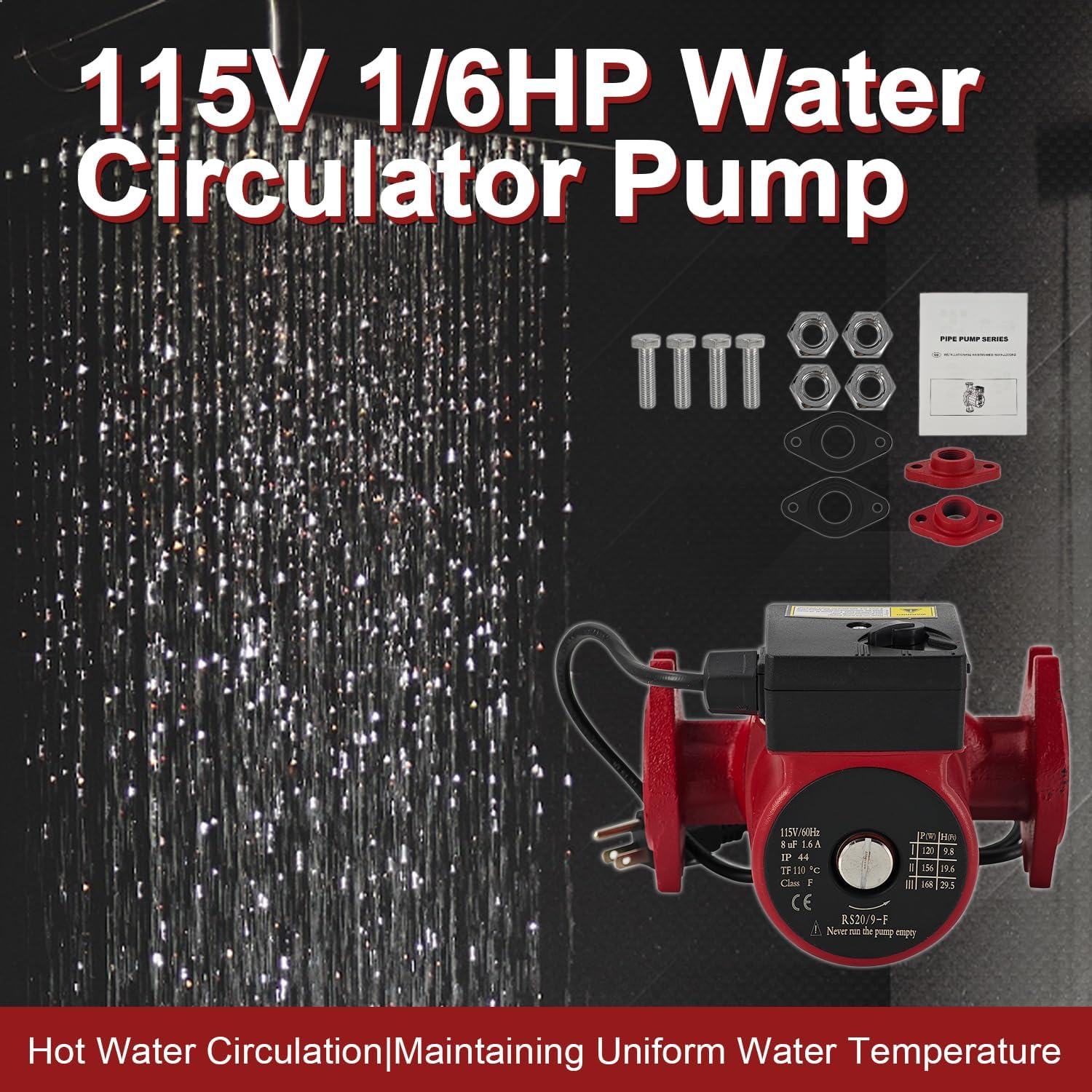
A circulator pump is the heart of a hot-water heating system — it’s the motorized pump that pushes heated water from your boiler through pipes to radiators, baseboards, or radiant floor loops and then back again. The Grundfos UPS26-99FC has been the industry default for decades: it’s a three-speed, wet-rotor circulator sized for most residential and light-commercial hydronic applications, and it’s the pump that replacement projects are almost always spec’d against. When that pump fails — or when a budget conversation starts — contractors and DIY-savvy homeowners alike start asking: is there a comparable alternative at a lower price point, and what actually changes in the field?
This article compiles what owners and installers have reported across aggregated reviews and forum discussions, cross-referenced against published specs. If you have a replacement decision pending right now, here’s what you need to know before you torque a single flange bolt.
| EDITOR'S PICKUPS26-99FC 115V 1/6 HP Hot Wate… | Mid-tierUPS26-99FC 52722512 115V 1/6HP… | Budget pickCrestWave 130W Hot Water Recirc… | |
|---|---|---|---|
| Voltage | 115V | 115V | 110V |
| Horsepower | 1/6 HP | 1/6 HP | 130W |
| Speeds | — | 3 | 3 |
| Max Flow | — | — | 13 GPM |
| Max Head | — | — | 24 ft |
| Flanges | — | — | 1" FNPT |
| Price | $125.00 | $123.99 | $51.84 |
| See on Amazon → | See on Amazon → | See on Amazon → |
Performance Parity Is Real — But Installation Details Differ in Ways That Cost You
The headline finding across owner reports is straightforward: on hydraulic performance — flow rate, head pressure, operating temperature range — UPS26-99FC alternatives from established aftermarket suppliers largely deliver what their spec sheets promise. Owners consistently report that on a standard two-zone residential baseboard system, a properly installed clone moves the same GPM through the same loop without detectable difference in heat delivery or zone balance.
That said, “comparable performance” is not the same as “drop-in identical.” HPAC Engineering’s circulator selection feature notes that even pumps with matching flow-head curves can differ in casing dimensions, flange face thickness, and port geometry in ways that matter during installation. The three differences that come up most often in owner accounts:
1. Gasket thickness and material. Multiple reviewers flag this directly. The OEM Grundfos flanged connection uses a specific gasket thickness — typically a reinforced rubber composite — that compresses predictably under the torque spec listed in the installation manual. Several aftermarket units ship with thinner or softer gaskets. If you torque to the Grundfos spec without checking, you can either over-compress a softer gasket (creating a leak path as it relaxes over thermal cycles) or under-seal a thicker one. The practical fix: before you torque any flange, measure gasket thickness and match it to the appropriate torque spec from the alternative pump’s documentation. If that documentation is missing, that is itself a red flag about the supplier.
2. Wiring termination style. Some clones arrive with a different terminal block arrangement or junction box orientation than the OEM. In a tight mechanical room where conduit is already run and terminated, this can mean re-routing a flex whip — not a showstopper, but a 20-minute surprise that experienced installers have noted in reviews. Check the dimensional drawings before the pump is on the truck.
3. Speed switch labeling. Grundfos labels its three-speed settings in a specific sequence with corresponding flow-head curves in the documentation. Some aftermarket units relabel speed settings without providing equivalent performance data per speed. If you’re doing zone balancing by speed — which is common practice in multi-zone baseboard systems — the absence of per-speed curve data makes that job harder.
None of these are dealbreakers. They are the kind of friction that experienced installers absorb easily and that first-time replacers trip on. Go in with eyes open.
The Outdoor Wood Boiler Test: What a 350-Foot Run Reveals
One of the more credible real-world accounts in aggregated reviews involves an owner running an outdoor wood boiler with a 350-foot supply run to a heat exchanger located 16 feet off grade — a configuration that pushes a circulator significantly harder than a standard residential baseboard loop. The owner reports zero performance issues with an aftermarket circulator across a full heating season.
Why does this matter as a reference point? Because it addresses the two stress variables that matter most for head pressure: pipe length (friction loss) and static lift (the pump working against gravity to push water uphill). Per published pump curves for UPS26-99FC-class pumps, a 350-foot run of standard 1-inch pipe at typical residential flow rates produces roughly 8–12 feet of head loss from friction alone; adding 16 feet of static lift brings the working head demand to the 20–28 foot range, which sits solidly within the middle of the UPS26-99FC performance envelope.
The takeaway for contractors: if an aftermarket unit performs reliably on that load profile, it’s not a marginal product. That said, the owner’s configuration is a closed loop — and that distinction matters more than almost anything else in this category, as the next section explains.
The Closed-Loop Requirement: The Installation Error That Keeps Appearing
Across recirculating pump reviews — a related but distinct product category from zone circulators — one pattern shows up repeatedly: buyers testing the pump outside of a closed loop, reporting failure, and then being corrected by the manufacturer.
Let’s define terms. A closed-loop system is one where the fluid circulates continuously through sealed piping without exposure to an open reservoir or atmospheric pressure. Most hydronic heating systems are closed loops: the boiler, the distribution piping, and the expansion tank form a sealed circuit. A recirculating pump (sometimes called a hot-water recirculation pump, used for domestic hot water delivery, not hydronic heating) is specifically designed for this environment. It relies on the system’s static pressure to maintain internal seal integrity and keep the rotor wet. Running one outside a pressurized closed loop — for example, pumping from an open bucket to test it on a bench — can starve the seal and damage the unit.
In the most instructive case from aggregated reviews, a buyer ran a recirculating pump in an open-loop test configuration, reported failure, and the manufacturer both replaced the unit and explained the installation requirement. The replacement performed correctly once installed properly. The customer-service response was positive — but the underlying confusion is real and common enough that it warrants a prominent flag here.
Practical rule: Never bench-test a wet-rotor recirculating pump outside a pressurized loop. If you need to verify function before full installation, pressurize the system, install the pump, then test.
This applies to aftermarket units and OEM Grundfos units equally — it’s a pump-category requirement, not a brand quality issue. But owners encountering an unfamiliar brand for the first time are more likely to skip the installation manual, which makes the error more common in the aftermarket segment.
The Watt Savings Are Real — Here’s the Math
One of the most compelling owner accounts involves a 26-year-old single-speed circulator running at 71 watts being replaced with a variable-speed unit drawing approximately 10 watts at typical operating conditions. The owner describes the new pump as nearly inaudible compared to the old unit.
Let’s frame that concretely.
By the numbers:
- Old pump: 71W × 3,000 hrs/heating season = 213 kWh/year
- New pump: ~10W average × 3,000 hrs = 30 kWh/year
- Annual savings:
183 kWh × $0.16/kWh (U.S. average, 2025–2026) = **$29/year** - Simple payback on a $120–180 aftermarket variable-speed unit: 4–6 years
That math is modest on a single pump. On a three-zone system with three circulators, it’s $87–$90/year in savings and a payback of 4–5 years — more meaningful. Building Green’s 2024 analysis of pump energy use in radiant and baseboard systems reinforces the finding: variable-speed circulators on residential systems consistently outperform single-speed units on energy draw, with the largest gains in systems where the pump runs continuously rather than cycling with zone demand.
The noise reduction is a real secondary benefit. Single-speed wet-rotor pumps running at fixed RPM generate a consistent hum that’s audible in mechanical rooms and sometimes through baseboard enclosures. Variable-speed units modulating to match actual system demand run quieter because they’re not fighting a fixed curve — they’re matching output to load. Owners in long-run reviews consistently note this as a quality-of-life improvement that wasn’t in the original purchase calculus.
Should You Stock a Spare Pump? The Contractor’s Calculus
Experienced installers increasingly keep a spare circulator on the truck or in the shop, and the aftermarket’s lower price point makes this more viable. Plumbing & HVAC Magazine’s 2025 field performance roundup notes that circulator failure during peak heating season — when overnight lows drive the highest system demand — is one of the most common emergency service calls in residential hydronic work. A replacement that takes two days to ship is two days of no heat.
For contractors managing a service territory: if you’re running five or more jobs annually involving UPS26-99FC-class pumps, having two aftermarket spares on the shelf costs roughly what a single OEM emergency-delivery markup costs. The math favors stocking.
For homeowners on a multi-zone system: a single spare aftermarket circulator is reasonable insurance, particularly on a system older than 15 years where adjacent components are statistically approaching end-of-life simultaneously. The ACHR News variable-speed circulator coverage from 2024 notes that pump motor windings in older single-speed units fail without clear warning signals — no gradual degradation, just a stopped pump. Having a spare on hand converts a potential emergency into a two-hour afternoon job.
The caveat: a spare pump sitting in a box for five or more years in an unconditioned garage may have gasket degradation before it’s ever installed. Store spares in conditioned space and inspect gasket condition before installation.
Frequently Asked Questions
1. Will a UPS26-99FC clone work as a direct replacement without modifying my piping?
In most cases, yes — with one important check. Confirm that the replacement unit’s flange spacing, port size, and overall centerline dimensions match your existing pump. Most UPS26-99FC alternatives are designed to this footprint, but dimensional drawings should be verified before ordering, not assumed. The hydraulic performance will be comparable; the fit is the variable.
2. What is the gasket difference between aftermarket and OEM Grundfos pumps, and does it matter?
It can matter significantly. Aftermarket gaskets vary in thickness and durometer (hardness). If the gasket is softer or thinner than the OEM spec, applying the Grundfos torque value can over-compress it, creating a leak path after thermal cycling. Measure gasket thickness on the replacement unit, compare it to the OEM gasket you removed, and adjust torque accordingly. When in doubt, match the replacement manufacturer’s torque spec, not Grundfos’s.
3. How much electricity will I actually save switching from an old single-speed circulator to a variable-speed model?
Based on published specs and owner reports, a typical swap from a ~70-watt single-speed unit to a 10-watt variable-speed equivalent saves approximately 60 kWh per zone per 1,000 hours of operation. On a full heating season (2,500–3,500 hours), that’s $25–$35 per pump per year at current U.S. average electricity rates. Multi-zone systems with three or more circulators see proportionally larger returns.
4. What does “closed loop” mean for a recirculating pump, and why does it matter?
A closed loop is a sealed fluid circuit with no open connection to atmosphere — the fluid circulates continuously without being replenished from a tank or reservoir. Wet-rotor recirculating pumps require this environment to maintain seal integrity and keep the motor cavity flooded. Running one outside a pressurized closed loop risks seal damage and motor failure. Always install first, pressurize the system, then test.
5. Can a recirculating pump handle a long outdoor wood boiler loop, and what head pressure should I look for?
Owner reports confirm that UPS26-99FC-class pumps handle 300-plus-foot closed-loop runs to elevated heat exchangers without issue, provided the pump’s published head curve covers the calculated friction and static lift of the run. For a 350-foot, 1-inch loop with 16 feet of lift, budget for 24–30 feet of total dynamic head and verify that the pump’s curve delivers adequate flow at that head point. Spec sheet pump curves are the definitive reference; don’t rely on rule-of-thumb sizing for unusual configurations.
6. Is it worth buying a backup circulator pump to keep on the shelf?
For contractors: yes, at current aftermarket pricing the math clearly favors stocking one or two spares rather than paying emergency-shipping premiums. For homeowners on aging multi-zone systems: a single spare is reasonable insurance that converts a potential no-heat emergency into a scheduled repair. Store spares in conditioned space and inspect gaskets before installation if the unit has been stored for more than two to three years.