In a hydronic heating system — the kind where a boiler heats water and sends it through pipes to radiators or baseboards — the boiler itself rarely decides which room gets heat. That job belongs to two small, overlooked components: the switching relay panel and the zone valve power head. A switching relay panel is a low-voltage circuit board that tells the boiler to fire and the circulator pump to run whenever a thermostat calls for heat. A zone valve power head is the motorized actuator that physically opens or closes a valve on a branch pipe, routing hot water to one zone of the house and not another. Together, these two components are the traffic controllers of a multi-zone hydronic system. They’re inexpensive relative to the boiler, rarely thought about during an install, and almost never replaced proactively — which is exactly why a failure at six years old, on the coldest night in January, feels like a crisis instead of routine maintenance.
This guide covers what actually fails inside these components, the timeline installers and homeowners report seeing, what the failure signatures look like before a full burnout, and which spares are worth keeping on the truck or on the shelf.
| EDITOR'S PICK[Azel SP-83](https://www.amazon.com/dp/B00GEJSLZC?tag=greenflower20-20) Three Zone Switching… | Mid-tier[Upgrade SR501-4 Switching Relay](https://www.amazon.com/dp/B0FN442495?tag=greenflower20-20) | Budget pick[555-050RP](https://www.amazon.com/dp/B0009XE3RY?tag=greenflower20-20) Zone Valve Power Head… | |
|---|---|---|---|
| Zone count | 3 | 1 | — |
| Type | Switching relay | Switching relay | Zone valve power head |
| Voltage | — | 24V | 24V |
| Compatibility | — | Taco SR501, SR501-4 | Taco 556, 570 series |
| Warranty | — | — | 3-year free replacement |
| Price | $165.73 | $72.59 | $59.15 |
| See on Amazon → | See on Amazon → | See on Amazon → |
How These Components Actually Fail
Neither switching relays nor zone valve power heads fail randomly. Both follow degradation paths that are predictable once you know what to look for.
Inside a switching relay panel, the load-bearing failure mode is the electromechanical relay itself — a small coil-and-contact assembly that closes a 24V circuit every time a thermostat calls. Each call is a switching event. In a two- or three-zone residential system running a typical northern U.S. heating season, that relay may cycle 15,000–25,000 times per year. The contact surface oxidizes and pits over time. The coil eventually draws enough irregular current that it begins rapid-cycling — the audible clicking that owners consistently describe as the first sign of trouble — before the contact fuses open or closed and the zone goes dead or stuck on. Per HPAC Magazine’s coverage of low-voltage control system failure modes, relay contact wear is the dominant failure mechanism in panels that lack transient-suppression components on the relay coil circuit, which describes most residential-grade units built before the mid-2010s.
Two separate reviewers of the Azel SP-83 three-zone switching relay panel report relay failure at six and seven years respectively — one presenting as incessant clicking, one as a complete zone burnout. The pattern is consistent enough that it should be treated as a lifecycle event, not a random defect. The SP-83 is not uniquely fragile; it simply has enough install base and enough years in the field that the failure timeline is now well-documented in aggregated owner feedback.
Zone valve power heads fail by a different mechanism. The internal motor is a small synchronous or shaded-pole type that drives a cam and spring assembly to open the valve and close a micro-switch that signals the boiler circuit to fire. Failure modes reported across contractor forums and manufacturer service literature include:
- Motor winding failure (most common after 8–12 years in systems with high call frequency)
- Micro-switch failure, causing the zone to open mechanically but never signal the boiler
- Spring fatigue, leaving the valve cracked open and bleeding heat to a zone regardless of thermostat state
- Terminal corrosion at the wire connections, causing intermittent zone behavior that mimics thermostat or control board problems
Contracting Business technical coverage of hydronic zone valve maintenance consistently flags spring fatigue as the most frequently misdiagnosed failure — it presents as an overheated zone, which owners and even some techs initially attribute to a runaway thermostat.
The Failure Timeline: By the Numbers
Based on aggregated owner reviews, installer reports, and published manufacturer service guidance:
| Component | Typical First Symptom | Median Failure Timeline | Most Common Failure Mode |
|---|---|---|---|
| Residential switching relay (SP-82, SP-83 class) | Audible relay clicking | 6–8 years | Contact oxidation / coil fatigue |
| Taco 556/570-class zone valve power head | Zone stuck open or dead | 8–12 years | Motor winding or micro-switch |
| Aftermarket 555-050RP-compatible power head | No reported pattern yet | N/A (newer in market) | — |
The six-to-eight-year relay window is the number worth internalizing. If you’re servicing a system installed in 2017 or 2018 and the panel has never been touched, the relays are living on borrowed time heading into the 2025–2026 heating seasons.
What to Stock and Why the 555-050RP Matters
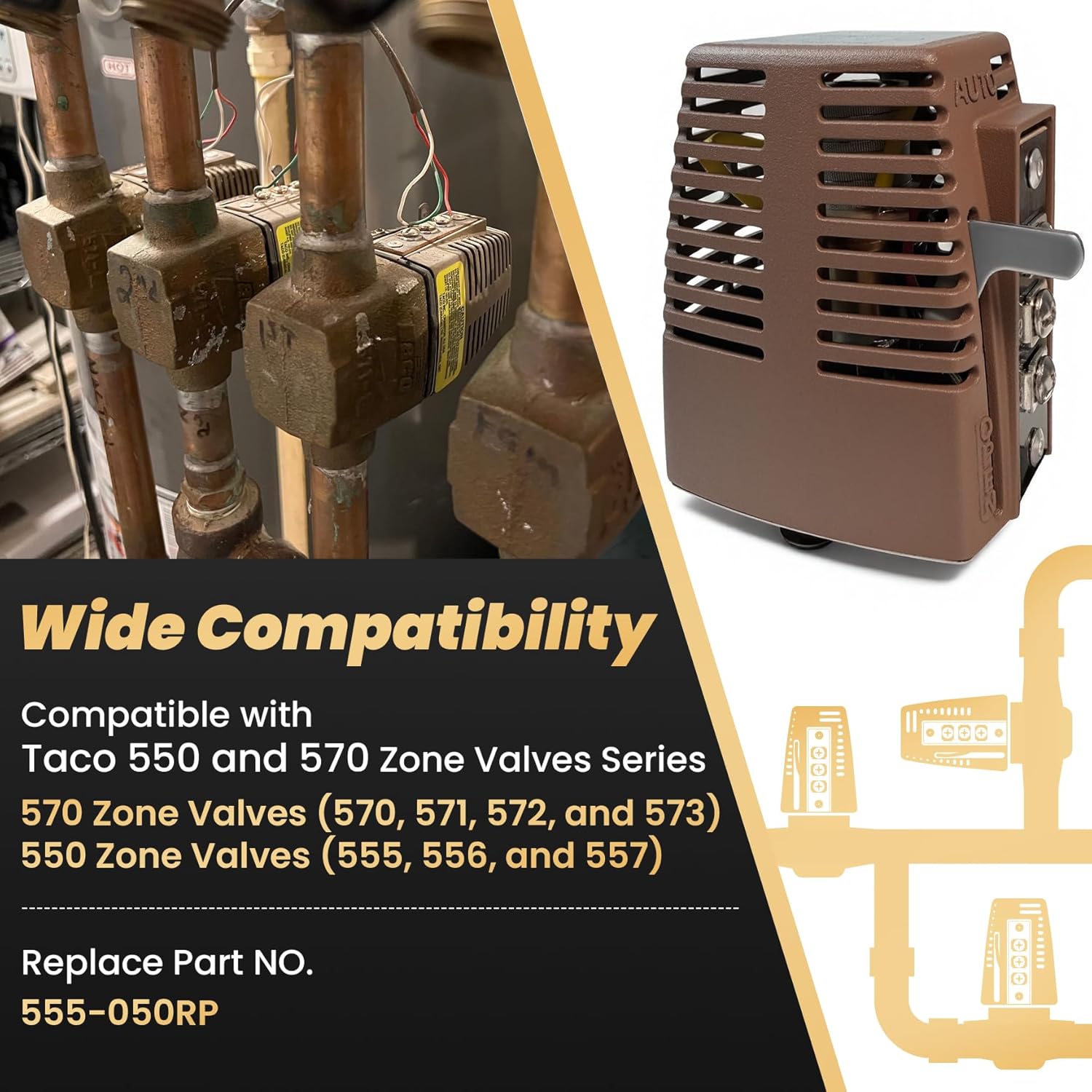
The aftermarket Taco 555-050RP-compatible power head has earned a specific reputation in installer and prosumer reviews: it is consistently described as a true plug-and-play replacement for Taco 556 and 570 series zone valves, with no rewiring required when the existing valve body is in serviceable condition. At least one documented reviewer purchased a second unit immediately after a successful first install, specifically to keep as a shelf spare — a behavior pattern that signals unusually high confidence in fit and function for an aftermarket component.
This matters for stocking decisions. The Taco 556 and 570 are among the most installed zone valves in northeastern U.S. residential hydronics from the 1990s onward, per This Old House’s technical coverage of hydronic zone control. A power head that swaps without rewiring means the job can be completed by a homeowner with moderate mechanical comfort or by a tech on a first visit without a dedicated parts run.
For switching relay panels, the calculus is slightly different. The Taco SR501-4 and its compatible equivalents occupy a similar position in the relay panel market — one aggregated reviewer’s entire endorsement was literally “it’s a Taco,” which in the installer community functions as a complete quality statement. The SR501-4 class panels are well-supported by distributors and have known-good compatibility with the Taco zone valve ecosystem.
The upgrade opportunity: One homeowner whose SP-82 two-zone panel failed chose to replace it with an SP-83 three-zone panel rather than a like-for-like swap. The marginal cost difference was low, the wiring effort was nearly identical, and the system now has a spare zone circuit available for a future baseboard loop addition. ACHR News technical coverage of zone control upgrades notes this approach — using a failure event as a capacity expansion trigger — is standard practice for experienced installers and almost never considered by first-time DIY replacements. If a client is going to pull a panel anyway, it is worth five minutes to ask whether two zones is the permanent answer.
Before You Touch Anything: Documentation Protocol
This is the step that separates a two-hour job from a four-hour job with a callback.
Reviewers and installers across multiple panel replacement accounts are unanimous: photograph every wire connection before disconnecting anything. On a three- or four-zone panel, the terminal block has 15–20 individual wire terminations. The colors are not always consistent across installers, wire age causes color fading, and the wiring diagram on the inside of the panel cover may not reflect field modifications made at original install or during a prior service call.
The practical protocol before removing any switching relay panel:
- Photograph the full panel face with all wiring in place, from straight-on and from each side angle
- Label each wire with painter’s tape and a marker before pulling terminals — zone 1 R, zone 1 W, common, etc.
- Photograph again after labeling, before disconnecting
- Note thermostat wire colors at each zone terminal in a text note — do not rely solely on photos if the space is dim
The re-wiring process is consistently reported as straightforward when photos are available. Without them, it is a process of elimination that risks miswiring a zone and sending 24V to the wrong circuit.
Frequently Asked Questions
How do I know if a clicking noise from my switching relay means it is about to fail completely?
Intermittent clicking from a relay panel is contact oxidation in progress — the relay is closing partially, bouncing, and trying to complete a circuit it can no longer hold cleanly. Per HPAC Magazine’s failure mode analysis of low-voltage switching components, rapid-cycling clicking under a thermostat call is a late-stage symptom, not an early warning. The relay may hold for another few weeks or fail within days. Treat any clicking relay panel as a pending failure and order the replacement before it becomes an emergency.
If one zone relay fails, will the other zones in my panel still work?
In most residential switching relay panels, each zone circuit runs through an independent relay. A single relay failure typically takes down only that zone — the other relays continue operating normally. The exception is a failure mode where the faulty relay draws enough current to affect the common power supply rail, which can cause erratic behavior across all zones. If multiple zones start behaving unpredictably at the same time, suspect the power supply or common wiring before assuming all relays have failed simultaneously.
Is the 555-050RP power head truly plug-and-play for Taco 556 and 570 zone valves, or does any rewiring get required?
Based on aggregated installer and owner reports, the 555-050RP-compatible power head is a direct mechanical and electrical replacement for Taco 556 and 570 valve bodies — the connector and terminal configuration matches without rewiring. The only prerequisite is that the existing valve body actuator port is clean and the manual open lever is in the normal (closed) position before installing the new head.
What is the expected service life of a switching relay board in a residential hydronic system?
Six to ten years is the practical range based on field reports, with six to eight years being the most common failure window for panels in high-call-frequency residential systems. Panels in mild climates or systems with fewer daily thermostat cycles may push toward ten years. No residential switching relay panel should be assumed to be indefinitely reliable past year eight without inspection.
Can I replace a zone valve power head myself, or does it require an HVAC technician?
Power head replacement is within the mechanical comfort range of a careful homeowner for most Taco-compatible units — it involves disconnecting low-voltage wiring (24V, not line voltage), removing the head from the valve body, and reversing the process with the new unit. The low-voltage wiring carries no shock hazard in normal operation. Confirm the boiler and zone circuit are powered down before working on terminals. If the valve body itself needs replacement — which requires cutting and soldering copper — that work should be done by a licensed plumber or HVAC technician.
What should I photograph and document before removing a switching relay panel?
Document every wire at every terminal before disconnecting: a straight-on photo of the full panel, photos from both side angles, and written notes of zone-to-terminal assignments. Photograph the wiring diagram on the inside of the panel door if present. Label each wire with tape before pulling terminals. This documentation step takes five minutes and eliminates the most common source of callbacks after relay panel replacements.
The Decision Rule
If you’re evaluating a system right now: age plus symptom equals urgency.
A panel or power head under five years old with no symptoms — monitor, no action. Five to eight years old with no symptoms — stock a spare relay panel; it will be cheaper to have it ready than to overnight-ship one in February. Eight or more years old, or any panel producing audible relay clicking — treat it as failed and schedule replacement proactively, not reactively.
And if the panel is coming out anyway: price the next-tier-up panel. The wiring labor is largely the same, the terminal blocks are comparable, and a spare zone circuit costs almost nothing when it’s built into a job you’re already running.