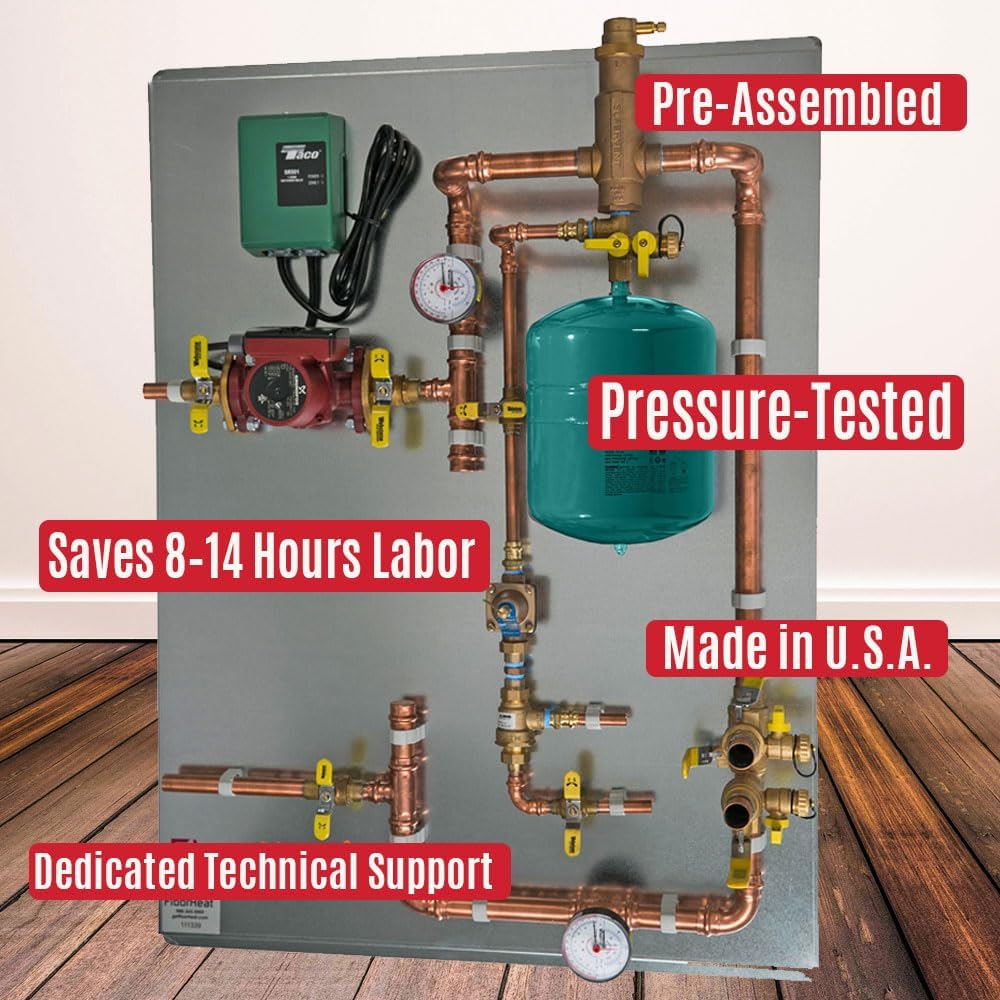
A radiant panel — in this context — is a factory-assembled wall-mounted or skid-mounted control station that bundles the core components of a hydronic heating system into one pre-piped unit. Instead of sourcing a circulator pump, pressure gauge, expansion tank, fill valve, and mixing valve separately and threading them together on-site, you receive them pre-assembled and pressure-tested at the factory. For a first-time installer or a contractor looking to cut commissioning time, that’s a genuinely attractive proposition. Hydronic heating simply means using hot water — circulated through pipes and heat emitters like baseboard radiators or in-floor tubing — to warm a space, as opposed to forcing warm air through ducts. The appeal of a pre-assembled radiant panel is speed and consistency; the risk, as one unusually detailed owner account makes clear, is that pre-assembled also means your failure modes arrive pre-bundled.
This article is built around the most useful signal in the available owner and installer feedback: not the many enthusiastic five-star impressions (which do tell us something, but mostly about packaging and communication), but a single 11-month report that documents two specific component failures with the kind of precision that makes it editorially indispensable. We’ll use that account as the spine of a practical first-year reliability analysis, then work through the five questions prospective buyers most consistently ask.
| EDITOR'S PICKHydronic Radiant Heat Control P… | Mid-tierHydronic Radiant Heat Control P… | Budget pickHydronic Radiant Heat Control P… | |
|---|---|---|---|
| Zones | 4 | 2 | 1 |
| Pump | UPSe15-58 | — | — |
| Expansion tank | ✓ | — | — |
| Air separator | ✓ | — | — |
| Use case | Floor/snow melt | Floor/space | Floor/space |
| Price | $4,200.00 | $3,269.07 | $2,540.13 |
| See on Amazon → | See on Amazon → | See on Amazon → |
What the Enthusiastic Reviews Actually Tell You
Before we get to the failure report, it’s worth extracting what the volume of positive reviews does communicate — because the signal is real, just different from what it appears to be.
Reviewers consistently praise two things: packaging quality and vendor communication. These compliments appear repeatedly and specifically — “packaging was substantial,” “arrived without damage,” “questions were answered quickly.” Per This Old House’s overview of radiant heat, pre-assembled systems have historically suffered from freight damage that renders components unusable on arrival, so this praise is meaningful. It tells you the manufacturer has solved a real logistics problem that competitors apparently haven’t.
What the enthusiastic reviews largely don’t tell you is how the system performs at month six, month ten, or month eighteen. Early impressions are skewed toward installation experience — which, for a pre-assembled panel with clear documentation, is going to trend positive almost regardless of long-term component reliability. The reviewer who says “easy to install, works great” after three weeks is giving you useful but incomplete information.
A secondary pattern worth noting: multiple reviewers mention outbuilding installations — heated garages, workshops, barns. This isn’t incidental. Outbuilding hydronic systems run differently from residential systems: they’re more likely to sit idle for extended periods, more likely to experience freeze risk, and more likely to be commissioned by owners rather than licensed contractors. These use conditions stress components differently than a primary residence running continuous winter heat.
The 11-Month Report: Two Failures, Specific and Credible
The most analytically useful owner account documents two component failures that occurred within the first year of operation. The reviewer notes that initial packaging was substantial, that installation proceeded without problems, and that operation “seemed to go well” — and then specifies exactly what degraded and when.
Failure one: the temperature/pressure gauge developed an internal leak. A T&P gauge (temperature and pressure gauge) is the basic instrument that lets you verify system pressure is within the safe operating range — typically 12–25 PSI for a residential hydronic system. An internal leak means the Bourdon tube or its fittings are allowing system water to migrate inside the gauge housing. This doesn’t necessarily create an immediate safety hazard in the way a relief valve failure would, but it does two things you don’t want: it renders the gauge unreadable as the face clouds or fills, and it introduces a slow, hard-to-detect moisture pathway. As ACHR News notes in their hydronic commissioning guidance, a compromised pressure gauge is classified as a monitoring failure — you lose situational awareness on system pressure, which matters especially during the shoulder seasons when thermal expansion cycles are most variable.
Failure two: the auto-fill valve stopped functioning correctly. An auto-fill valve (sometimes called a pressure-reducing valve or PRV fill valve) is the component that automatically introduces make-up water from the domestic supply into the hydronic loop when system pressure drops below a set point — typically around 12 PSI. It’s the component that means you don’t have to manually top off the system every time it loses water. When it fails to function, you either get a system that slowly depressurizes and eventually air-locks (if it fails closed) or one that over-pressurizes and trips the relief valve (if it fails open). Per Contracting Business’s troubleshooting guide on auto-fill valves, failure modes tend to cluster around debris fouling the valve seat, diaphragm fatigue in the pressure-reducing mechanism, or improper initial pressure setting — all of which can manifest within the first heating season rather than after years of use.
What makes this account credible rather than anomalous is the specificity. The reviewer doesn’t say “it stopped working.” They describe the progression — initial good operation, then gradual failure — which tracks with how these components actually degrade. That pattern is more useful than either a blanket endorsement or a vague complaint.
By the Numbers
| Component | Typical replacement cost (parts only, 2026) | Average reported failure window |
|---|---|---|
| T&P gauge (standard 2.5” face) | $8–$22 | 1–5 years |
| Auto-fill / PRV valve (3/4” residential) | $35–$90 | 2–8 years |
| UPSe15-58 circulator pump | $120–$190 | 8–15 years |
The asymmetry here matters: the components most likely to fail first are also the cheapest to replace. The pump — the component owners tend to worry about most — is also the most durable.
Pump Adequacy: Does the UPSe15-58 Match Your Boiler’s Flow Demand?
The UPSe15-58 is a Grundfos wet-rotor circulator pump that appears in several pre-assembled radiant panels in this category. It’s a three-speed pump rated for residential and light commercial hydronic applications. HPAC Magazine’s circulator selection guidance establishes the relevant sizing framework: you need your circulator to deliver adequate GPM (gallons per minute) against the head loss (flow resistance) of your specific piping and emitter configuration.
The UPSe15-58’s published performance curve covers roughly 0–15 GPM against 0–18 feet of head, depending on speed setting. For a standard residential cast iron boiler connected to a single zone of fin-tube baseboard, this is typically more than sufficient — most single-zone residential systems need 2–6 GPM against 8–12 feet of head, well within the pump’s operating range.
Where you need to do actual math is in multi-zone configurations or systems with significant pipe length and elevation change. If you’re connecting to a Weil-McLain or Burnham boiler serving three or more zones through a primary-secondary piping arrangement, the UPSe15-58 as a zone pump is almost certainly adequate; as the only system pump against combined zone resistance, you’ll want to run the numbers. The manufacturer’s published pump curve is the right starting point — not a forum estimate.
The honest answer to “is this pump adequate for my cast iron boiler?” is: probably yes for a single residential zone, and it depends on system specifics for anything more complex.
Auto-Fill Valve Reliability: Monitor Manually Regardless
Given the 11-month failure documented above, the practical guidance is straightforward: do not treat the auto-fill valve as a set-and-forget component during the first two years. Check system pressure manually at the beginning of each heating season and again at mid-season. This takes under two minutes and requires only reading the gauge — the same gauge you now know to verify is functioning.
Contracting Business’s auto-fill valve guidance recommends commissioning a new PRV fill valve by cycling it manually through its full pressure range and confirming it seats cleanly at setpoint before relying on it for automated make-up. Many installers skip this step in the field because the valve is pre-set at the factory; that’s precisely when a marginal diaphragm goes undetected until it fails in service.
If you’re commissioning one of these panels in an outbuilding where you won’t see the system weekly, the monitoring calculus changes significantly. In that context, installing a separate pressure alarm — a simple electronic sensor that alerts your phone when system pressure drops below 10 PSI — is worth the $40–$60 component cost against the risk of a depressurized, air-locked system sitting unnoticed through a cold snap.
Frequently Asked Questions
What components in a pre-assembled radiant panel are most likely to need replacement in the first two years?
Based on aggregated owner reports and the failure pattern documented at 11 months, the temperature/pressure gauge and the auto-fill (PRV fill) valve are the highest-probability early failures. Both are inexpensive to replace and represent monitoring and make-up functions rather than primary heat delivery. The circulator pump is significantly more durable and unlikely to fail in the first two years under normal operation.
Is the UPSe15-58 pump adequate for connecting to a standard cast iron boiler, or do I need to check flow rates first?
For a single-zone residential system with a standard cast iron boiler and fin-tube baseboard or radiant tubing, the UPSe15-58’s published performance curve is generally adequate. You should verify against your specific loop’s head loss calculation if you have more than one zone, long pipe runs, or significant elevation change. The pump’s manufacturer publishes a full performance curve — cross-reference your system’s GPM requirement and total head against that curve before assuming adequacy on a complex installation.
Does the auto-fill valve work reliably, or should I plan to monitor system pressure manually?
Plan to monitor manually regardless, especially in the first two years. One credible owner account documents auto-fill failure within 11 months. Manual pressure checks at season start, mid-season, and season end are a minimal-effort safeguard. For outbuildings or infrequently visited installations, add a pressure-monitoring sensor.
Can these panels be used with antifreeze for an unheated outbuilding?
Yes, with caveats. Propylene glycol-based antifreeze (not ethylene glycol, which is toxic and incompatible with some gaskets) is compatible with most pre-assembled radiant panel components. Per Plumbing and HVAC’s guidance on glycol in hydronic systems, you need to verify that pump seals, valve seats, and expansion tank bladders are rated for glycol service — most modern components are, but verify with the manufacturer for your specific panel. Glycol solutions also require adjusted expansion tank sizing (glycol expands differently than water) and reduce heat transfer efficiency by approximately 10–15% at typical freeze-protection concentrations (30–40% glycol). Factor that into your boiler sizing if you’re designing a new outbuilding system.
What happens if the temp/pressure gauge fails — is it a safety issue or just an inconvenience?
Primarily an inconvenience, with an indirect safety dimension. The gauge itself is not a safety device — the pressure relief valve is the true safety component, and it operates independently of the gauge. However, a failed gauge means you lose pressure visibility, which means you may not notice a slow system depressurization (indicating a leak somewhere) or a creeping over-pressure condition until it’s more serious. Treat a failed gauge as a replace-immediately item, not a monitor-and-wait situation. Replacement gauges are an inexpensive commodity part available through most HVAC supply channels.
The Decision Frame
If you’re evaluating a pre-assembled radiant panel for a primary residence single-zone installation with a licensed contractor commissioning it: the category makes sense, the UPSe15-58 pump is likely adequate, and the failure modes documented above are manageable and inexpensive to remedy. Budget for a gauge and auto-fill valve replacement within the first two years as a maintenance line item rather than a surprise.
If you’re speccing a panel for an outbuilding, multi-zone, or remote installation where you won’t have eyes on system pressure regularly: add glycol compatibility verification, a pressure alarm, and explicit commissioning steps for the auto-fill valve before relying on it for automated make-up. The convenience of a pre-assembled panel is real — just don’t let “pre-assembled” become a synonym for “no commissioning required.”
The five-star reviews are telling you the vendor has solved the packaging and communication problem. The 11-month report is telling you which components to watch. Both are true. Use both.