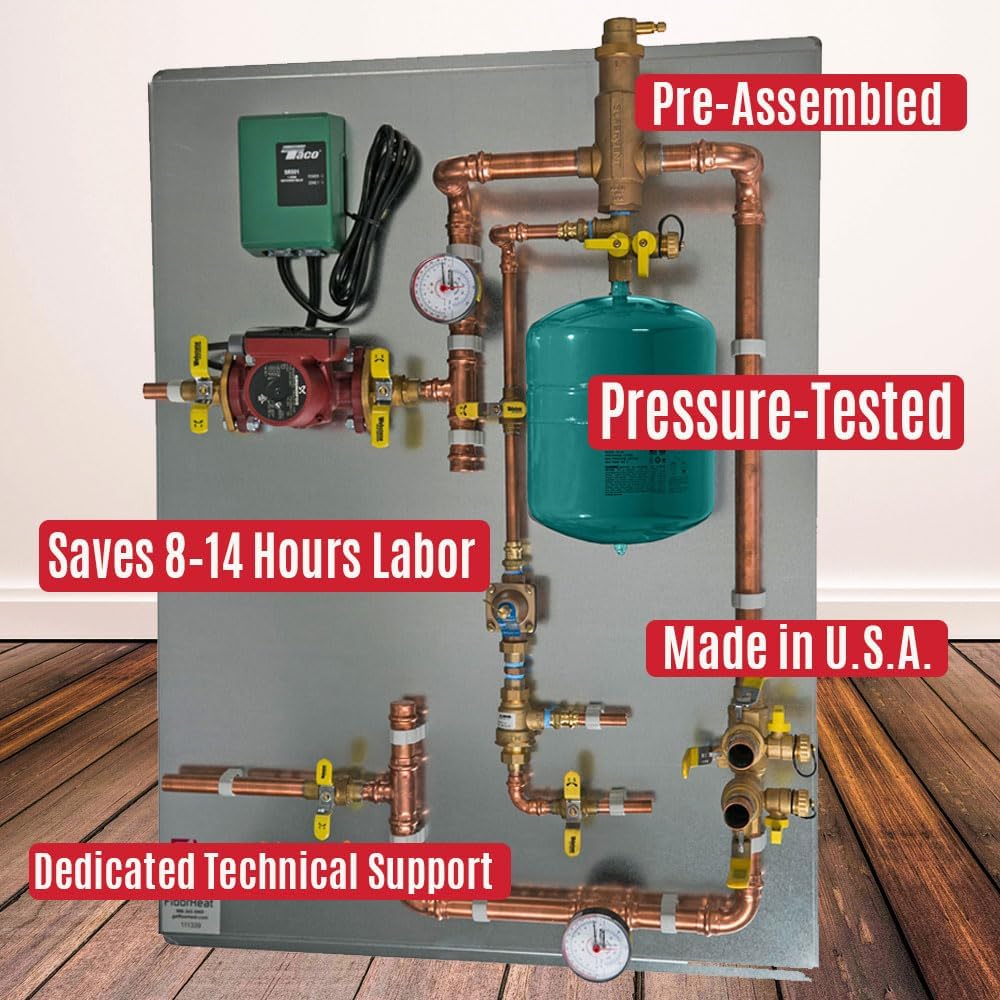
A radiant panel — in the context of hydronic heating, which uses heated water flowing through pipes to warm a floor or baseboard — is a pre-assembled mechanical skid that bundles several components you’d otherwise source and pipe together yourself: a circulator pump, a mixing valve (which tempers the water to safe floor-heating temperatures), a pressure gauge, an auto-fill valve (which adds water automatically when system pressure drops), and zone manifolds. Instead of a plumber spending a day fabricating that assembly on-site, you hang one bracket on the wall and connect your boiler supply and return lines. The appeal is real. The question worth asking after the first year of ownership is whether the convenience premium also buys you reliability — or whether a single weak component in an otherwise well-engineered assembly just traded one service call for another.
This article draws on aggregated owner reviews, published specifications, and installer-sourced failure pattern data to give you an honest picture of what FloorHeat pre-assembled panels look like at the twelve-month mark. If you’re a first-time radiant installer pairing one of these panels with a cast iron boiler, you’ll get enough context to set expectations. If you’re a contractor spec’ing these for outbuilding or light-commercial applications, you’ll get the component-level detail you need to write a defensible service plan.
| EDITOR'S PICKHydronic Radiant Heat Control P… | Mid-tierHydronic Radiant Heat Control P… | Budget pickHydronic Radiant Heat Control P… | |
|---|---|---|---|
| Zones | 4 | 2 | 1 |
| Pump model | UPSe15-58 | — | — |
| Expansion tank | ✓ | — | — |
| Air separator | ✓ | — | — |
| Price | $4,200.00 | $3,269.07 | $2,540.13 |
| See on Amazon → | See on Amazon → | See on Amazon → |
The Convenience Case Is Real — and So Is the Risk
The buying and delivery experience for FloorHeat panels earns consistent praise from owners. Reviewers across aggregated platforms repeatedly cite proactive freight coordination — multiple owners note that a named sales representative handled FedEx scheduling directly, including flagging pallet dimensions in advance. One reviewer described a complex return situation that was resolved without friction, which is notable for a heavy-freight mechanical product where return logistics are genuinely complicated. The packaging itself — pallet-mounted, banded, corner-protected — draws specific mention; several owners note zero dents on arrival, which matters for an assembly with a factory-brazed copper manifold.
This is not a trivial differentiator. Per Building Green’s analysis of pre-packaged mechanical systems, a significant share of field complaints about pre-assembled hydronic products trace back not to design failures but to shipping damage that wasn’t caught at delivery — bent manifold ports, cracked gauge fittings, dislodged auto-fill valve seats — that only present as leaks after the system is pressurized. FloorHeat’s logistics operation appears to have solved that problem at the process level.
The failure pattern that warrants serious attention comes from a different direction entirely. At least one owner who installed a panel approximately eleven months before reviewing reported two distinct early failures: an internal leak at the temperature/pressure gauge, and an auto-fill valve that did not perform as specified. Both failures occurred within the first year. Neither failure is catastrophic in isolation — a T&P gauge leak is typically a threaded-fitting issue, and auto-fill valve drift is a known failure mode across multiple manufacturers — but together they illustrate a structural risk inherent to pre-assembled panels: when one component in a brazed or close-coupled assembly underperforms, the service response is more complicated than swapping a standalone part.
Contracting Business has documented this dynamic in hydronic system component failure analyses: the labor cost of diagnosing and repairing a failure in a pre-assembled panel is frequently higher than the equivalent repair on a field-assembled system because access to individual components requires either disassembly of the manifold block or partial system drain-down. The convenience premium at purchase can reverse itself at the first service call.
Component Reliability at the One-Year Mark: What the Data Suggests
Temperature/Pressure Gauges
The T&P gauge failure reported by the eleven-month owner is consistent with a pattern ACHR News has flagged in radiant panel troubleshooting guidance: bourdon-tube gauges (the most common type used in these assemblies) are sensitive to water hammer — the pressure spike that occurs when a zone valve closes quickly — and to installation torque. In a pre-assembled panel, gauge thread engagement is set at the factory, which eliminates over-torque risk but also means the fitting compound and thread engagement depth are not field-verified by the installing contractor. If the factory seal degrades — from vibration in shipping or thermal cycling in the first heating season — a weep at the gauge base is the most common result.
The good news: a T&P gauge on most manifold-style panels is a 1/4-inch or 1/8-inch NPT threaded fitting. In most configurations, replacing just the gauge does not require manifold disassembly. The panel needs to be isolated (ball valves on supply and return), drained to below the gauge port, and the gauge spun out. This is a sub-hour repair for a competent installer. The caveat is access — some panel configurations mount the gauge in a location that requires removing the pump or mixing valve cover to get a wrench on it, which adds time.
Auto-Fill Valves
Auto-fill valve underperformance is a more nuanced failure mode. These valves — sometimes called pressure-reducing valves or PRVs — are set to maintain system pressure within a specified range, typically 12–15 PSI for a single-story system. If the valve seat doesn’t seal cleanly, it can either overfill (introducing fresh oxygen-rich water, which accelerates corrosion in cast iron sections) or fail to fill (allowing pressure to drop below the low-pressure cutoff on the boiler, shutting the system down). Owners who don’t monitor system pressure closely may not notice either condition until secondary damage is visible.
Per HPAC Engineering’s guidance on low-temperature hydronic applications, auto-fill valve failures in the first year are disproportionately attributable to debris in the supply line — particulate that settles in the valve seat and prevents full closure. On a new installation, this is especially likely if the PEX loops weren’t flushed before the panel was connected. If you’re commissioning one of these panels, flush your loops before opening the panel’s supply connection.
By the Numbers
| Component | Typical Failure Mode | First-Year Risk | Field-Serviceable Without Panel Teardown? |
|---|---|---|---|
| T&P Gauge | Threaded fitting weep | Low–Moderate | Yes, in most configurations |
| Auto-Fill Valve | Seat debris / drift | Moderate | Yes, with isolation |
| UPSe15-58 Pump | Bearing seal / air lock | Low | Yes |
| Mixing Valve Cartridge | Wear / scale | Low (year 1) | Partial disassembly required |
Outbuilding and Remote Installation: Where These Panels Earn Their Keep
Owners using FloorHeat panels in outbuildings — shops, barns, guest structures — are consistently the most enthusiastic segment in aggregated reviews. The reason is structural: in a remote building served by a dedicated cast iron boiler, every component that’s pre-assembled and factory-tested is one fewer field connection that can fail in an unoccupied space. A shop that runs at 55°F overnight with no one monitoring it benefits disproportionately from a self-contained panel versus a field-assembled system with six individually soldered joints.
The all-in-one nature also simplifies the boiler connection. A cast iron boiler’s near-boiler piping — the closely spaced tees, primary loop, and injection point — can be configured to feed a pre-assembled panel cleanly, with the panel handling all secondary-loop mixing and zoning. For outbuilding applications where a single zone of slab-embedded PEX is the norm, this is a genuinely elegant solution.
The eleven-month failure case, notably, does not appear to have come from an outbuilding installation. Remote installations where early failures go undetected for weeks carry higher risk of water damage from a gauge weep than attended residential installations. If you’re specifying one of these panels for a remote structure, the service plan should include pressure monitoring (a simple remote pressure sensor wired to a notification relay is a low-cost hedge) and a quarterly visual inspection protocol.
Sizing Your Panel to Your Cast Iron Boiler and PEX Layout
The most common sizing error with pre-assembled radiant panels is treating the zone count as the only variable. It isn’t.
Zone count vs. loop length vs. pump head. The UPSe15-58 circulator included in FloorHeat panels is rated for a specific head pressure and flow range. For short loops in a single room or small outbuilding (under 200 feet of 1/2-inch PEX per circuit), the pump is adequate. For longer slab loops — 300 feet or more per circuit, common in garage slabs — you need to verify that the pump curve intersects your system curve at the design flow rate. HPAC Engineering’s circulator sizing guidance recommends calculating loop resistance at 0.5 feet of head per 100 feet of 1/2-inch PEX at design flow, then adding fitting losses. If your calculated head requirement exceeds the UPSe15-58’s published curve at your target GPM, a panel with a higher-head pump option is the right call — not an afterthought booster pump spliced into the circuit.
Zone count to boiler output matching. A one-zone panel paired with a 150,000 BTU cast iron boiler serving a 200-square-foot slab is a short-cycling recipe. The boiler will fire, heat the small water volume in the slab loop quickly, and shut off before the cast iron sections reach steady-state temperature — which accelerates thermal fatigue in the sections and produces condensation in the flue. Right-size the panel zone count to distribute the boiler’s output across enough loop volume to produce run cycles of at least 10–15 minutes.
Rule of thumb: One zone panel for up to ~500 square feet of slab (assuming standard 12-inch PEX spacing and design heat loss around 25 BTU/sq ft). Two-zone for 500–1,200 square feet with distinct temperature requirements. Four-zone for multi-room applications or any layout where occupancy schedules differ by space.
Frequently Asked Questions
What components are actually included in a pre-assembled panel versus what I still need to purchase separately?
FloorHeat panels typically include: circulator pump, mixing valve, temperature/pressure gauge, auto-fill valve (PRV), zone manifold with flow meters, isolation ball valves, and a mounting bracket. What you still supply: the boiler, the near-boiler primary loop piping, PEX tubing for your loops, manifold end caps if your zone count doesn’t fill the manifold, and a thermostat or zone valve controller for each zone. Some configurations require a separate expansion tank if the panel’s integral tank is undersized for your system volume — verify the tank sizing against your total water volume.
Is the UPSe15-58 pump adequate for longer PEX radiant loops in a slab?
For loops under 200–250 feet of 1/2-inch PEX, yes — the pump curve supports adequate flow at typical radiant design temperatures. For loops approaching 300 feet or using 5/8-inch PEX (which has lower resistance but higher volume), verify against the published pump curve. Published specs put the UPSe15-58 at roughly 11 GPM at zero head, dropping to approximately 6 GPM at 8 feet of head. Calculate your system head before assuming adequacy on longer runs.
If the temp/pressure gauge fails, can I replace just that component or does the whole panel come apart?
In most configurations, the gauge is a threaded NPT fitting and can be replaced independently after isolating and partially draining the panel. Confirm your specific panel configuration — some mounting orientations restrict wrench access without removing an adjacent component. This is a field-serviceable repair, not a panel replacement scenario.
How do I size between a one-zone, two-zone, and four-zone panel for my existing cast iron boiler?
Match zone count to the number of independently controlled areas AND to your boiler’s output capacity. Undersizing zone count relative to boiler output creates short-cycling. Oversizing zone count beyond your actual area creates pumping and control complexity with no thermal benefit. Use the 500 square feet per zone rule of thumb as a starting point, then adjust for your actual heat loss calculation.
What is the return and warranty process if a component fails within the first season?
Based on owner reports, FloorHeat’s vendor communication is a genuine strength — the named-rep model means you have a direct contact rather than a ticket queue. For component failures under warranty, the documented process involves contacting the sales rep directly, providing installation photos and a description of the failure mode, and — per the return experience owners describe — receiving responsive handling. Clarify at purchase whether the warranty covers labor for a field repair or only the replacement component; most pre-assembled panel warranties cover parts only, not the cost of a service call.
Pre-assembled radiant panels like FloorHeat’s lineup occupy a legitimate and defensible position in the hydronic market. The logistics and vendor experience are genuinely above average, and for outbuilding or remote applications, the all-in-one format solves real problems. The eleven-month failure data is a signal worth taking seriously, not a reason to reject the product category. The decision rule is straightforward: if your installation is attended, your system pressure is monitored, and your installer is comfortable with the component-level serviceability of the gauge and auto-fill valve, the convenience premium is well-spent. If you’re installing in a remote or unmonitored structure, add a pressure monitoring device and build a quarterly inspection into your service agreement before the warranty clock runs out.