An outdoor wood furnace — a firebox sitting in a weatherproof cabinet in your yard, connected to your house by insulated underground pipes — seems simple on the surface: burn wood, heat water, heat house. But the moment you tie that furnace into a closed hydronic system (a sealed loop of water that carries heat to radiators or baseboard convectors), you inherit all the engineering demands of any pressurized hot-water system, plus several challenges that are unique to outdoor wood heat. Water expands when it heats up; if there’s nowhere for that expansion to go, pressure climbs until a relief valve opens or a fitting fails. Outdoor supply lines can freeze if the fire goes out. And the temperature swings from a wood furnace are far more extreme than from a gas boiler, which means every component in the loop has to work harder. This guide walks through the three components that practitioners most often get wrong on their first outdoor furnace integration: expansion tank sizing, heat exchanger selection, and antifreeze concentration. Get these three right and the system runs reliably for years. Get them wrong and you’ll be chasing leaks, frozen pipes, or chronic over-pressure before the first heating season ends.
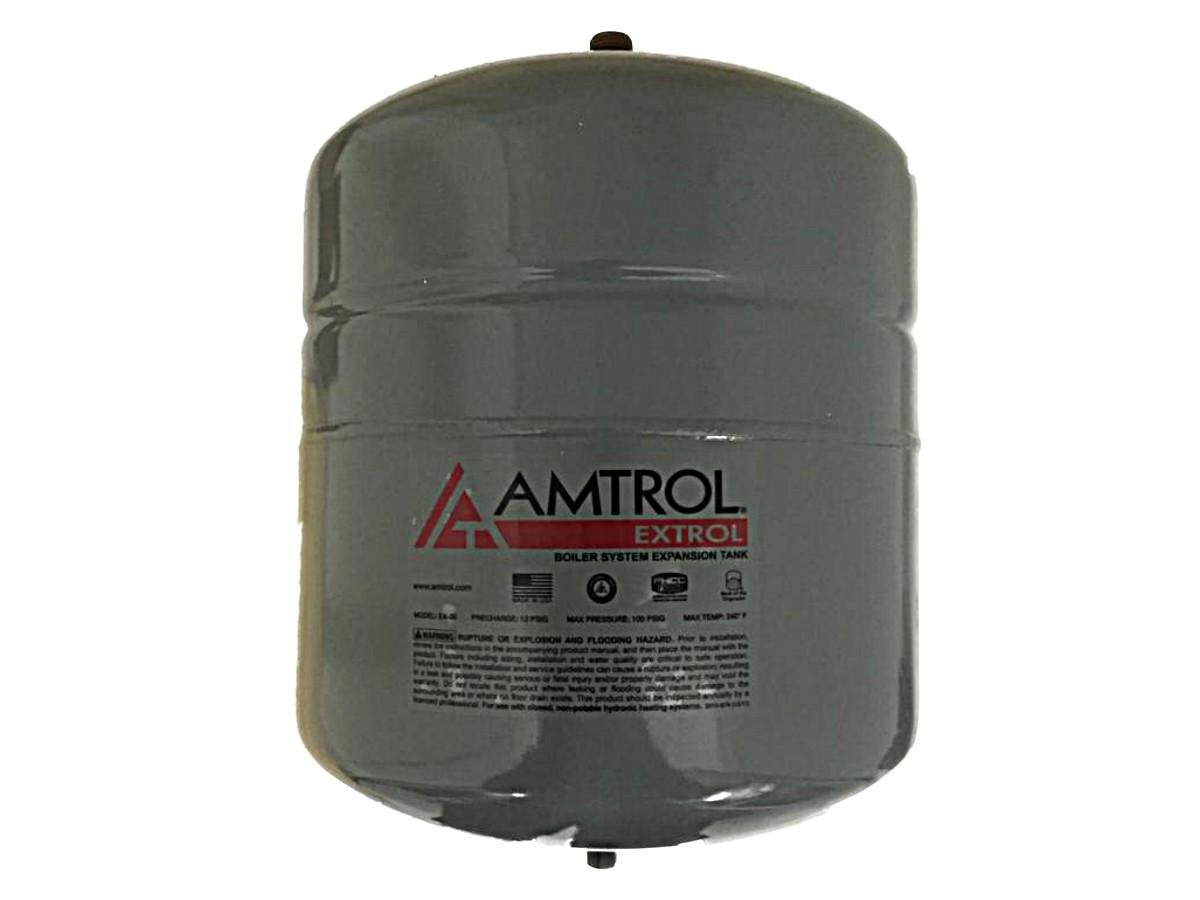
| EDITOR'S PICKAmtrol 60 Extrol Boiler System… | Mid-tierAMTROL 102-1#30 EX-30 30 Extrol… | Budget pickAMTROL EX-15 15 Extrol Expansio… | |
|---|---|---|---|
| Volume | 7.4 gal | — | — |
| Diameter | 11" | — | — |
| Height | 23" | — | — |
| Model # | 60 | EX-30 | EX-15 |
| Price | $150.95 | $71.25 | $59.99 |
| See on Amazon → | See on Amazon → | See on Amazon → |
Why Outdoor Wood Furnaces Break Conventional Expansion Tank Rules
In a standard residential hydronic system fed by a gas or oil boiler, the operating temperature range is fairly predictable — typically 140°F to 180°F — and the system volume is fixed. The ASHRAE Handbook on HVAC Systems and Equipment provides acceptance volume formulas that work well in that narrow band. Outdoor wood furnaces don’t play by those rules.
Wood combustion is inherently batch-loaded: you stoke the fire, temperatures spike, then the fire slowly dies back between loadings. It’s common for an outdoor furnace to swing from 140°F to 210°F or higher within a single firing cycle, especially in systems without sophisticated controls. That 70°F swing represents significantly more volumetric expansion than the modest delta a gas boiler produces. And because outdoor furnace water jackets typically hold 50 to 150 gallons — far more than the heat exchanger of an indoor boiler — the total system volume is higher, compounding the expansion problem.
This is the core reason that outdoor furnace owners consistently underestimate expansion volume requirements. Reviewers of the Amtrol Extrol EX-30, a 4.4-gallon acceptance-volume tank that is a go-to choice for smaller indoor systems, have noted specifically in the outdoor furnace context that a single EX-30 is often inadequate. One long-run owner documented how replacing a failing EX-30 with another EX-30 only partially resolved a recurring over-pressure condition — the relief valve still opened periodically under heavy firing. Swapping to the EX-60 (7.6 gallons acceptance volume, roughly 70% more capacity) finally eliminated the problem. The lesson isn’t that the EX-30 is a bad tank — it’s an excellent tank — but that the outdoor furnace application demands you size up.
The math that guides that decision:
The Amtrol Extrol EX-30 installation and service instructions provide an acceptance volume formula based on system volume and temperature rise. For a 100-gallon wood furnace with a 70°F operating swing and a standard 30 PSI relief valve, a rough calculation yields a required acceptance volume of approximately 6–8 gallons — squarely in EX-60 territory, not EX-30. For systems exceeding 120 gallons of total water volume, two EX-60 tanks piped in parallel is a configuration that experienced installers on contractor forums have reported resolves over-pressure complaints definitively.
By the numbers — Expansion tank quick-sizing for outdoor furnaces:
- System volume under 75 gal + temp swing ≤ 60°F → EX-30 (4.4 gal acceptance) may suffice
- System volume 75–130 gal OR temp swing 60–80°F → EX-60 (7.6 gal acceptance) is the baseline
- System volume over 130 gal OR temp swing over 80°F → two EX-60 tanks in parallel, or step up to an EX-90
Pre-charge pressure on the tank should match static fill pressure at the tank connection point. This is not an outdoor-furnace-specific rule — the Amtrol installation documentation covers it clearly — but it’s the most common field error regardless of application. A tank pre-charged at 12 PSI installed on a system filled to 20 PSI will log-waterlog within a season.
Heat Exchanger Selection: Matching the Interface to Your Forced-Air System
If your home is heated by forced air (a furnace blowing warm air through ducts), you can’t connect an outdoor wood furnace directly to that air handler — the two systems run on entirely different principles. The bridge is a water-to-air heat exchanger: a coil of copper tubing bonded to aluminum fins, designed to sit inside the supply plenum (the main duct leaving your air handler). Hot water from the outdoor furnace flows through the coil; the air handler’s blower pushes house air across the fins; heat transfers into the airstream.
This is an application where the fit between coil dimensions and plenum geometry is non-negotiable. A 12×15-inch coil is a common residential size, but “12×15” describes the face dimensions of the coil, not the duct opening. The coil needs to seal tightly against the plenum walls — any air bypass around the edges means cold spots and wasted heat. Before ordering, measure the inside dimensions of the plenum, not the outside, and verify that the coil’s mounting flange will seal against your specific duct material. HPAC Magazine’s coverage of outdoor wood boiler integrations has flagged improper coil seating as one of the most common commissioning failures in this application.
Flow rate through the coil matters as much as coil size. Most residential water-to-air coils are rated at a design flow of 2–4 gallons per minute (GPM) for full heat output. Under-pumping — a common outcome when a small circulator pump is carried over from an indoor boiler application — reduces output dramatically. A coil rated for 40,000 BTU/hr at 3 GPM may deliver only 25,000 BTU/hr at 1.5 GPM. The outdoor furnace loop should have its own dedicated circulator sized to the heat exchanger manufacturer’s spec, independent of any circulators serving zone valves or radiant circuits inside the house.
A note on procurement and shipping damage: aggregated reviews of water-to-air heat exchangers in this size class consistently flag shipping damage — bent fins, dented end plates — as an occasional but not rare occurrence. Inspect the coil immediately on delivery. Document any damage photographically before installation. Fin damage that looks cosmetic can reduce face-area airflow and permanently derate the coil’s output. Replacement processes through major retailers are straightforward if initiated promptly, but a damaged coil installed and sealed into a plenum creates a much harder problem.
Antifreeze Selection and Concentration: Getting the Chemistry Right for Buried Lines
The outdoor supply loop — the insulated underground pipes connecting the furnace to the building — is the most freeze-vulnerable part of the entire system. If the fire goes out during a cold snap and the loop isn’t protected, you’re looking at burst supply lines, potentially under several feet of landscaping.
Propylene glycol is the correct antifreeze choice for outdoor hydronic systems. Ethylene glycol, which is used in automotive cooling systems, is toxic and is not appropriate in systems that could potentially contact potable water lines or soil through a leak. This is a well-established position in the hydronic industry; the Fernox antifreeze and inhibitor application guide for closed hydronic systems, along with guidance from Sentinel and Rhomar, all specify propylene glycol for HVAC and hydronic applications where safety margins matter.
Concentration by design temperature — propylene glycol:
The standard guidance (corroborated by both Fernox and ASHRAE system equipment references) is to target a freeze protection point approximately 15°F below your design low outdoor temperature, not your average winter low. For a Northern climate where -20°F is a realistic extreme event:
- Target protection to -35°F
- Required propylene glycol concentration: approximately 50% by volume
- At 50% concentration, propylene glycol also provides burst protection to approximately -55°F (the fluid gels rather than freezing solid, which can still damage fittings — hence the additional margin)
In more moderate climates (design low around 0°F), a 35–40% concentration achieves -20°F freeze protection with better heat transfer efficiency, since glycol reduces the fluid’s heat capacity relative to plain water. Don’t over-concentrate: beyond 50%, freeze protection improvement plateaus while heat transfer penalty grows.
RV hydronic system owners — a user base that parallels outdoor furnace owners in their exposure to severe freeze risk and periodic system inactivity — have contributed substantial long-run review data on propylene glycol products including Star Brite antifreeze. The consistent finding is that propylene glycol performs as expected when the concentration is verified with a refractometer (not a cheap float-ball tester, which is unreliable at the concentrations needed here) and when the system includes an inhibitor package to prevent glycol degradation and metal corrosion. Propylene glycol alone degrades over time, particularly in systems that experience high temperatures — exactly what outdoor furnaces produce. An uninhibited glycol solution becomes acidic as it degrades, attacking pump seals, heat exchanger tubes, and boiler sections.
Per Fernox’s application documentation, propylene glycol solutions in hot-water systems should be tested annually with a pH test strip and a refractometer, and replaced when pH drops below 7.0 or when the freeze point has risen more than 5°F from the original charge. In high-temperature outdoor furnace applications, every-other-year replacement is a reasonable conservative schedule. Drain, flush, and recharge — the fluid cost is modest compared to the cost of replacing a heat exchanger from acid corrosion.
Frequently Asked Questions
How do I know if my outdoor wood furnace expansion tank is undersized, and what symptoms should I look for?
The clearest symptom is a pressure relief valve that opens and discharges water during or immediately after a heavy firing cycle, then reseats as the system cools. Other signs include system pressure that climbs well above the design operating range (typically 15–25 PSI for residential systems) when the furnace is firing hard, or a expansion tank that feels completely solid (waterlogged) when tapped — a properly functioning tank has an air side that gives slightly. A waterlogged tank has lost its air charge and provides zero expansion volume. Per Amtrol’s installation documentation, a waterlogged tank is often the first failure mode in undersized outdoor furnace installations.
Can I use the same expansion tank sizing rules for an outdoor furnace as for an indoor cast iron boiler?
No — not directly. Indoor boiler sizing formulas assume a narrower temperature swing and a much smaller water volume. Per ASHRAE’s hydronic system guidance, the two key inputs are total system water volume and the maximum temperature rise from fill temperature to peak operating temperature. Outdoor furnaces have both a larger volume and a wider temperature swing, which means the calculated acceptance volume will be larger than a boiler of comparable output would require. Always calculate from first principles rather than using a rule-of-thumb table built for conventional boilers.
What propylene glycol concentration do I need to protect a buried outdoor supply line in a cold climate?
A 50% propylene glycol solution is the standard for climates where temperatures reach -20°F or below. This provides a freeze point of approximately -35°F with a meaningful safety margin. Verify concentration with a refractometer — this is the only accurate field method at high concentrations. Include an inhibitor package appropriate for mixed-metal systems, and verify pH annually.
Will a standard 12×15 water-to-air heat exchanger work with my existing forced-air plenum, and what flow rate does it need?
It depends on your plenum’s interior dimensions and your existing duct layout. The coil face must seal completely against the plenum walls — measure inside dimensions carefully. Flow rate requirements vary by manufacturer and coil model, but most residential coils in this size range are designed for 2–4 GPM. Verify your circulator’s output against the coil manufacturer’s rating table at your system’s operating head pressure. This Old House’s overview of hydronic heating systems provides accessible background on circulator sizing principles if you’re working through the fundamentals.
How often should I check and replace propylene glycol antifreeze in an outdoor furnace loop?
Test pH and freeze point concentration annually, ideally at the start of each heating season. Replace the solution when pH drops below 7.0 or when freeze protection has degraded more than 5°F from the original spec. In high-temperature outdoor furnace applications, plan on a full drain-and-recharge every two to three years as a conservative maintenance baseline, per Fernox and Sentinel application guidance. The cost of replacement fluid is negligible against the cost of a corroded heat exchanger or pump failure.
The decision rule: If your outdoor furnace holds more than 75 gallons of water or regularly fires to temperatures above 190°F, start with the Amtrol Extrol EX-60 as your baseline expansion tank and add a second if system volume or temperature swing pushes the math past its acceptance capacity. Pair it with a properly sized water-to-air coil that is sealed — not just placed — in your plenum, circulated at the manufacturer’s design GPM, and protected by a 50% propylene glycol/inhibitor blend verified with a refractometer at installation and every fall thereafter. That combination handles what outdoor wood heat throws at a hydronic system without the chronic over-pressure, freeze events, and acid corrosion that cut short so many first installations.