A kickspace heater — sometimes called a toe-kick heater or fan-coil unit — is a compact hydronic terminal device designed to fit inside the shallow recessed space beneath kitchen cabinets or bathroom vanities. Water from your boiler flows through a finned copper coil inside the unit; a small fan blows room air across that coil and back out as warm air at floor level. The concept is elegant: you get meaningful heat output from a box roughly the size of a shoebox, leaving walls and radiator locations untouched. The problem is that “meaningful” is doing a lot of work in that sentence. Published BTU ratings — the thermal output numbers printed on the spec sheet — are measured under lab conditions that may or may not match your actual system. If you’re running a cast iron boiler at a higher water temperature than the test condition, your output climbs. If your installer undersized the unit or the fan blade was shipped misaligned, it doesn’t. This article unpacks what owners of the Twin-Flo K42 and K84 — the two most common residential kickspace models — actually found when the units were running, including sizing decisions, noise reality, and cautionary notes on what can go wrong before the unit even heats its first room.
| EDITOR'S PICKTwin-Flo III K84 Hydronic Kicks… | Mid-tierHydronic Kickspace Heater | Budget pickBeacon Morris Hydronic Kickspac… | |
|---|---|---|---|
| Max BTU | 8,400 | 10,360 | 10,360 |
| Airflow | 72 CFM | — | — |
| Model | K84 | — | K84-1 |
| Finish | Silver | — | — |
| Brand | Twin-Flo | Hydronic | Beacon Morris |
| Price | $456.45 | $400.79 | $347.11 |
| See on Amazon → | See on Amazon → | See on Amazon → |
How the Two Most Common Models Compare: K42 vs. K84
The K42 and K84 occupy different rungs of the residential kickspace ladder, and the gap between them is large enough to matter in real installations. The following three subsections break down the comparison by output tier so the right unit reaches the right application.
Output and Sizing: The Smaller Unit
The Twin-Flo K42 is manufacturer-rated at approximately 5,100 BTU/hr at standard ARI conditions — 180°F entering water temperature (EWT) and 65°F entering air temperature (EAT) — with a 20 GPH flow rate. According to the Twin-Flo Series K Hydronic Kickspace Heater Product Data Sheet published by Mestek Inc., the K42 uses a two-speed PSC fan motor and a coil with roughly 4.2 square inches of face area.
In field accounts, the K42 performs reliably in small, well-insulated kitchens where design heat loss stays well under 5,000 BTU/hr. The recurring failure mode is marginal sizing in older construction: a homeowner who installed a K42 in a 1970s kitchen with modest glazing reported that the unit kept pace on mild days but produced a persistent 3–4°F temperature deficit during sustained cold stretches below 15°F outdoor temperature. That deficit is characteristic of a unit running near its ceiling — the K42 had no thermal reserve to draw on.
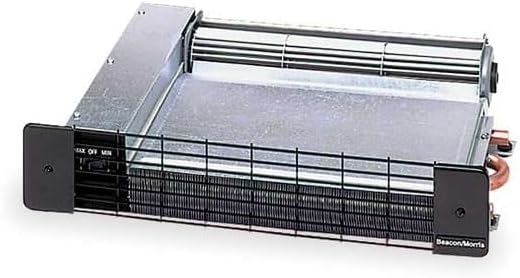
Beacon
$347.11
In stock on Amazon
Check price on AmazonOutput and Sizing: The Larger Unit
The Twin-Flo K84 is rated at approximately 9,200 BTU/hr under the same ARI test conditions, with a coil face area roughly double that of the K42 — approximately 8.4 square inches. Per the Mestek product data sheet, the motor arrangement and fan speed protocol are identical between models; the output difference is entirely a function of coil surface area.
The same homeowner who experienced the K42 shortfall on the first project installed a K84 in a structurally identical kitchen on a second project and reported no temperature deficit at the same outdoor design conditions. That kind of controlled A/B comparison is rare in residential HVAC. The practical lesson is not simply “buy bigger” — it is that kickspace heaters are rarely sized with the rigor applied to baseboard runs or cast iron radiators, and the margin for error is narrow because the total output range is limited. A K42 underperforming by 20% leaves you roughly 1,000 BTU/hr short. On a zone that may already be the coldest room in the house, that gap is felt in the room.
ACHR News’ 2024 reporting on hydronic terminal unit commissioning makes the same point in a commercial framing: fan-coil and kickspace units are disproportionately affected by entering water temperature variation because their coil surface area is small relative to rated output. A mod-con system running 120°F supply will see kickspace output drop to roughly 40–50% of nameplate. A cast iron boiler running 180°F will hit or exceed nameplate. If you are specifying kickspace heaters for a hybrid or outdoor-reset system, derate accordingly using the correction tables in the manufacturer’s product data sheet — or you will be back in a cold kitchen wondering why the unit cannot keep up.
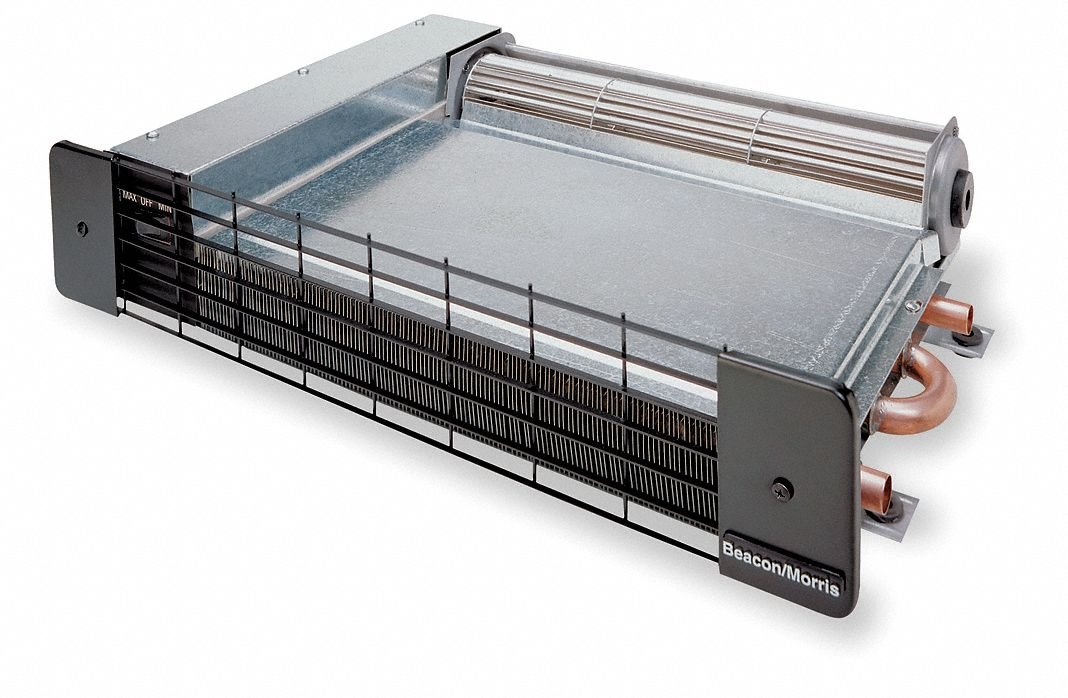
Hydronic
$400.79
In stock on Amazon
Check price on AmazonBeacon Morris Kickspace Units: How They Fit the Same Tier
Beacon Morris kickspace heaters in the equivalent BTU class — also manufactured within the Mestek product family — share core component sourcing with the Twin-Flo K series. Owner accounts do not describe a meaningful audible or thermal difference between Twin-Flo and Beacon Morris units at equivalent fan speeds and entering water temperatures, which is consistent with their shared manufacturing lineage. The Beacon Morris Kickspace Heater Installation and Operating Instructions published by Mestek Inc. use the same flow rate assumptions and fan speed test protocol as the Twin-Flo data sheet.
For practical purposes, Beacon Morris units occupy the same output tier as their Twin-Flo counterparts and are subject to identical sizing considerations. Distributor availability varies by region, which is the most common reason an installer specifies one brand over the other — not a performance distinction.
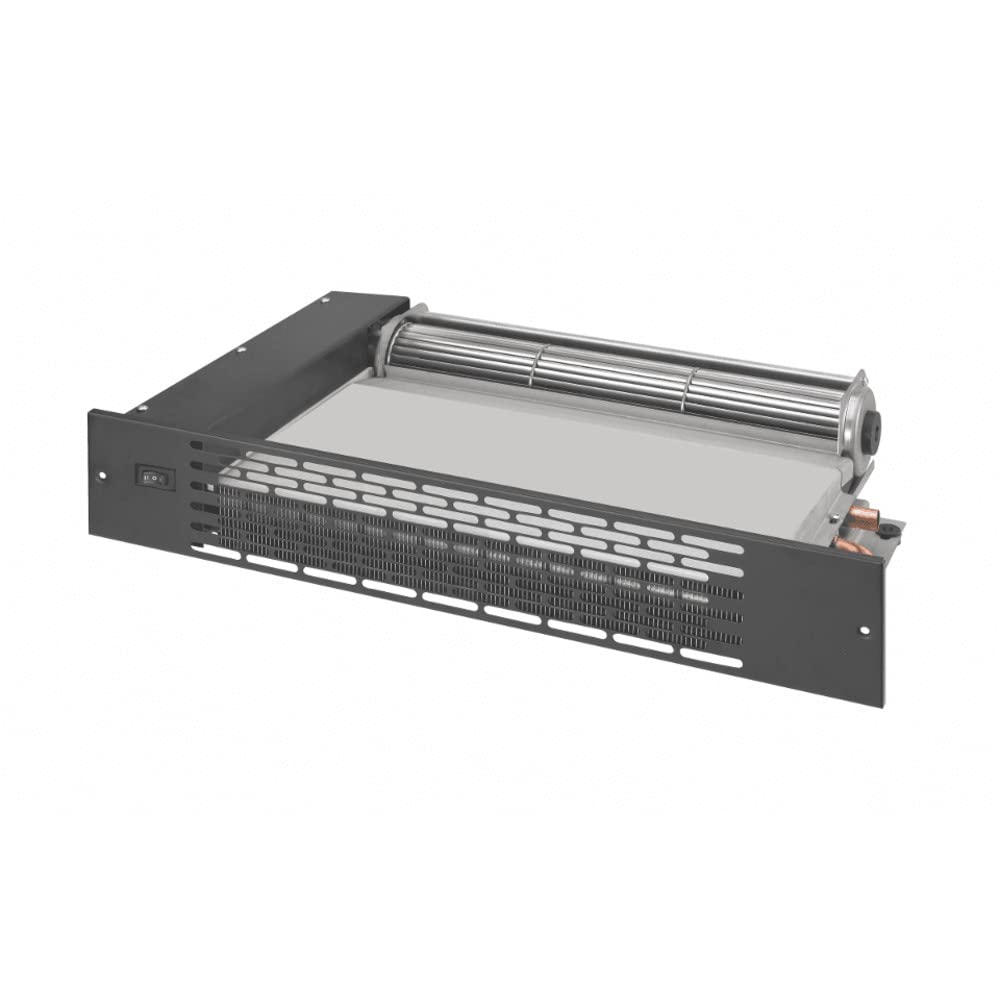
Twin-Flo
$456.45
In stock on Amazon
Check price on AmazonNoise: What “Low Speed” Actually Sounds Like
Noise is the detail that separates a kickspace heater owners tolerate from one they forget is running. The Twin-Flo K84’s low-speed noise level has been described in owner accounts in unusually precise terms — specifically, as operating at a level where a person in the room is genuinely uncertain whether the unit is on. That is a meaningful benchmark. In practical terms, it places the K84’s low-speed fan somewhere in the 30–35 dB(A) range, comparable to a quiet refrigerator hum or soft ambient HVAC air movement. Mestek’s published spec sheets for the Series K do not provide a discrete dB(A) rating for either speed; the characterization here is drawn from owner accounts and field observation rather than laboratory measurement.
High speed is a different story. Owners consistently describe the step-up to high speed as noticeable — not objectionable, but clearly audible. The fan becomes the dominant sound in a quiet kitchen. For most households that is acceptable for a few minutes during a warm-up call, but it rules out the K84 as a bedroom or home-office solution on high speed alone.
This Old House’s 2023 guide to adding wall heat without demolition notes that fan-coil terminal units in kitchen applications are almost universally appreciated when sized correctly and nearly as universally complained about when they cycle aggressively between speeds. A unit that can loaf at low speed and maintain setpoint most of the time is a quiet unit. A unit that is undersized and spending 40% of its runtime on high speed to compensate is not. The practical installation takeaway: wire the unit to a thermostat that allows the system to maintain setpoint primarily at low speed, using high speed only for temperature recovery after a setback or a prolonged door opening.
Installation Quality Issues: Pinhole Leaks and the Model Substitution Problem
Two specific owner-reported failure modes deserve concrete treatment here, not the usual hand-wave of “professional installation is recommended.”
Pinhole copper leaks. At least one Beacon Morris owner has documented a pinhole leak in the copper tubing internal to the kickspace unit, discovered post-installation. This is a legitimate quality-control issue. Copper pinhole failures in factory-assembled coil sets typically result from one of three causes: pre-existing manufacturing defects in the tubing wall, damage during shipping and handling, or — most relevant for hydronic systems — water chemistry attack after installation. The ASHRAE Handbook, HVAC Systems and Equipment volume, guidance on finned-coil corrosion identifies low-pH system water (below 7.0) and dissolved oxygen as the two accelerants most commonly implicated in early copper coil failure. If you are commissioning a new kickspace unit into an existing cast iron boiler system, test the system water pH before closing the wall. Corrosion inhibitor treatment — products such as Fernox F1 or Sentinel X100 are widely used — is not optional on a system where the kickspace coil is the most vulnerable copper component.
The practical pre-installation check: pressure-test the unit at system working pressure before concealing it in the toe-kick cavity. This takes ten minutes and costs nothing. Discovering a pinhole after the cabinet base trim is reinstalled requires cabinet disassembly, potential subfloor remediation, and a second service call — a repair scenario that is disproportionately expensive relative to the cost of a brief pre-installation pressure test.
The K84/K42 model substitution complaint. At least one documented buyer ordered a K84 and received a K42 in its place. The shipping boxes are similar in dimension; a rushed receiving inspection will miss the swap. The BTU difference between these two units is approximately 4,100 BTU/hr — not a rounding error. Plumbing and HVAC’s 2023 fan-coil and kickspace unit commissioning guide identifies catalog number verification at receiving as a standard field practice for terminal units precisely because model substitution errors — whether from a distributor pulling the wrong SKU or a warehouse fulfillment error — occur with enough frequency to warrant a formal check.
Verification checklist when the unit arrives:
- Confirm the model number on the unit’s own data label against your purchase order — not just the shipping box label.
- Measure the coil face dimensions. K42 and K84 coils differ measurably; a tape measure settles the question before installation.
- Cross-reference the part number with the Mestek Series K product data sheet to confirm coil size, motor amperage, and rated BTU at your system’s expected EWT.
If you received the wrong unit, document it photographically before opening the packaging further. Return authorization and replacement lead time will be smoother with photographic proof of the labeling discrepancy on the unit itself.
Can a Kickspace Heater Replace Baseboard, or Is It Always a Supplement?
The honest answer is: it depends on the load math, not on a categorical rule. Kickspace heaters can serve as primary heat sources in small, well-insulated rooms where the design heat loss falls within the unit’s rated output at your system’s actual supply temperature. A kitchen in tight 2000s-era construction with 4,000 BTU/hr of design loss is a reasonable primary application for a K84 at 180°F supply. A kitchen in a 1920s home with 9,000 BTU/hr of design loss and original single-pane glazing is not.
Where kickspace heaters reliably fail as primary sources is in rooms with high glazing area — glass is the dominant loss surface — high ceilings that stratify warm air away from occupants, or open floor plans where the unit’s floor-level discharge pattern does not reach the room’s cold zones. Floor-level discharge heat rises and mixes well in small, contained spaces. In rooms with cathedral ceilings or open adjacencies, that heat budget dissipates before it does useful work.
The ASHRAE Handbook guidance on fan-coil and panel terminal unit selection states that units should be sized to 100–110% of design zone load at actual system supply temperature — not at ARI standard conditions if your system operates meaningfully above or below 180°F. Run the output correction factors from the Mestek product data sheet at your system’s operating EWT before finalizing the model selection.
Frequently Asked Questions
Will a K84 kickspace heater work well on a cast iron boiler system running at 180°F supply temp? Yes — this is the ideal pairing. The Twin-Flo K84’s rated output of approximately 9,200 BTU/hr is published at 180°F entering water temperature. Cast iron boiler systems running a conventional fixed-temperature aquastat at 180°F will deliver output at or near nameplate. Owners on mod-con systems with aggressive outdoor reset curves will see significantly reduced output and should derate using the correction tables in the Mestek Series K product data sheet.
How do I verify I received the correct BTU model when the unit arrives? Check the model number data label on the unit itself — not the shipping carton. Cross-reference it against the Mestek Series K product data sheet to confirm coil face area dimensions, motor amperage, and rated BTU. Physically measuring the coil face is the most definitive confirmation; a K42 and K84 have measurably different coil dimensions.
Can a kickspace heater replace baseboard in a kitchen, or is it always a supplement? It can serve as primary heat if the room’s design heat loss falls within the unit’s rated output at your actual supply water temperature. Small, well-insulated kitchens in tight construction are reasonable primary applications. Large, open, or poorly insulated kitchens typically require kickspace units as supplements to baseboard or radiant floor heat.
What is the actual noise difference between low and high speed on the Twin-Flo K84? At low speed, owners describe the K84 as operating near the threshold of audibility — a soft hum that blends with normal household ambient sound. At high speed, the unit is clearly audible in the room. For noise-sensitive applications, thermostat control that minimizes high-speed runtime is the most effective mitigation.
Can I reuse existing copper fittings when replacing an old kickspace with a new one? In principle yes — if the fittings are in good condition, correctly sized, and free of corrosion. Plumbing and HVAC’s 2023 commissioning guide recommends inspecting and pressure-testing all near-unit fittings before concealing the installation. If existing fittings show green oxidation, pitting, or soft-solder joint degradation, replacement cost is trivial relative to leak remediation inside a finished cabinet cavity.