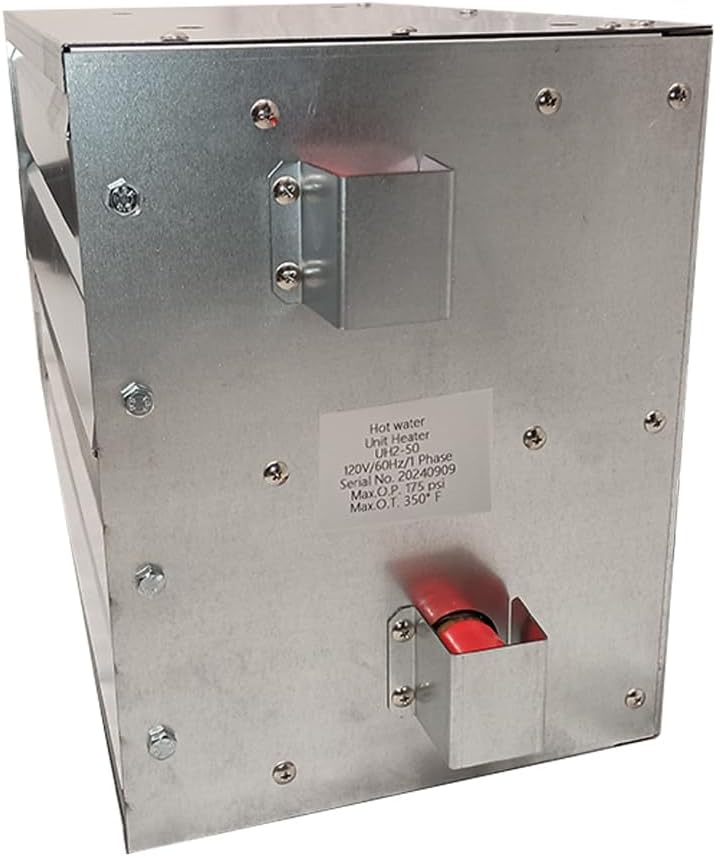
Your existing cast iron boiler heats the house. The garage — right next to it on the same mechanical plant — stays at 34°F all winter while you try to work on a transmission or run a table saw in a down jacket. There’s a cleaner answer than a propane torpedo heater or a standalone electric unit: a hydronic hanging unit heater, which is a fan-coil device (a metal box with a hot-water coil inside and a fan behind it) that mounts to the ceiling, connects to your boiler loop with two pipes, and turns excess boiler capacity into real, controlled heat. If your boiler has BTU headroom — and many do — this addition can be completed for the cost of pipe, a circulator, and the heater itself, with no second fuel source and no separate combustion appliance to maintain.
This article walks through the decision in practitioner order: confirming your boiler has capacity to spare, calculating the garage heat load, selecting a unit heater by output and airflow, configuring the zone correctly, and comparing the units most commonly specified for this application. If you’re mid-quote on a boiler replacement and want to bake this zone into the project, the sizing math applies directly.
| EDITOR'S PICK[VEVOR Water to Air Heat Exchang…](https://www.amazon.com/dp/B0GZNHZH8W?tag=greenflower20-20) | Mid-tier100 | Budget pickWater to Air Heat Exchanger 12x… | |
|---|---|---|---|
| BTU Output | 225K | 100K | — |
| Dimensions | 24×24 in | — | 12×15 in |
| Material | Copper/Aluminum | — | Copper |
| Fan Included | ✗ | ✓ | ✗ |
| Port Size | — | — | 1" |
| Price | $349.90 | $345.95 | $130.13 |
| See on Amazon → | See on Amazon → | See on Amazon → |
Step One: Confirm Your Boiler Has Surplus Capacity
Before you spec anything, you need to confirm margin. A cast iron boiler’s net output rating — the delivered BTU/hr after flue losses, as distinct from the gross input — tells you what the boiler can actually send into the building. Most residential cast iron boilers are installed with 15–25% oversizing built in to account for pickup load (warming up a cold system) and design-day conditions. That buffer is your opportunity.
Pull the boiler’s data plate or spec sheet and find the IBR net output (Institute of Boiler and Radiator Manufacturers rating — the industry-standard delivered-capacity figure for hydronic equipment). Then sum the connected radiation in your existing zones. A rough rule is 170 BTU/hr per linear foot of standard residential baseboard at 180°F supply, though the ASHRAE Handbook of Fundamentals tables are more precise for non-standard fin-tube or cast iron radiators.
A practical threshold: If your existing zones consume less than 80% of the boiler’s IBR net output at design conditions, you have a candidate for an additional zone. If you’re at 90% or more of rated output on cold days, adding a high-demand unit heater zone without upsizing the boiler is a losing proposition — you’ll rob the house zones on the coldest nights.
One more variable: supply water temperature. Older systems running 180°F water give you plenty of delta-T across a unit heater coil. Systems converted to lower-temperature operation (140°F or below, increasingly common with outdoor reset controllers) will see significantly reduced unit heater output. As documented in ASHRAE Handbook — HVAC Systems and Equipment, Chapter 27: Unit Ventilators, Unit Heaters, and Makeup Air Units, manufacturers publish de-rating tables for entering water temperatures below the standard 200°F rating condition, and the correction factors are not trivial — output can drop 30–40% at 140°F entering water temperature versus the standard rating condition.
Sizing the Garage Heat Load: The Numbers That Drive Everything
A garage or shop is not a living space. It has no meaningful interior heat gains from occupants or appliances, is typically poorly air-sealed, has a large overhead door that leaks aggressively, and usually sits on a concrete slab with no underslab insulation. Size to reality, not to hope.
Approximate heat loss benchmarks for unoccupied garage spaces:
| Condition | BTU/hr per sq ft (at 70°F ΔT from outside) |
|---|---|
| Uninsulated walls, no insulated door | 20–30 BTU/hr/sq ft |
| Insulated walls (R-13+), uninsulated door | 12–18 BTU/hr/sq ft |
| Fully insulated (walls + ceiling + door) | 7–12 BTU/hr/sq ft |
A typical two-car garage of 500 sq ft with insulated walls but a standard steel overhead door lands around 7,500–9,000 BTU/hr heat loss at design conditions in a cold climate (−10°F design day, 70°F interior target). A three-car garage or shop at 800 sq ft, lightly insulated, can exceed 20,000 BTU/hr. Run the numbers before ordering anything — unit heaters are available across a wide output range, and undersizing means you’re cold while oversizing means short-cycling and poor humidity control.
Per John Siegenthaler’s Modern Hydronic Heating for Residential and Light Commercial Buildings, 4th Edition (Cengage Learning), garage loads are highly intermittent: the overhead door opens, cold air floods in, and the heater recovers. Specifying 20–25% above the steady-state calculated loss provides adequate pickup capacity without demanding a constant high-fire condition from the boiler.
Hydronic Unit Heater Options: What’s Actually on the Market
Hydronic hanging unit heaters for garage and light commercial applications cluster into two tiers: propeller-fan units (horizontal throw, simple, inexpensive, best for open bays) and centrifugal-fan cabinet units (quieter, better for workshops or spaces with equipment that doesn’t tolerate air blast). For most garages, propeller-fan units are the correct answer. The three brands that dominate distributor shelves and contractor specification lists are compared below.
Modine Hot Dawg HD Series (Hydronic)
Modine’s hydronic HD units are among the most-specified products in this application. Spec sheets rate them from 45,000 to 125,000 BTU/hr output at standard conditions (200°F entering water temperature, 60°F entering air). The HD45 and HD75 cover the bulk of residential garage applications. Airflow is propeller-fan horizontal discharge. Cabinet construction is aluminized steel. Units ship with a built-in aquastat — useful if you want fan startup to delay until the coil is warm, preventing cold air blast on ignition. Published weight runs 45–65 lbs depending on output, which matters for ceiling joist attachment planning.
As noted in coverage by Contracting Business (contractingbusiness.com) on unit heater selection and application, the Modine HD wiring harness and control board have been revised in recent production runs, improving reliability over early-generation units that occasionally experienced fan motor issues in cold-ambient conditions. The Modine HD is the default recommendation for straightforward residential garage installs where the load falls under 75,000 BTU/hr and first cost is a priority.
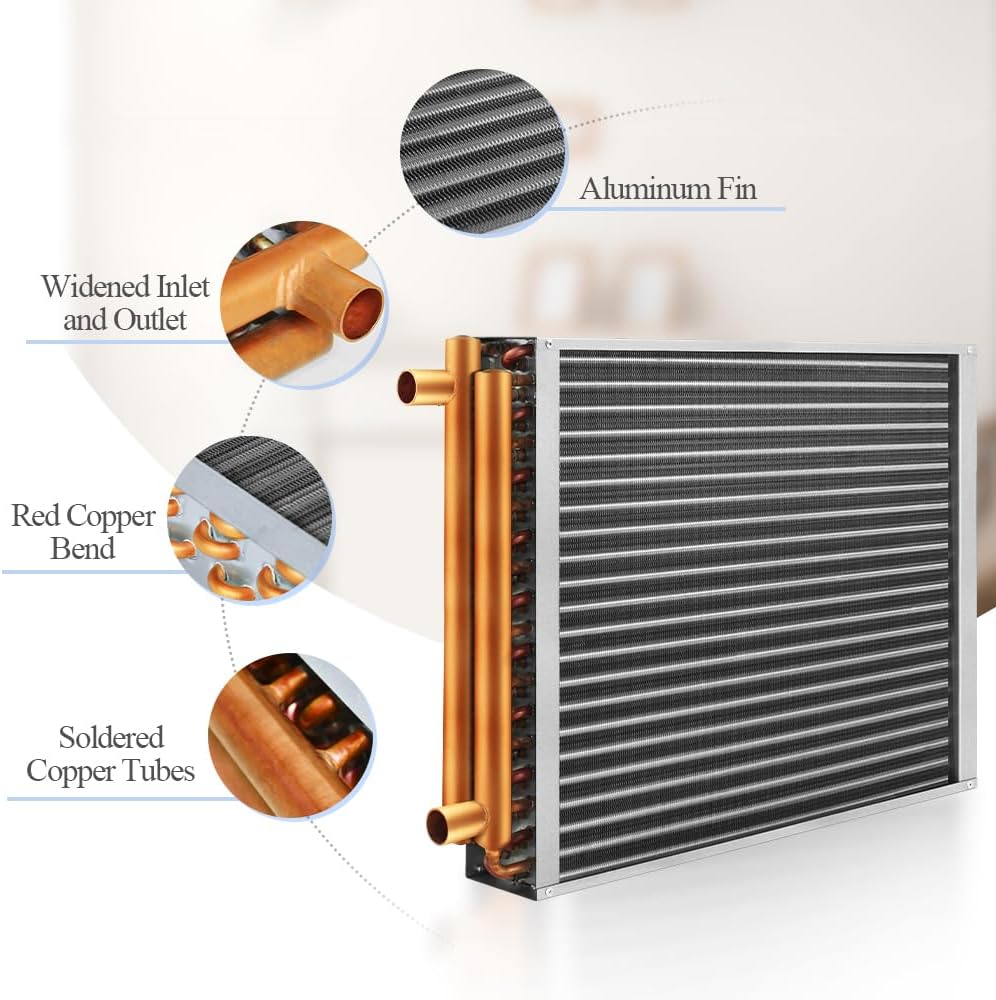
Water
$130.13
In stock on Amazon
Check price on AmazonReznor UDAP/UDBP Hydronic Series
Reznor’s hydronic unit heaters are the other dominant name on distributor shelves. The UDAP (propeller fan) line covers 30,000–150,000 BTU/hr in output increments. Reznor publishes entering-water-temperature correction factors prominently in their submittal packages — a detail practitioners appreciate when working with reset-controlled systems or boilers running below 160°F supply. Published airflow on a UDAP-45 runs approximately 1,400 CFM at rated conditions.
Contractors in multi-zone commercial installations frequently specify Reznor for parts availability and a broad distributor network. For systems where the boiler runs a low-temperature reset curve, Reznor’s detailed de-rating tables make it easier to confirm that the specified unit will actually meet the calculated load at actual operating conditions rather than at the idealized 200°F standard rating point — a distinction ACHR News (achrnews.com) has flagged repeatedly in coverage of hydronic zoning add-on projects as a common source of field underperformance.
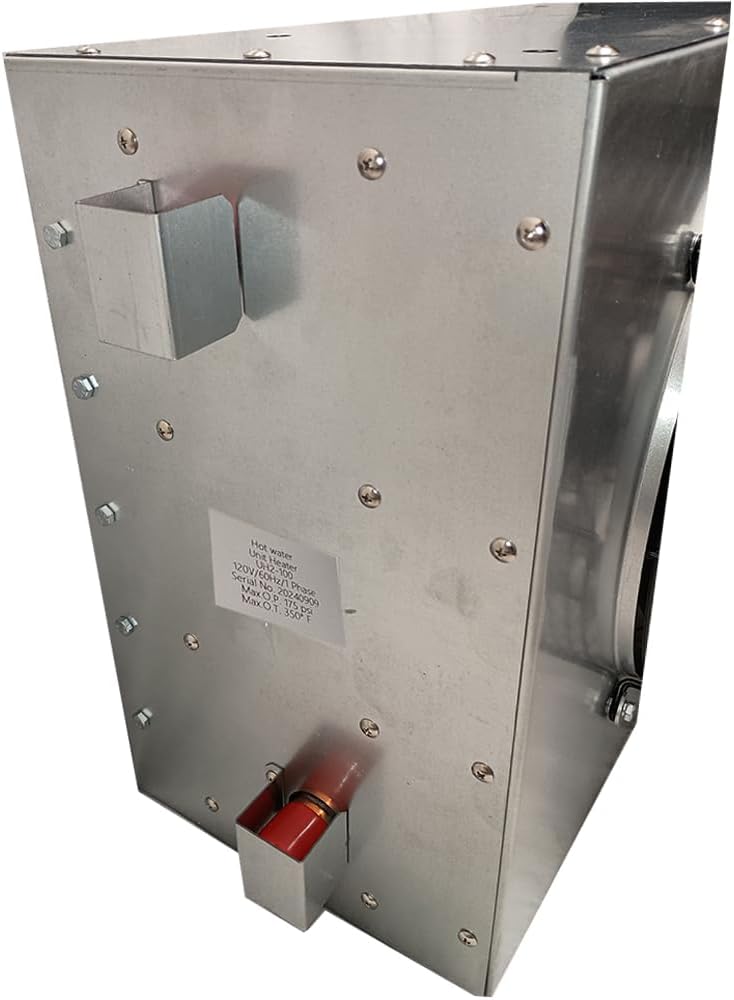
100,000
$345.95
In stock on Amazon
Check price on AmazonSterling F-Series Hydronic Unit Heaters
Sterling hydronic propeller-fan units (a Mestek brand) compete directly with Modine and Reznor at similar output ranges. Sterling’s F-Series is worth noting for historic renovation and light commercial work because Mestek — the parent company also behind Burnham and Weil-McLain boilers — can simplify procurement: one manufacturer’s representative, one warranty conversation, and controls familiar to technicians already servicing a Weil-McLain or Burnham cast iron plant.
The thermal performance testing methodology all three manufacturers use is standardized under ASHRAE Handbook — HVAC Systems and Equipment, Chapter 27, which means output claims are directly comparable across brands when you are reading submittals at the same entering water temperature and entering air temperature conditions. That standardization also means a low-bid Sterling unit and a higher-priced Reznor unit rated at the same BTU/hr at the same conditions will deliver the same output — the differentiators are construction robustness, parts availability, and local service support.
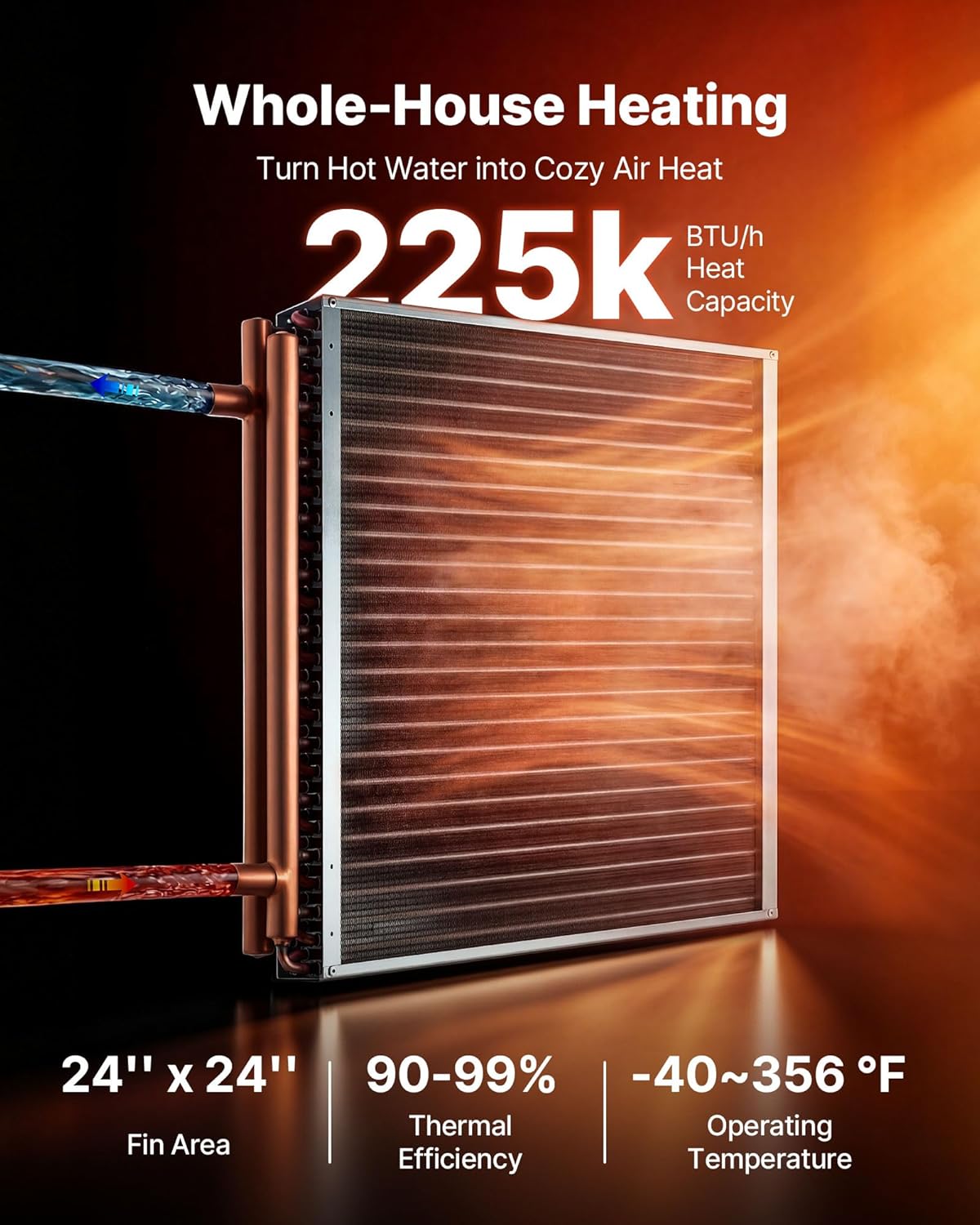
VEVOR
$349.90
In stock on Amazon
Check price on AmazonZone Configuration: Piping, Controls, and Freeze Protection
This is where practitioner decisions compound and where the project most often succeeds or fails independent of which unit heater is on the ceiling.
Dedicated zone vs. piggyback on an existing zone: A garage unit heater should almost always get its own zone — its own circulator or zone valve — for two reasons. First, the heat demand schedule is completely different from the house: you want the shop hot for Saturday morning, not running overnight. Second, if the garage ever loses heat in deep winter, you don’t want the house zones affected. ACHR News (achrnews.com) has noted in hydronic zoning coverage that mixing high-intermittent-demand loads like unit heaters onto house zones causes pressure-related circulation complaints and uneven room temperatures in the shared zones.
Circulator sizing: For a single unit heater zone under 75,000 BTU/hr output, a small wet-rotor circulator — a Taco 007, Bell & Gossett NRF-22, or equivalent — is typically sufficient at 1–3 GPM flow. Taco Comfort Solutions’ Zone Valve and Circulator Selection Guide walks through the Cv calculation for zone valve sizing; the math for a short garage loop under 50 equivalent feet of pipe rarely demands more than a small single-speed circulator.
Freeze protection is not optional. A garage zone that loses power or heat in February will freeze its coil and rupture it. Three layers of protection are standard practice:
- A low-limit aquastat on the unit heater that fires the zone circulator if coil temperature drops below 45°F, maintaining minimum flow.
- A glycol mix in the garage loop — 30% inhibited propylene glycol provides protection to approximately −10°F and is compatible with cast iron boiler sections. Use inhibited propylene glycol, not automotive ethylene glycol, which contains silicates that attack system metals.
- A manual isolation valve with a hose-bib drain so the loop can be drained if the building is truly decommissioned for a season.
If your system already runs glycol, confirm concentration before tapping in a new loop segment — dilution from adding volume can bring you below protection threshold. Fernox F1 inhibitor and Sentinel X100 are two products widely referenced in contractor technical literature for maintaining inhibitor levels in mixed glycol/water systems; both manufacturers publish dosing guidance specifically for systems containing cast iron boiler sections.
Decision Framework: If X, Then Y
If your boiler’s IBR net output exceeds current zone demand by 20% or more at design conditions, and your supply temperature holds at 160°F or above, you have a clean case for adding a unit heater zone with no equipment changes.
If your system runs a low-temperature reset curve with supply below 140°F at design, either specify a unit heater with a larger coil surface area rated at your actual entering water temperature, or install a small mixing station to give the garage loop a higher supply temperature independent of the house reset curve. The output penalty at low entering water temperature is large enough that an undersized unit will run continuously and still fall short of load.
If you’re mid-quote on a full boiler replacement, this is the moment to upsize by one model — moving from a smaller to the next larger output tier typically adds 30,000–45,000 BTU/hr of net output at the unit level for $200–$400 in additional equipment cost, far less than a second plant or standalone heater installation later.
If the garage is detached and more than 30 feet from the boiler, factor in pipe heat loss and the cost of insulated underground or above-grade piping — at that distance, a standalone hydronic plant or electric radiant may pencil out more favorably than running a long buried loop from the main plant.
The unit heaters themselves are not the hard part. The piping configuration, freeze protection strategy, and honest boiler capacity audit are where this project succeeds or fails. Get those right, and a properly specified propeller-fan hydronic unit heater will deliver years of reliable heat without drama — which is exactly what a cast iron plant is built to provide.