Hydronic heating — meaning a system that moves heat through your building by circulating hot water (or sometimes steam) rather than forced air — is one of the most efficient and comfortable ways to warm a home or commercial space. Cast iron boilers sit at the heart of most of these systems, and they’re built to last forty years or more when sized, installed, and maintained correctly. The catch: doing any of those three things well requires a working knowledge of fluid dynamics, heat transfer, system balancing, and boiler-specific code requirements. That knowledge isn’t born — it’s built. If you’re a homeowner managing an aging multi-zone system, an HVAC technician with a few boiler installs under your belt, or a building engineer spec’ing your first large radiant project, the fastest way to compress your learning curve is to read the books that working practitioners actually cite when the system doesn’t behave.
This article is a curated shelf — not an exhaustive bibliography. Every title listed here earns its space by being practically useful at the level where decisions get made: sizing a replacement boiler, diagnosing a pressure problem, writing a water treatment spec, or defending a near-boiler piping layout to a building inspector.
The Foundational Text: Siegenthaler’s Modern Hydronic Heating and Cooling
If you own exactly one hydronic reference, make it John Siegenthaler’s Modern Hydronic Heating and Cooling, now in its fourth edition from Cengage Learning. Siegenthaler — a licensed professional engineer and longtime contributor to HPAC Magazine — wrote the book that most hydronic-focused vocational programs, mechanical engineering curricula, and self-teaching contractors treat as the baseline. It covers everything from first principles (how water carries heat, what a BTU actually means in practice) through advanced topics like variable-speed injection mixing, radiant panel design, and primary-secondary piping loops.
For cast iron boiler owners specifically, the chapters on heat emitter sizing and system curve analysis are the ones you’ll return to repeatedly. The book’s treatment of low-temperature radiant systems versus high-temperature baseboard is unusually clear, and the worked examples are dimensioned in real project numbers — not clean textbook figures. Practitioners in ACHR News interviews and on contractor forums consistently name Siegenthaler as the reference they keep open while drawing near-boiler piping diagrams.
What it won’t cover: current Energy Star efficiency thresholds, brand-specific warranty terms, or distributor pricing. It’s an engineering text, not a shopping guide. Treat it as the “why” behind every boiler manufacturer spec sheet you read.
Who needs it most: Anyone sizing a new cast iron boiler for the first time, designing a multi-zone baseboard or radiant system, or troubleshooting a system that won’t balance. The fourth edition is available in print and digital formats through major technical booksellers.
Steam Systems: Holohan’s The Lost Art of Steam Heating
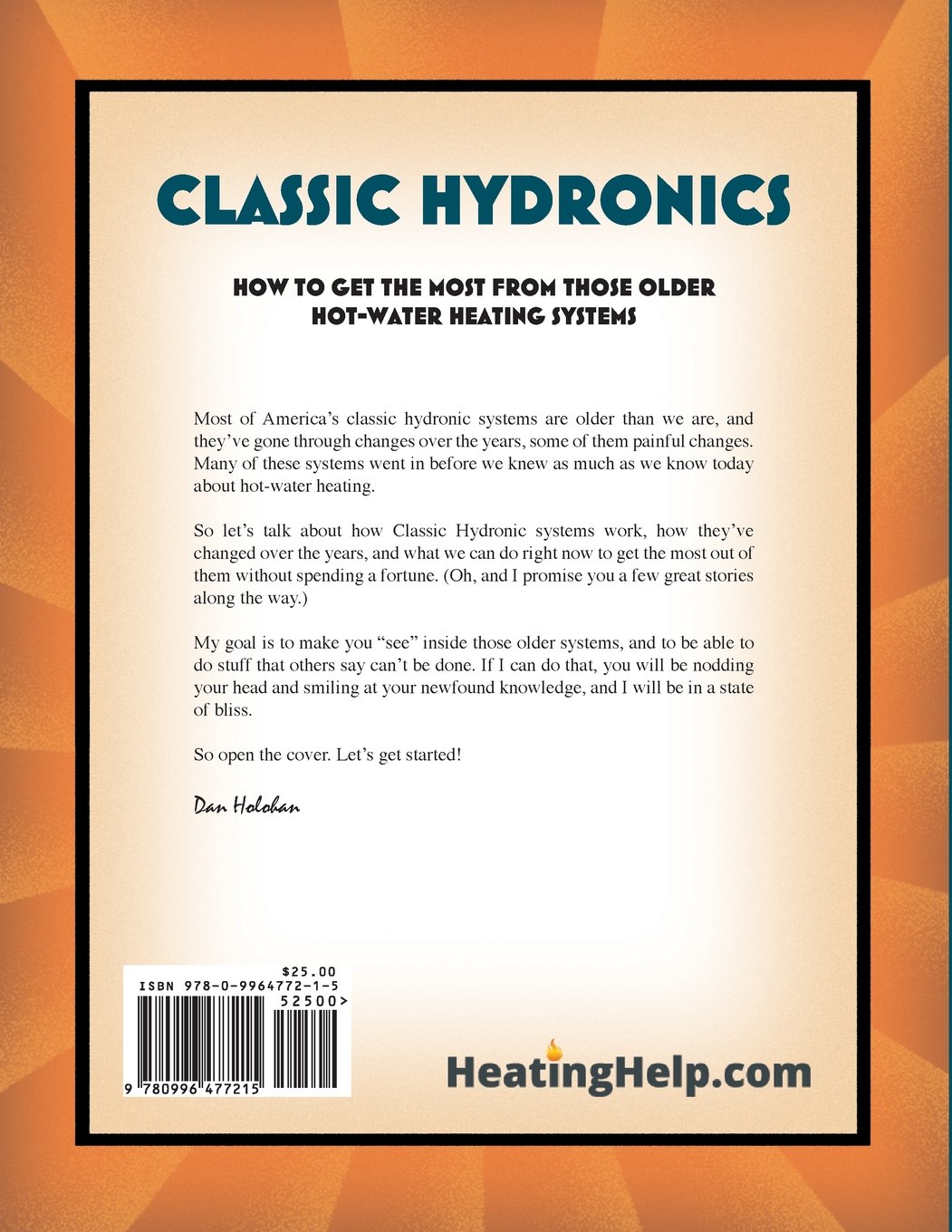
Dan Holohan’s The Lost Art of Steam Heating occupies a unique shelf position — it’s the only major reference that makes steam hydronic systems both comprehensible and compelling for a modern audience. Steam heating (where water is boiled to steam, circulated to radiators, and condensed back) dominated residential construction from roughly 1880 to 1950, which means millions of still-occupied buildings — particularly in the Northeast and Midwest — are running systems that most newly licensed HVAC techs have never been trained on.
Holohan, a veteran heating industry writer and educator, wrote this as a field guide: why one-pipe steam behaves differently from two-pipe, how to interpret the sounds a steam system makes, what differential pressure actually means in a residential steam loop, and how to diagnose the chronic problems (waterlogged returns, oversized replacement boilers, failed main vents) that plague these systems when homeowners replace the original cast iron boiler without understanding the distribution system upstream.
The Building Green publication has noted in its coverage of historic renovation projects that steam system literacy is increasingly rare among HVAC contractors, and that the gap creates real project risk when old cast iron steam boilers are replaced without accounting for the existing distribution design. Holohan’s book directly addresses that gap.
Practical trigger for this purchase: If you’re managing or inheriting a pre-1960 building with upright cast iron radiators and a single-pipe or two-pipe steam boiler — a Burnham, Peerless, or Weil-McLain steam unit — this is not optional reading. It will save you from the most common and most expensive steam system mistake: oversizing the replacement boiler because the installer used heat loss calculations instead of connected radiation EDR (Equivalent Direct Radiation, a measure of how much steam a given radiator can condense per hour).
The Professional Codes Reference: ASHRAE Handbook — HVAC Systems and Equipment
The ASHRAE Handbook series — published annually by the American Society of Heating, Refrigerating and Air-Conditioning Engineers — is the industry’s closest equivalent to a legal reference. The HVAC Systems and Equipment volume, updated through the 2024 edition, contains the chapters most relevant to cast iron boiler specification: boiler types and ratings, system piping configurations, heat distribution basics, and combustion efficiency testing protocols.
It is dense, technical, and not designed for casual reading. What it is designed for is defensibility. When a building engineer or mechanical engineer of record needs to document why a system was designed to a particular standard — boiler output, minimum efficiency, piping configuration — ASHRAE is the citation that holds up in a commissioning review, a permit dispute, or a warranty claim conversation.
By the numbers — ASHRAE coverage scope (2024 HVAC Systems and Equipment volume):
- Chapter 32: Boilers (covers cast iron sectional, steel fire-tube, condensing)
- Chapter 13: Hydronic heating and cooling systems
- Chapter 35: Radiant heating and cooling panels
- Chapter 9: Applied heat pump and heat recovery systems
ASHRAE memberships provide discounted access to the Handbook series, and many engineering firms maintain institutional subscriptions. For contractors and prosumer homeowners, the targeted chapter purchase (available through the ASHRAE bookstore) is more cost-effective than buying the full volume.
The Installer’s Tradeoff Reference: Near-Boiler Piping and System Configuration
No single book dominates this category the way Siegenthaler dominates system design — but several manufacturer-published technical guides and industry association documents fill the gap effectively.
Burnham’s Near-Boiler Piping Guides — published as installation supplements for their ESC, Series 2, and commercial product lines — are among the most practically detailed free resources available. They show exactly how to pipe a primary-secondary loop, where to place the air separator (the device that removes dissolved air from the system water), and why the circulator placement relative to the expansion tank matters for system pressure stability. HPAC Magazine has specifically cited Burnham’s near-boiler documentation as a model for manufacturer installation support.
Weil-McLain’s System Design Guide — available as a downloadable PDF from Weil-McLain’s technical resource library — goes further into multi-zone design, including how to size zone valves versus zone circulators for different load profiles. For contractors managing their first multi-zone hydronic upgrade on a Weil-McLain Gold or Ultra Series installation, this document is the practical companion to Siegenthaler’s theoretical foundation.
Neither of these is a book you purchase — they’re technical documents you download, print, and keep in the job folder. But they belong in the reference library discussion because they’re the documents contractors actually reach for when the piping layout decision needs to be made on site.
Water Chemistry: The Gap in Most Hydronic Libraries
Water chemistry is where most hydronic reference libraries have a visible hole. Neither Siegenthaler’s engineering text nor the ASHRAE Handbook is written to help a field tech evaluate whether a system needs Fernox F1 inhibitor treatment, Sentinel X100, or a Rhomar Hydro-Solv flush before the new boiler goes in. That decision has real stakes: Building Green’s coverage of cast iron boiler longevity specifically identifies corrosive system water and oxygen ingress as leading causes of premature section failure — the most expensive cast iron boiler failure mode, often occurring outside the standard warranty window.
The closest thing to a definitive reference here is the Fernox Technical Handbook (published by Fernox, a Chemetall brand), which covers inhibitor selection, corrosion chemistry, and system flush protocols in accessible language. Rhomar Water Technologies also publishes application guides for their hydronic product line that are written at the contractor-deployment level rather than the laboratory level.
Neither document is glamorous shelf material. Both are worth reading before you commission any cast iron boiler installation into an existing system with unknown water chemistry history.
Building the Working Reference Stack: A Decision Framework
If you’re allocating budget and shelf space deliberately, here’s how to sequence the investment:
If you’re a homeowner with a single-zone hot water system: Start with Siegenthaler’s Modern Hydronic Heating for the foundational concepts, and pull the near-boiler piping guide for whatever boiler you’re installing or inheriting. That’s enough to have an informed conversation with your contractor and to evaluate whether the system design you’re being quoted actually makes sense.
If you’re a contractor with 1–5 boiler installs behind you: Add Holohan’s steam text if you’re in a market with pre-1960 housing stock — it will differentiate you from competitors who don’t understand steam. Keep the Burnham and Weil-McLain technical guides in rotation. Budget for ASHRAE access when you start working on projects that require mechanical engineer sign-off.
If you’re specifying multi-zone or light commercial hydronic systems: The ASHRAE Handbook is non-negotiable for defensibility. Siegenthaler is your design reference. Manufacturer system design guides become project-specific appendices. Water chemistry documentation from Fernox or Rhomar should be part of your commissioning checklist, not an afterthought.
The honest truth about hydronic system knowledge is that it’s cumulative and system-specific. No single book covers the quirks of a 1970s two-pipe Peerless installation in a Chicago three-flat the same way it covers a new-construction radiant slab job in the mid-Atlantic. The reference library’s job is to give you the vocabulary and the principles — the site-specific judgment comes from applying those tools to actual systems over time.
That’s the stack. Start where you are, add as your project complexity grows, and treat the manufacturer technical documents as living files that get updated when product lines change. The contractors who consistently produce well-functioning hydronic systems are almost uniformly the ones who’ve done the reading.