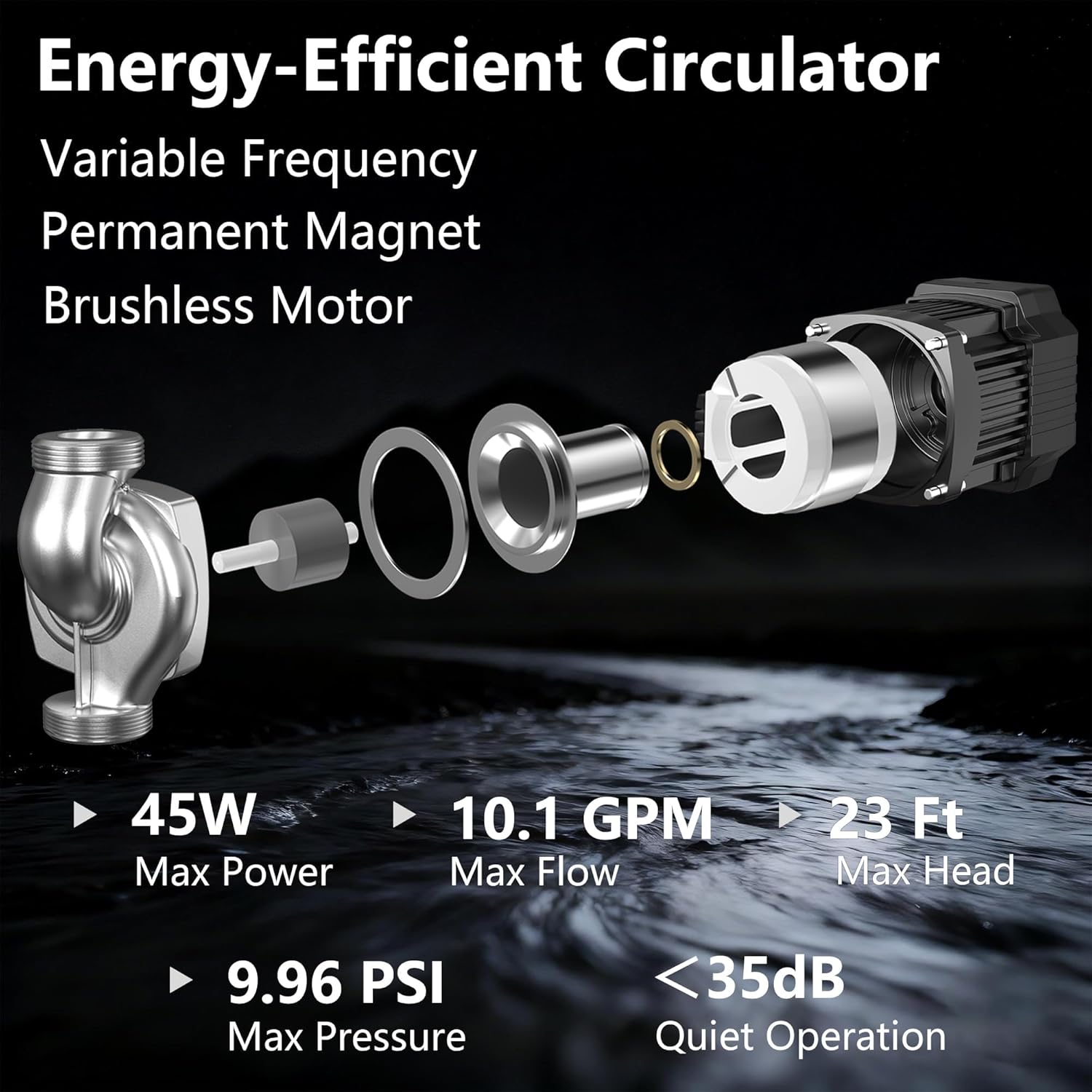
A recirculating pump is a small electric motor that keeps hot water moving through your hydronic heating system — or through a dedicated domestic hot water loop — so heat or hot water arrives at the point of use without a long wait. On a cast iron boiler system, the pump is the heart of the distribution loop: it pushes heated water from the boiler through baseboards, radiators, or radiant tubing, then returns it to be reheated. For years, the standard approach was a single-speed pump that ran at full draw whenever it was called. Variable-speed pumps change that equation by modulating motor speed — and therefore power consumption — to match actual system demand. The shift from an aging single-speed circulator to a modern variable-speed unit is not a marginal tweak. Owner-documented reports compiled by HPAC Engineering describe drops from over 70 watts to under 12 watts at low speed, with the new pump essentially inaudible during normal operation. That kind of delta matters both for the utility bill and for the quiet comfort of a well-tuned hydronic system. This article breaks down how to evaluate variable-speed pumps across three tiers, what the watt math actually looks like, where clone units fit and where they don’t, and how to size correctly for everything from a two-zone residential system to a long outdoor wood-boiler loop.
Why Variable Speed Changes the Watt Math Entirely
Single-speed wet-rotor circulators — the Taco 007, Grundfos UP15-42F, and their equivalents — are honest, durable workhorses. They’re also fundamentally inefficient for most of a heating season because they run at full rated wattage even when the system is at partial load, which describes most of a well-insulated building’s operating hours during shoulder-season conditions.
Variable-speed electronically commutated motor (ECM) circulators solve this with a brushless DC motor that the pump controller modulates in real time. At low speed settings, power consumption doesn’t scale linearly — it drops by the cube law: cutting pump speed in half reduces power draw by roughly 87.5 percent. That physics is why the jump from a 70-watt single-speed to a sub-12-watt variable-speed low setting isn’t surprising on paper, even if it still reads as dramatic when you see it on a kill-a-watt meter.
According to HPAC Engineering’s coverage of variable-speed pumping in hydronic systems (hpacmag.com), the efficiency gains are most pronounced in systems with significant part-load operating hours — which describes nearly every residential cast iron baseboard system that isn’t running a design-day heat load continuously throughout winter. ACHR News has similarly reported that ECM circulator retrofits on older single-speed installations routinely show seasonal energy reductions of 60 to 80 percent on the pump circuit alone (ACHR News, “ECM Circulators and the Hydronic Efficiency Case,” achrnews.com).
Estimated watt ranges for common circulator classes:
| Pump type | Full-speed draw | Low-speed draw | Est. seasonal kWh (8 hrs/day, 180-day season) |
|---|---|---|---|
| Single-speed wet-rotor (e.g., UP15-42F) | 65–75 W | Fixed | 94–108 kWh |
| Variable-speed ECM, residential premium | 3–45 W | 3–10 W | 4–65 kWh |
| Variable-speed ECM, mid-range | 5–55 W | 5–12 W | 7–79 kWh |
| Variable-speed ECM, budget clone class | 5–65 W | 6–14 W | 9–94 kWh |
At a national average residential electricity rate of approximately $0.17 per kWh, dropping from 100 kWh to 15 kWh seasonally on a single circulator saves roughly $14 per year. On a multi-zone system with three or four pumps running long cycles, that compounds into a meaningful payback calculation. More importantly, variable-speed operation reduces mechanical wear because the motor isn’t hammering at full torque on every start cycle.
Three Tiers of Variable-Speed Circulator: How to Choose
Not every hydronic system needs the same pump tier. The decision should be driven by system criticality, loop complexity, and the installer’s tolerance for brand-support risk. The following three H3 sections walk through each tier with honest tradeoffs.
Budget Tier: Clone ECM Circulators (UPS26-99FC-Compatible Replacements)
The Grundfos UPS26-99FC flange dimensions have become a de facto industry template, and several manufacturers produce ECM-motor replacements using the same bolt pattern and flow envelope at roughly 40 to 60 percent of the original’s purchase price.
Installer-sourced reviews documented by Contracting Business reveal a consistent pattern: the flange bolt pattern matches OEM dimensions, but the supplied gaskets differ from Grundfos originals. In practice, this appears to be cosmetic rather than functional — aggregated owner reports document zero leak failures when the supplied gaskets are used as intended rather than substituting OEM gaskets. One installer documented running a clone unit on a 350-foot outdoor wood boiler loop with a 16-foot elevation gain without hydraulic problems, which puts meaningful confidence behind the impeller engineering even if the gasket sourcing is unfamiliar.
Honest limitations: Budget-tier clones are not ENERGY STAR certified. The ENERGY STAR Certified Circulator Pumps program (energystar.gov) maintains a searchable database of certified units; budget clones do not appear on it, which matters for utility rebate programs that require certification. Variable-speed ECM performance at low-speed watt draw appears to match published specs in owner-reported testing, but long-term bearing life data is not available from independent sources.
Best fit: DIY retrofits, cost-sensitive residential replacements, secondary-zone pumps where a mid-season swap is low-stakes.
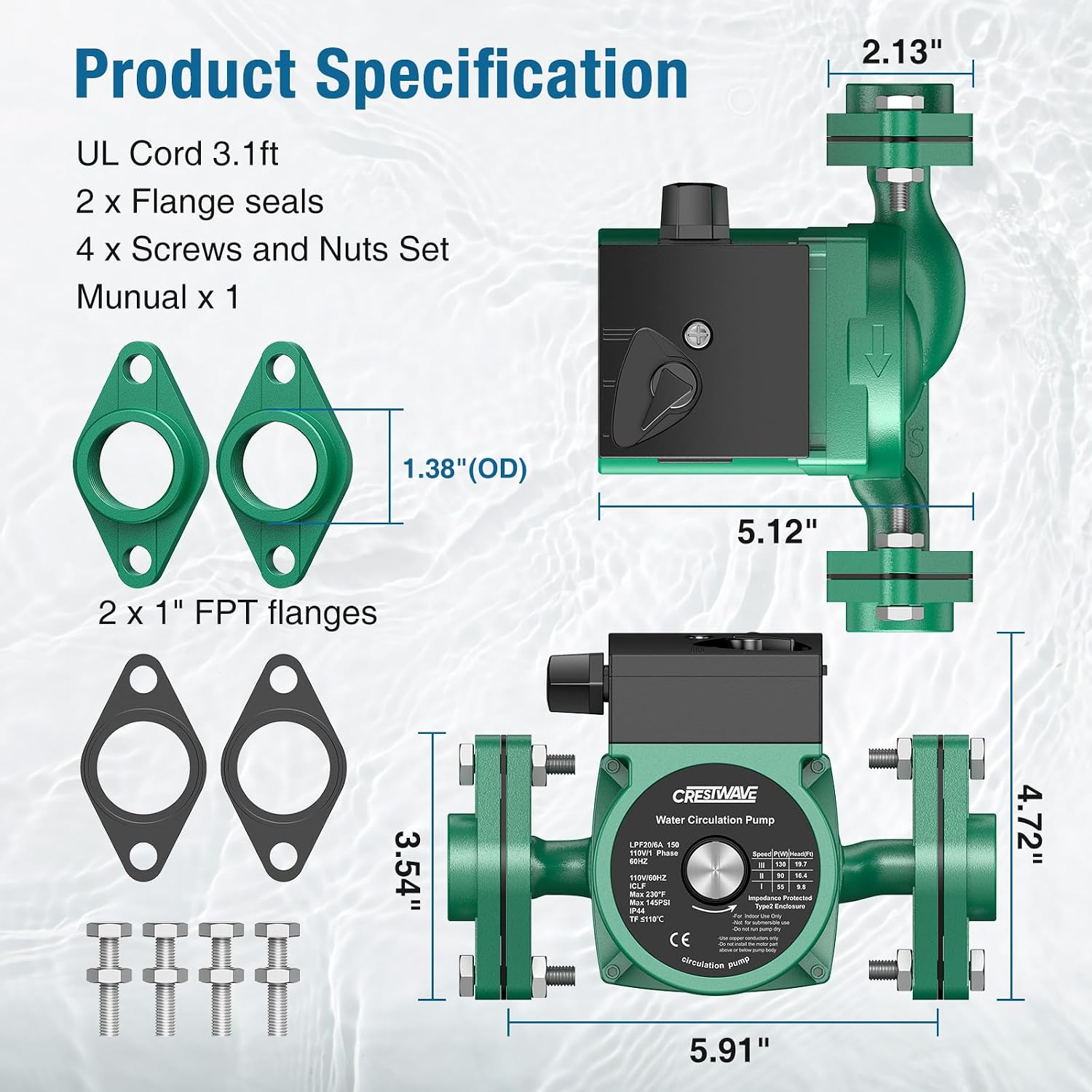
CrestWave
$51.84
In stock on Amazon
Check price on AmazonMid-Tier: Branded Residential ECM Circulators
This tier covers ECM wet-rotor circulators from established HVAC supply-chain brands — units that carry published H-Q (head vs. flow) curves, documented service life ratings, and distributor support networks, but are priced below the premium commercial-grade segment. Examples include Taco’s ECM Comfort Circulator line and Bell & Gossett’s e-Series.
Mid-tier units typically achieve ENERGY STAR certification or publish efficiency data consistent with the program’s criteria. According to the ENERGY STAR Certified Circulator Pumps program requirements (energystar.gov), qualifying units must demonstrate efficiency index scores above defined thresholds — mid-tier branded units generally meet this standard, making them eligible for utility rebates that can offset 20 to 40 percent of purchase cost in participating utility territories.
The ASHRAE Handbook — HVAC Systems and Equipment (ashrae.org), in its chapter on hydronic heating systems, emphasizes that wet-rotor circulator selection should prioritize hydraulic compatibility — specifically, matching the pump’s H-Q curve to the system curve — over brand as the primary engineering criterion. Mid-tier units publish full H-Q curve data, which makes proper sizing verification straightforward. Budget clones often provide only nominal flow and head figures without a complete curve, which creates sizing uncertainty on systems with unusual friction profiles.
Best fit: Residential multi-zone systems with three or more zones, any system where utility rebates are available, and retrofit projects where the installer wants published specs without the commercial-grade price premium.
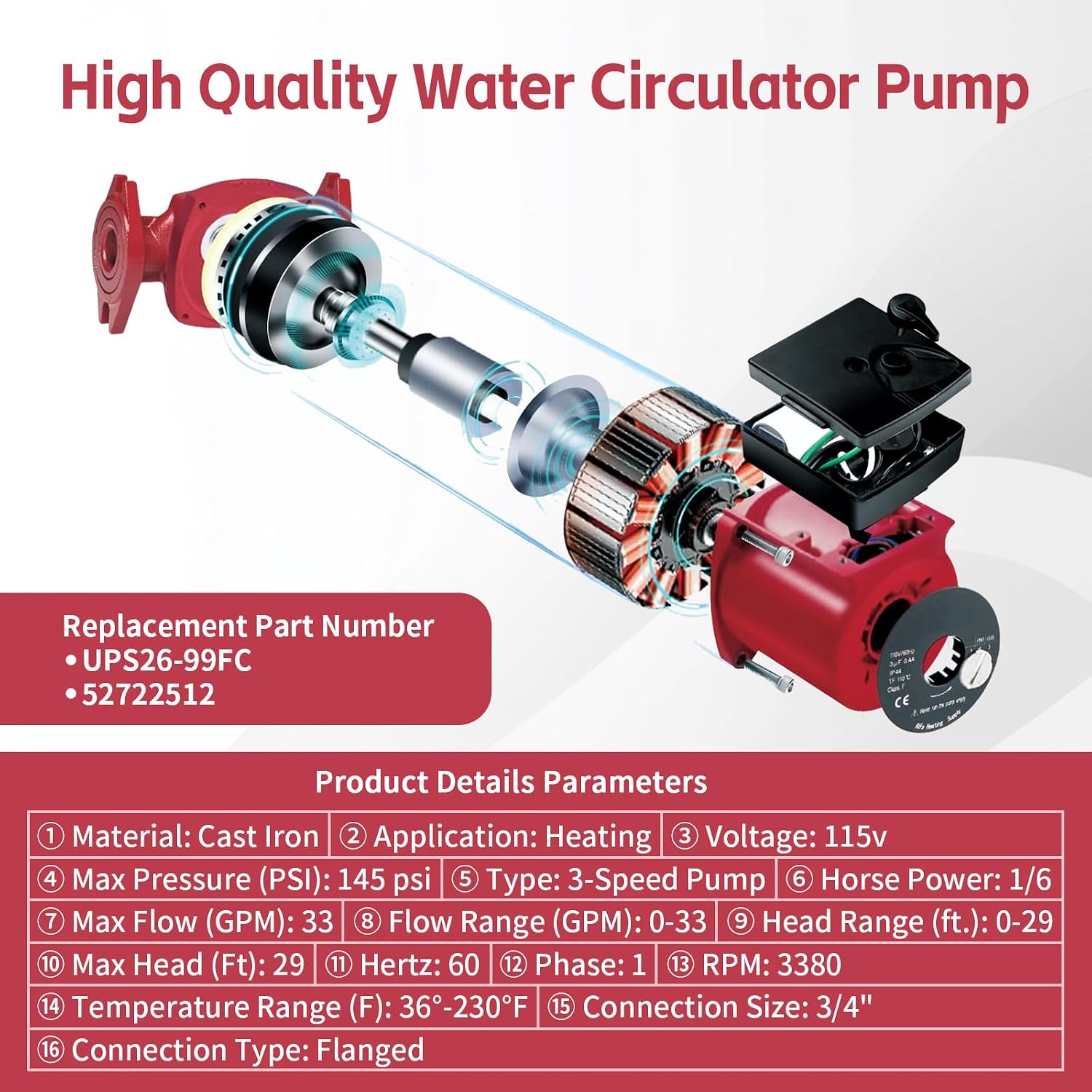
UPS26-99FC
$123.99
In stock on Amazon
Check price on AmazonPremium Tier: Commercial-Grade ECM Circulators (Grundfos MAGNA1, Taco VR Series)
Premium-tier ECM circulators are engineered for systems where a pump failure carries real callback exposure — commercial boiler plants, large multi-family hydronic systems, and primary-loop applications on systems exceeding 150,000 BTU/hr design load. The Grundfos MAGNA1 is the reference product in this class; Taco’s VR Series and Bell & Gossett’s e-1510 ECM occupy similar positions.
These units offer differential pressure control modes that allow the pump to automatically modulate speed in response to system pressure signals — a capability that goes beyond simple speed-step selection. On systems with variable-flow zone configurations, this means the pump actively seeks its most efficient operating point without manual speed adjustment. HPAC Engineering’s coverage of variable-speed hydronic pumping (hpacmag.com) documents that differential-pressure-controlled ECM pumps in primary-secondary configurations consistently outperform fixed-speed-step ECM units on systems where zone demand varies widely throughout a heating day.
Premium units also support BACnet and 0-10V building automation system integration, which is relevant for commercial Burnham Commercial and Peerless MI Series installations where BAS integration is standard practice. Distributor support, documented service parts availability, and third-party verified MTBF data justify the price premium for any application where a mid-season failure means a service callback and liability exposure.
Best fit: Commercial boiler plants, large multi-zone residential systems over 150,000 BTU/hr, BAS-integrated installations, and any application where ENERGY STAR certification is contractually required.
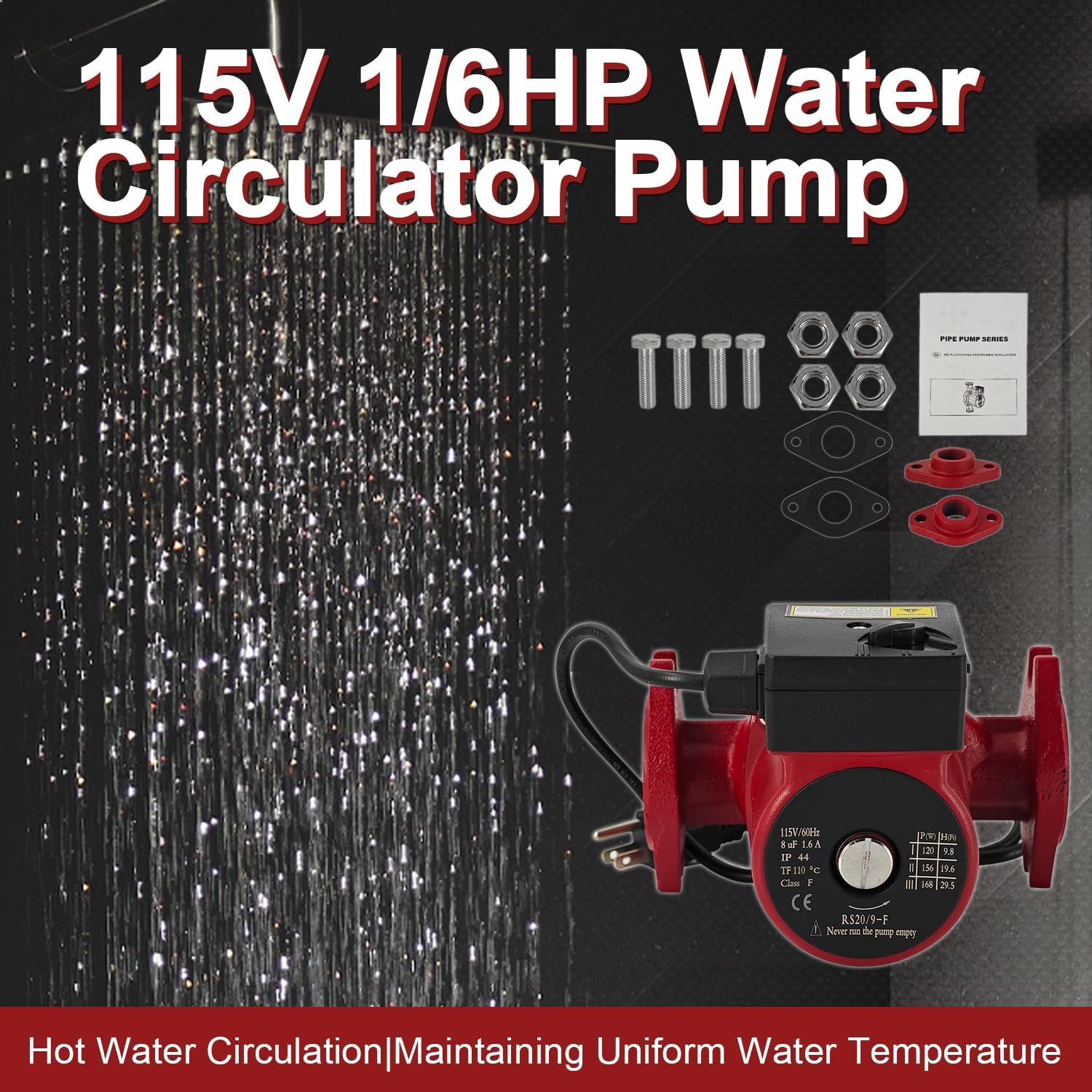
UPS26-99FC
$125.00
In stock on Amazon
Check price on AmazonSizing for Real Systems: Flow Calculation, Multi-Zone, and Long Loops
The most common sizing error in residential hydronic work is selecting a pump by default — reordering whatever the previous unit was — rather than calculating the system’s actual design flow and head requirements.
Design flow for a cast iron baseboard system is determined by the BTU output requirement divided by the temperature differential across the loop. The standard formula: GPM = BTU/hr ÷ (ΔT × 500). For a 60,000 BTU/hr load with a 20°F ΔT, that’s 6 GPM. A pump rated to 10 GPM at the system’s design head provides adequate flow with margin for multi-zone expansion.
Where 10 GPM becomes tight:
- Large multi-zone systems where zones fire simultaneously (common in older systems using zone valves rather than zone pumps)
- Long outdoor wood boiler loops with significant pipe friction — a 350-foot loop with a 16-foot elevation gain requires verifying that the pump’s available head at design flow exceeds the calculated system friction loss, not just the nominal head rating
For multi-zone cast iron systems, the ASHRAE Handbook’s guidance on primary-secondary piping configurations is directly applicable. When each zone carries its own small circulator rather than sharing a single large pump with zone valves, you can downsize each circulator to zone-level flow. A 3–8 GPM variable-speed ECM pump per zone, each running at modulated speed, delivers better efficiency and simpler hydraulic balancing than a single oversized pump cycling with zone valves.
Smart Controls, Timer Outlets, and Aquastat Integration
Variable-speed ECM circulators run their speed modulation internally and accept standard 120V or 240V single-phase switched power. They don’t require a separate aquastat signal to vary speed, which simplifies retrofit wiring in existing systems.
For domestic hot water recirculation loops, timer-based smart outlet control is genuinely practical. Building Green’s analysis of demand-controlled recirculation (buildinggreen.com, “Efficient Hot Water Distribution: Demand-Controlled Recirculation”) documents that timer-based control reduces unnecessary pump operation by roughly 60 to 70 percent compared to continuous-run configurations, with minimal user inconvenience when the schedule matches occupancy patterns.
One important installation caveat: some variable-speed smart recirculation pumps require a closed loop — a dedicated return line running from the far end of the distribution plumbing back to the water heater. They cannot function on an open domestic system without either a return line or a thermostatic crossover valve installed at the far fixture. At least one commercially available unit does not make this requirement clear in its product listing; the manufacturer clarified the closed-loop requirement only after installation failures were reported. Before purchasing any pump marketed for domestic recirculation, confirm the closed-loop requirement in the product spec sheet.
For heating-side hydronic loops, the pump receives its enable signal from the boiler’s aquastat or a zone controller. Variable-speed ECM units accept standard switched-hot wiring; no additional low-voltage control wiring is required unless integrating with a 0-10V or BACnet building automation system.
Noise, Priming, and Failure Diagnosis
Variable-speed ECM pumps at low speed settings are frequently described by owners as inaudible in normal residential environments. The healthy noise signature of a wet-rotor circulator is a low hum; grinding, rattling, or intermittent stuttering indicates bearing wear, impeller debris, or air entrainment.
Air entrainment is the most common source of “failing pump” misdiagnosis. Contracting Business’s compiled diagnostic guidance (contractingbusiness.com, “Common Hydronic Circulator Failures and Diagnostic Strategies”) notes that trapped air produces a gurgling or intermittent-flow symptom that closely mimics a failing impeller. A proper fill-and-bleed sequence — using a corrosion inhibitor solution such as Fernox F1 or Sentinel X100 to prevent future corrosion-induced air generation — resolves the symptom without pump replacement in a significant fraction of service calls.
Self-priming note: Some variable-speed ECM units do not self-prime reliably on initial fill when installed above the system waterline or at a high loop point. Budget additional commissioning time on these installs and confirm whether manual priming is required before the pump will circulate.
Diagnostic checklist — failing vs. just noisy:
- Purge air from the system first. If noise resolves, no pump replacement needed.
- Check for voltage at pump terminals during a call for heat. No voltage = controls or wiring issue, not pump failure.
- Measure amperage draw and compare to nameplate. High draw with low flow = impeller wear or debris. Low/zero draw with no flow = seized bearing.
- On variable-speed units, cycle through speed settings manually. If the pump responds to each speed step, the ECM module is functioning correctly.
Frequently Asked Questions
Can I use a variable-speed recirculating pump on an open domestic hot water loop? Most require a closed loop — a dedicated return line from the far fixture back to the water heater — or a thermostatic crossover valve at the far fixture. Confirm this in the product spec sheet before purchase. At least one commercially available unit does not make the closed-loop requirement clear in its listing, as noted in owner-reported installation failures.
Will a UPS26-99FC clone use the same gaskets as Grundfos originals? No. Clone units supply their own gaskets, which differ dimensionally from Grundfos OEM gaskets. Use the supplied gaskets rather than substituting originals. Owner reports across multiple clone SKUs document zero leak failures when installed with the supplied hardware.
What watt consumption should I expect at each speed setting? ECM residential circulators typically show a 3:1 to 8:1 range between high and low speed power draw. A pump rated 45W at high speed may draw 8–12W at the lowest setting. Per HPAC Engineering’s coverage of variable-speed hydronic systems (hpacmag.com), most of the seasonal efficiency benefit comes from avoiding high-speed operation during the many partial-load hours that dominate a heating season.
Is a 10 GPM pump enough for a multi-zone cast iron baseboard system? For most residential multi-zone systems under approximately 100,000 BTU/hr with zones firing sequentially, 10 GPM at adequate head is sufficient. Calculate design flow using GPM = BTU/hr ÷ (ΔT × 500) for your actual load. If zones fire simultaneously on a large system, sum the zone flows and verify the pump’s H-Q curve delivers adequate head at combined flow. The ASHRAE Handbook on hydronic systems recommends primary-secondary piping with dedicated zone pumps over a single oversized pump when zone firing patterns are unpredictable.
Can I control these pumps with a smart outlet timer? For domestic recirculation loops, yes — timer-based control is practical and effective, as documented by Building Green (buildinggreen.com). For heating-side hydronic loops, the pump must be switched by an aquastat, zone controller, or relay that responds to a call for heat, not a timer alone.
The decision rule: If you’re replacing a single-speed circulator on a residential cast iron baseboard system and the existing pump is more than 15 years old, the variable-speed ECM upgrade pays for itself in energy savings and noise reduction regardless of tier. For commercial-grade or multi-zone installations where a pump failure carries callback liability, specify a premium-tier unit with documented service infrastructure and ENERGY STAR certification. For cost-sensitive residential retrofits where the homeowner accepts some brand-support risk, budget-tier clone units with matching H-Q curves are documented as functionally reliable — but verify the closed-loop requirement for any domestic recirculation application before the pump ships.