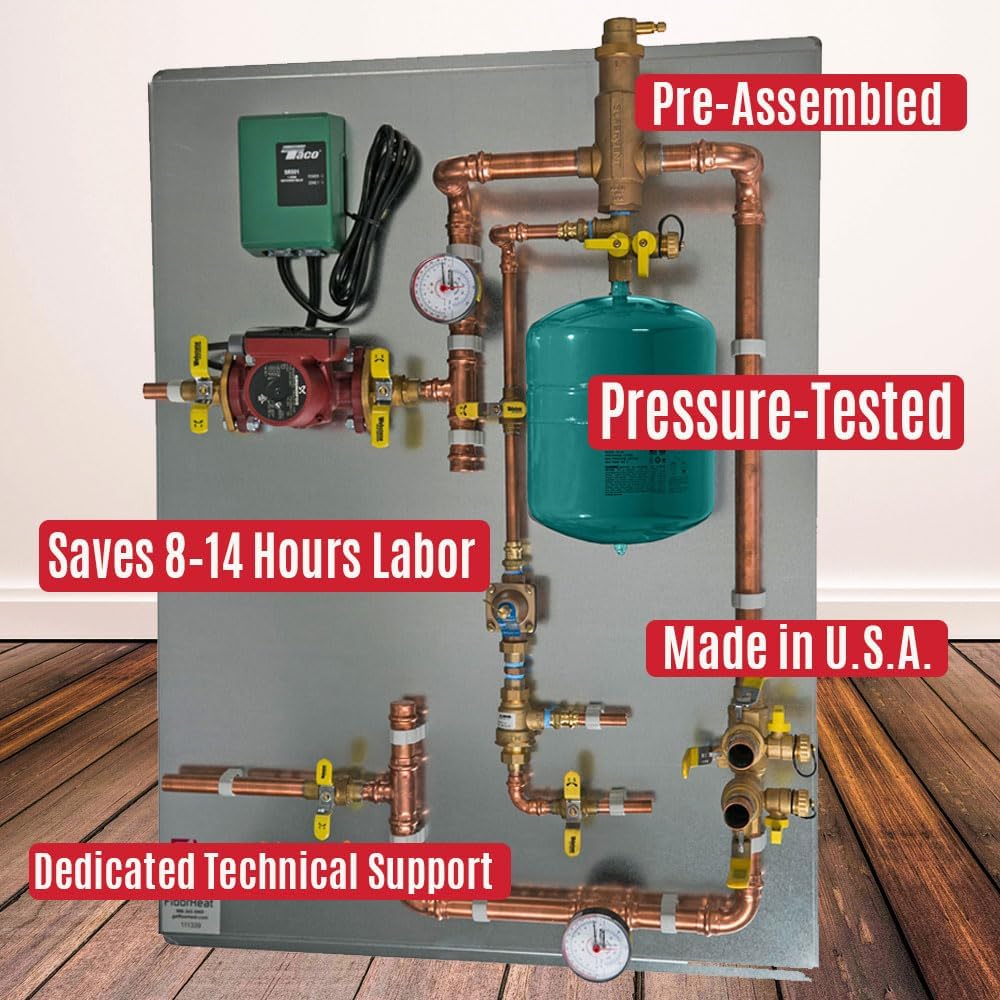
If you’ve looked at a pre-assembled hydronic radiant panel — the kind that arrives as a wall-mounted manifold board with pumps, zone valves, a mixing valve, and all the fittings already plumbed together — and wondered how to figure out whether your boiler can actually support it, you’re asking exactly the right question. A radiant panel in this context isn’t a decorative radiator; it’s a pre-built control and distribution hub that sends hot water from your boiler through a series of in-floor or in-ceiling tubing loops, one circuit (called a zone) at a time, to heat different rooms or areas independently. The “zone count” is simply how many of those circuits the panel can run simultaneously. The “pump specs” describe how hard and how fast the panel moves water through those circuits. Both numbers feed directly back to how hard your boiler has to work — and whether it’s sized and configured correctly to keep up.
This article gives you the decision framework to cross-reference a pre-assembled panel’s listed specs against your boiler’s output before you’re standing in a mechanical room with a commitment already made.
| EDITOR'S PICK[Essential Series Hydronic Radia…](https://www.amazon.com/dp/B07T9NS2NG?tag=greenflower20-20) | Mid-tier[Hydronic Radiant Heat Control P…](https://www.amazon.com/dp/B0GYTZWQJF?tag=greenflower20-20) | Budget pickHydronic Radiant Heat Control P… | |
|---|---|---|---|
| Zone Count | 3 | 2 | 1 |
| Application | Radiant Floor | Underfloor, Home & Space | Underfloor, Home & Space |
| High-Efficiency | — | ✓ | ✓ |
| Easy Install | — | ✓ | ✓ |
| Price | $3,406.00 | $3,269.07 | $2,540.13 |
| See on Amazon → | See on Amazon → | See on Amazon → |
Why the Zone Count Is a Boiler Load Multiplier, Not Just a Planning Detail
Every active zone on a radiant panel is a simultaneous heat demand. A 4-zone panel running all four loops at the design flow rate isn’t asking for one-quarter of anything — it’s asking for the full combined load of all four circuits running concurrently at design conditions.
The math the industry uses starts with the basic hydronic heat transfer equation:
Q = GPM × ΔT × 500
Where Q is BTU/hr output, GPM is flow rate in gallons per minute, and ΔT is the temperature difference (in °F) between the supply and return water across that loop. The constant 500 is a simplification of the specific heat and density of water at typical hydronic temperatures (per John Siegenthaler’s Modern Hydronic Heating and Cooling, the precise multiplier varies with water temperature but 500 is accepted practice for preliminary sizing).
So a 4-zone panel where each zone runs at 1.5 GPM with a 20°F ΔT contributes:
1.5 × 20 × 500 = 15,000 BTU/hr per zone
Four zones simultaneous: 60,000 BTU/hr total demand on the boiler.
That’s before you’ve added domestic hot water, any baseboard zones, or standby losses. If your boiler’s net output is rated at 70,000 BTU/hr — which is a common mid-tier cast iron unit — you just consumed most of it with one panel.
By the numbers:
| Zones Active | GPM/Zone | ΔT (°F) | Total Panel Load |
|---|---|---|---|
| 2 | 1.5 | 20 | 30,000 BTU/hr |
| 4 | 1.5 | 20 | 60,000 BTU/hr |
| 6 | 1.5 | 20 | 90,000 BTU/hr |
| 6 | 2.0 | 20 | 120,000 BTU/hr |
The tradeoff becomes visible quickly: more zones or higher per-zone flow rates can push panel demand past what a single residential cast iron boiler can deliver without short-cycling, cold rooms, or — more insidiously — a supply temperature that drops below what the radiant loops need to maintain comfort setpoints.
The ASHRAE Handbook on Panel Heating and Cooling notes that radiant systems are particularly sensitive to supply temperature stability because the emitter (the floor or ceiling) has significant thermal mass — it takes 30–60 minutes to respond to a change in water temperature, which means a boiler that short-cycles or drops supply temp under load produces comfort complaints that trail the actual cause by an hour or more.
Reading Pump Specs on the Panel: Head Pressure, Flow Rate, and the Wet Rotor Trap
Most pre-assembled radiant panels in the residential and light commercial segment — brands like Watts Radiant, Uponor, Caleffi, and Taco — use small wet-rotor circulators for each zone or a single larger circulator combined with zone valves. The difference matters for your boiler piping.
Zone-pump panels (one small pump per zone, typically 1/25 HP to 1/8 HP wet-rotor units) allow hydraulic independence between zones. Each pump operates against the resistance of its own loop only. This is a better fit for older cast iron boilers because the pumps don’t fight each other hydraulically and the primary/secondary piping is more forgiving. The Taco Comfort Solutions Zoning Products Application Guide recommends primary/secondary piping — also called closely spaced tees or hydraulic separation — specifically when using zone-pump manifold panels with cast iron boilers, because it decouples the panel’s variable flow from the boiler’s fixed-flow primary loop.
Zone-valve panels (one circulator runs the whole panel, zone valves open and close per thermostat) are hydraulically simpler to wire but more demanding on the system circulator. When only one or two zones are open, the single pump is now pushing the same GPM through fewer circuits — system pressure spikes, flow velocity through open loops increases, and the boiler may see intermittent reduced flow if the primary loop isn’t properly protected. The Watts Radiant Design Manual flags this directly: zone-valve panels require careful minimum-zone-open calculations or a bypass valve to prevent overpressure and noise.
For practitioners evaluating a panel spec sheet, check three numbers:
-
Maximum working pressure — most residential panels are rated 80–100 PSI. Cast iron boilers typically operate at 12–15 PSI working pressure, so this is rarely a constraint, but verify it before specifying any commercial-grade panel in a system that runs higher.
-
Pump head at design flow — given in feet of head (ft.H₂O). Confirm your loop lengths and tubing diameter (typically 3/8” or 1/2” PEX) produce a friction loss within the pump’s published curve. A pump specified for 3 GPM at 12 ft. head failing to move adequate water through a 300-foot loop (which may demand 18 ft. head at that flow) is the most common field complaint in aggregated installer reviews on ACHR News’s coverage of radiant panel commissioning callbacks.
-
Minimum boiler loop flow — the panel’s feed connection size and the primary circulator recommendation. Many 4–6 zone panels want 4–6 GPM on the primary boiler loop continuously, even when only one zone is open. If the boiler circulator is undersized for that, the supply temperature never stabilizes and you’re back to the thermal-mass lag problem.
Matching the Panel to Your Cast Iron Boiler: The Decision Rules
Cast iron boilers have two characteristics that interact with radiant panels differently than they interact with baseboard zones: minimum return water temperature requirements and high thermal mass.
Minimum return water temperature is the critical one. Cast iron sections are vulnerable to thermal shock and flue-gas condensation if cold return water (below roughly 130°F) hits a hot section repeatedly. Most cast iron manufacturers publish a minimum return water temperature of 120–140°F in their installation manuals. Radiant floors, by design, are low-temperature systems — they typically operate at 85–120°F supply, which means return temperatures of 65–100°F are normal. That’s a problem without a mixing strategy.
The solution is a mixing valve or injection mixing system on the panel side, which blends hot boiler water with cooler return water to hit the radiant supply setpoint, while maintaining the boiler loop at a protective higher temperature. All reputable pre-assembled panels include this — look for a thermostatic mixing valve (TMV) or motorized mixing valve rated for the BTU throughput of the panel. BuildingGreen’s hydronic radiant coverage notes that undersized mixing valves are a common spec error on multi-zone panels: if the valve body is too small for the combined zone flow, it throttles total capacity even when fully open.
If you are specifying a Weil-McLain Gold Series, Burnham ES2, or similar mid-tier cast iron unit with a 4–6 zone radiant panel, the practical decision rules are:
-
If the panel’s maximum simultaneous load (all zones open) is within 80% of the boiler’s net output: Primary/secondary piping with a properly sized hydraulic separator, a boiler protection valve set to 130°F minimum, and a dedicated boiler pump sized for the primary loop flow. Standard practice, most installers comfortable.
-
If the panel’s maximum simultaneous load approaches or exceeds the boiler’s net output: Either upsize the boiler, limit the number of zones that can run simultaneously via the thermostat wiring, or add a buffer tank (30–80 gallons is typical for residential) between the boiler and the panel. The buffer tank absorbs peak demand, prevents short-cycling, and protects return temperature. Siegenthaler’s Modern Hydronic Heating and Cooling devotes a full chapter to buffer tank sizing for radiant systems — the rule of thumb is roughly 1 gallon of buffer volume per 1,000 BTU/hr of boiler output for systems prone to short-cycling.
-
If the project is multi-family or light commercial with 8+ zones and a premium cast iron unit such as a Burnham Commercial or Peerless MI Series: Zone-pump panel architecture almost always outperforms zone-valve panels in field reliability, per contractor-reported feedback aggregated in ACHR News coverage through early 2026. The higher upfront cost of individual zone pumps pays back in reduced service calls from hydraulic noise, pressure fluctuation, and uneven heat complaints.
What the Spec Sheet Won’t Tell You (But the Installation Manual Will)
The glossy data sheet for a pre-assembled panel lists maximum BTU capacity, zone count, and pump model numbers. It typically does not tell you:
- The panel’s internal pressure drop at design flow (check the installation manual’s hydraulic schematic — this is what your boiler circulator has to overcome on the primary side)
- The mixing valve’s max BTU throughput (often listed as a flow coefficient, Cv, buried in the valve spec sheet — match it to your calculated peak panel GPM)
- The minimum zone open requirement for zone-valve panels (some panels require at least two zones open to prevent pump deadheading)
- Glycol compatibility — if the system will use an antifreeze mixture for freeze protection in a garage or crawlspace application, confirm the panel’s pumps and valve seats are rated for propylene glycol at the concentration you’re running. Some wet-rotor motors run hotter with glycol because of its lower specific heat, and the manufacturer’s derate factor may reduce effective BTU capacity by 10–15%.
The Watts Radiant Design Manual and Taco’s application documentation both address glycol derate explicitly. Specify it on the submittal if it applies.
The If-X-Then-Y Summary
You’ve read the spec sheet, you know your boiler’s net output, and you have a zone count in mind. Here’s the decision framework:
- All zones < 80% of boiler net output, water-only system: Standard primary/secondary piping, TMV on the panel, boiler protection at 130°F minimum return. Proceed.
- All zones 80–100% of boiler net output: Add a buffer tank. Size it per Siegenthaler’s 1 gal/1,000 BTU/hr guidance. Recalculate short-cycle risk.
- All zones > boiler net output: Upsize the boiler or redesign to sequential zone limiting. Do not assume diversity factor saves you — radiant systems in cold climates routinely run all zones simultaneously at design conditions.
- Zone-valve panel with 4+ zones: Verify minimum-zones-open requirement, add bypass valve, confirm primary pump curve covers full panel flow at all valve positions.
- Glycol system: Apply manufacturer derate (typically 10–15% BTU reduction), recheck all three decision thresholds above.
The zone count and pump specs on a pre-assembled radiant panel aren’t marketing details — they’re the load inputs your boiler sizing calculation has been waiting for. Get them from the installation manual, not the brochure, and run the BTU math before the order is placed.