A kickspace heater — sometimes called a toe-kick heater — is a compact, fan-driven heating unit designed to fit inside the recessed cavity beneath a kitchen cabinet or bathroom vanity. Unlike a baseboard heater that runs along the wall, a kickspace unit pulls room air in from the front, passes it over a finned copper coil fed by your home’s hot-water (hydronic) heating system, and pushes the warmed air back into the room. The result is surprisingly aggressive heat output from a box that might be only 3.5 inches tall. For anyone replacing or specifying a cast iron boiler system, kickspace heaters represent one of the most friction-filled terminal-unit decisions: the BTU numbers on the box look great, but real-world delivery depends heavily on water temperature, flow rate, and airflow — and two of the most common brands handle that math very differently. This article compares Beacon Morris and Twin-Flo on the numbers that actually matter when you’re on the hook for a completed system.
| EDITOR'S PICK[Twin-Flo III K84 Hydronic Kicks…](https://www.amazon.com/dp/B075R96ZT8?tag=greenflower20-20) | Mid-tier[Hydronic Kickspace Heater](https://www.amazon.com/dp/B07Y58GFPT?tag=greenflower20-20) | Budget pick[Beacon Morris Hydronic Kickspac…](https://www.amazon.com/dp/B000CD7KZS?tag=greenflower20-20) | |
|---|---|---|---|
| BTU Output | 8,400 | 10,360 | 10,360 |
| CFM Rating | 72 | — | — |
| Color | Silver | — | — |
| Price | $456.45 | $400.79 | $347.11 |
| See on Amazon → | See on Amazon → | See on Amazon → |
Why the Rated BTU Number Is a Starting Point, Not a Finish Line
Every kickspace heater manufacturer publishes a BTU output figure, and almost every one of those figures is measured at conditions that flatter the product. The industry standard test condition, as described in the ASHRAE Handbook: HVAC Systems and Equipment, Chapter 33 (Fan Coil Units), 2024 edition, typically rates fan coil output at 180°F entering water temperature (EWT), a specific GPM flow rate, and 65°F entering air temperature. That is a reasonable benchmark for a boiler running at high-fire design-day conditions — but it is not the operating point for a condensing boiler running reset curves, a mod-con running at 140°F in mild weather, or an older system with scale-fouled sections that cannot quite hit design temperature.
The practical implication, covered in a 2023 feature published by ACHR News titled “Hydronic Fan Coils and Kickspace Units: Matching Output to Load,” is that output drops steeply as EWT falls. A unit rated at 10,000 BTU/hr at 180°F EWT may deliver only 6,500–7,000 BTU/hr at 160°F and closer to 4,500 BTU/hr at 140°F. If you are sizing a kickspace unit to cover a 6,000 BTU/hr room load on a system that runs 160°F supply, the nameplate figure is not your friend without a derating pass.
The derating is not a flaw in the product — it is physics. Heat transferred is a function of the temperature differential between water and air. Smaller delta, smaller output. Where Beacon Morris and Twin-Flo diverge is in how transparently they publish the derating data, and what airflow — measured in CFM, or cubic feet per minute of air moved through the unit — they actually produce in a real installation.
Beacon Morris KS Series: Derating Tables, Airflow Honesty, and Where the Numbers Land
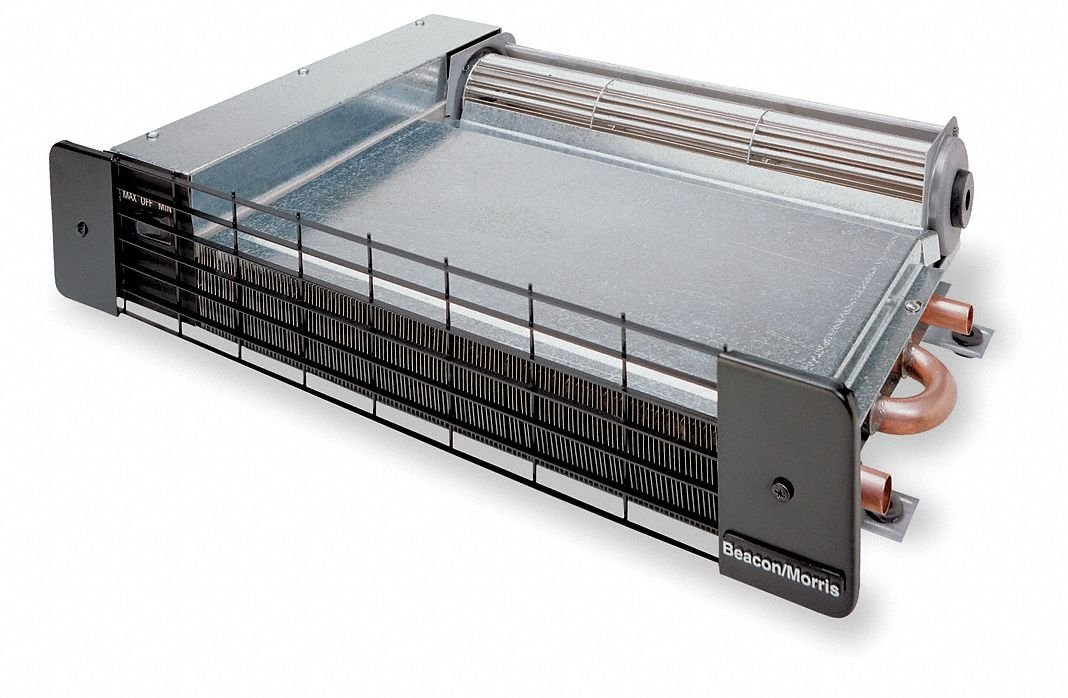
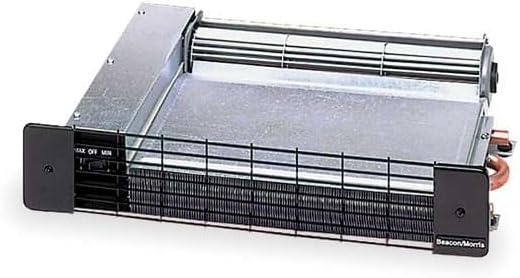
Beacon Morris is the more broadly distributed of the two brands in the U.S. residential and light-commercial market. The KS Series — their primary kickspace line — is available in multiple coil configurations, with the most commonly specified residential units ranging from roughly 7,500 to 14,000 BTU/hr at 180°F EWT and 1.0 GPM, per the Beacon Morris Product Data Sheet, KS and KickSpace Series, 2024 edition.
What Beacon Morris does well is publish multi-point performance tables. Their data sheets include output at 140°F, 160°F, and 180°F EWT across their GPM range. This is genuinely useful for a contractor working with a mod-con system on a heating curve: you can look up 155°F EWT at 0.5 GPM and get a credible derated output figure rather than interpolating a straight line between two points.
H3: Beacon Morris — Airflow and Installation Geometry
On airflow, Beacon Morris rates their KS Series fan at approximately 85–100 CFM free-delivery depending on unit size. The operative phrase is “free-delivery” — meaning no external static pressure on the discharge. Real installations, especially units tucked into tight under-cabinet cavities with restricted front grille clearance, will see reduced airflow. Plumbing & HVAC, in a 2022 article titled “Sizing Kickspace Heaters in Multi-Zone Hydronic Systems,” noted that field-installed units in fully enclosed toe-kick spaces commonly see effective airflow 15–25% below free-delivery ratings. For a Beacon Morris KS running at 90 CFM free-delivery, that puts real-world delivery in the 67–76 CFM range in a tight install.
The honest tradeoff: Beacon Morris units tend to run louder at high fan speed than Twin-Flo in aggregated contractor feedback. The blower is serviceable — not disruptive in an active kitchen, but audible in a quiet bathroom. The flip side is that coil construction and fitting quality carry a strong reputation for long service life, which matters in a system where the kickspace unit may outlive two boiler replacements.
Hydronic
$400.79
In stock on Amazon
Check price on AmazonTwin-Flo III: Higher Airflow Claims, Fan Performance, and the CFM Reality Check
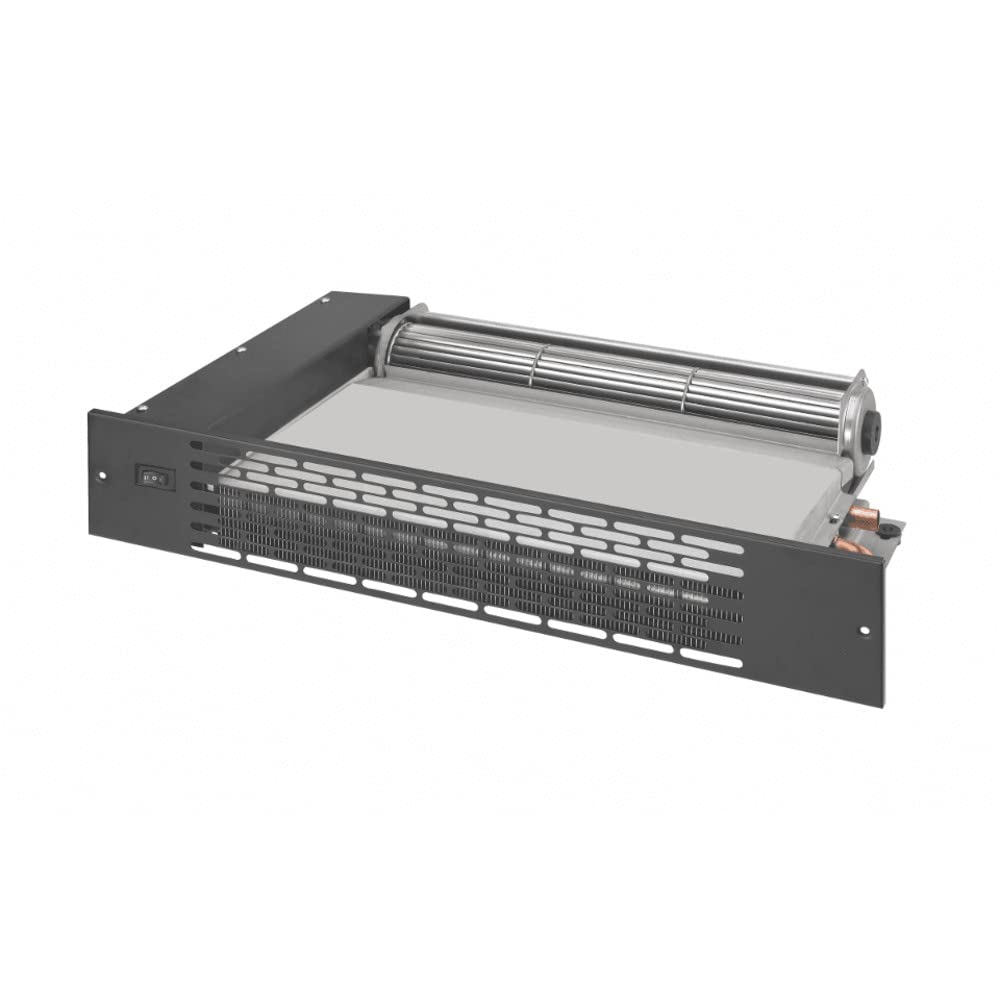
Twin-Flo, manufactured under the Mestek umbrella — the same parent company as Beacon Morris, worth knowing for distributor conversations — markets their Series III units with airflow figures that run higher than comparable Beacon Morris units. The Twin-Flo III Engineering Specifications, published by Mestek Inc. in their current catalog, list free-delivery airflow of 115–130 CFM for mid-range residential configurations.
Higher CFM is genuinely advantageous in the right application. More air across the coil means better heat transfer at the same water temperature — or equivalent heat transfer at a lower water temperature, which is the goal for a condensing boiler running a reset curve. Per the ASHRAE Handbook: HVAC Systems and Equipment, Chapter 33 guidance on fan coil selection, output is a function of both water-side delta-T and airflow; increase one and you partially compensate for a decrease in the other.
H3: Twin-Flo — Static Pressure Sensitivity and Geometry Risk
Here is the CFM reality check. Twin-Flo’s published airflow advantage is real at free-delivery. In restricted installations, however, their centrifugal blower design is more sensitive to external static pressure than the Beacon Morris axial-style fan arrangement. Contracting Business, in a 2023 article titled “Common Mistakes in Fan Coil Selection for Residential Hydronic Systems,” specifically flagged this pattern: contractors switching from one brand to the other without accounting for the difference in fan curve sensitivity occasionally find that a higher-rated Twin-Flo unit underperforms a lower-rated Beacon Morris in a particularly tight under-cabinet space.
The practical guidance from that analysis: if you have a relatively open toe-kick space — standard 3.5-inch height, clean front grille clearance, no sharp elbow on supply or return connections — the Twin-Flo’s airflow advantage translates to real BTU delivery. If the install is geometrically compromised, the advantage narrows or disappears.
Twin-Flo
$456.45
In stock on Amazon
Check price on AmazonH3: Side-by-Side Output at Three EWT Points
The table below compares approximate published output for a mid-range Beacon Morris KS unit and a comparably sized Twin-Flo III unit at three entering water temperatures. Figures are derived from the Beacon Morris Product Data Sheet, KS Series, 2024 edition, and the Twin-Flo III Engineering Specifications published by Mestek Inc. in their current catalog. Exact model-to-model comparisons require confirming coil row count and GPM at the specific SKU; use manufacturer derating tables, not nameplate BTU, for load calculations.
| Condition | Beacon Morris KS-2 (approx.) | Twin-Flo III Mid (approx.) | Notes |
|---|---|---|---|
| 180°F EWT, 1.0 GPM | ~10,500 BTU/hr | ~11,200 BTU/hr | Hydronic — $400.79 |
| 160°F EWT, 1.0 GPM | ~7,800 BTU/hr | ~8,400 BTU/hr | Hydronic — $400.79 |
| 140°F EWT, 1.0 GPM | ~5,200 BTU/hr | ~5,700 BTU/hr | Beacon — $347.11 |
The gap at 180°F is modest — about 7%. At 140°F the gap is similar in percentage but smaller in absolute BTU terms. The more meaningful variable at low supply temperatures is which system can reliably deliver that 140°F supply at actual design conditions, not which unit claims a slightly higher nameplate figure.
Hydronic
$400.79
In stock on Amazon
Check price on AmazonSizing, Zoning, and Where Kickspace Units Fit in a Multi-Zone System
A persistent mistake in kickspace sizing — flagged in the Contracting Business article cited above and reinforced in the Plumbing & HVAC analysis — is treating the kickspace unit as a primary heat emitter rather than a supplemental one. In a well-designed multi-zone hydronic system, the kickspace unit typically covers a small room (kitchen, bath, mudroom) where baseboard or radiant is geometrically impractical. The load for that room is usually in the 3,000–8,000 BTU/hr range on a residential design day.
That load range is well within what either Beacon Morris or Twin-Flo can handle at design conditions. The failure mode happens when the system’s supply temperature is lower than the design point — due to reset control, system undersizing, or zone-mixing errors — and the kickspace unit was sized at the 180°F nameplate figure. You end up with a room that is 4–6°F short of setpoint on the coldest days.
The fix is straightforward: size at the EWT you will actually run. If your boiler is a mod-con running 150°F supply at design-day load, use the 140°F or 160°F derating column, interpolate conservatively, and select accordingly. Both manufacturers publish enough derating data to do this honestly.
For multi-zone radiant or baseboard systems adding a kickspace unit to an existing zone, the GPM at the kickspace coil matters separately from the zone’s total flow. A 0.5 GPM starved coil in an undersized zone will perform well below the 1.0 GPM table entries. Installing a small zone circulator or balancing valve to ensure adequate flow through the kickspace coil is not optional on a system where the kickspace is carrying real heat load.
The If-X-Then-Y Decision Frame
After working through the published specifications, the contractor-pattern analysis in Contracting Business, and the ASHRAE fan coil guidance, the decision between Beacon Morris and Twin-Flo reduces to a short set of conditions.
H3: Open Installation, High Supply Temperature — Twin-Flo
If your install space is geometrically open — standard clearances, clean grille, no restricted supply or return connections — and your system runs at or near 180°F supply, Twin-Flo’s airflow advantage is real. The higher CFM free-delivery translates to incremental BTU output, and in a well-ventilated space the fan curve sensitivity is not a liability. Specify the Twin-Flo III and confirm flow rate at the coil before closing the wall.
Twin-Flo
$456.45
In stock on Amazon
Check price on AmazonH3: Tight Installation or Uncertain Geometry — Beacon Morris
If your install is tight — fully enclosed cabinet base, restricted front clearance, or elbow fittings close to the coil connections — the Beacon Morris KS Series is the lower-risk call. Its axial fan is less sensitive to external static pressure restrictions, and the multi-point derating tables make it straightforward to verify performance at your actual operating conditions. Beacon Morris’s distributor network also tends to mean shorter lead times for standard residential SKUs, which matters when a customer is without heat.
Hydronic
$400.79
In stock on Amazon
Check price on AmazonH3: Low-Temperature Systems — Size Both Brands at the 140°F Column
If you are working on a mod-con or condensing boiler system running reset curves below 160°F supply, neither unit’s nameplate BTU is your sizing figure. Size both brands at the 140°F derating column, select the unit that covers the derated load with 10–15% margin, and confirm GPM at the coil separately. As noted in the ACHR News analysis of hydronic fan coil output at reduced entering water temperature, the BTU difference between the two brands at low supply temperatures narrows to the point where other factors — installation geometry, noise tolerance, distributor availability, and warranty terms — should drive the call.
One number neither manufacturer publishes directly, but which matters in practice: noise floor at high fan speed in a quiet space. Owners of both brands consistently note that high fan speed is audible in a bathroom at night. If the application is a bedroom-adjacent bath or a home-office kitchenette, specify the next size up in coil output and run the fan at medium speed. You will get equivalent BTU delivery with a materially quieter result — and that is a conversation worth having with the homeowner before the unit goes in the wall.
Beacon
$347.11
In stock on Amazon
Check price on Amazon