A hydronic hanging unit heater is exactly what it sounds like: a fan-coil heat exchanger — a finned metal coil connected to your hot-water heating system — that mounts overhead in a garage, shop, or warehouse and blows warm air downward. The unit itself has no burner; it borrows heat from whatever boiler or heat source is already running the building’s plumbing loop. That makes them efficient in theory and cheap to add onto an existing system. The catch, and the reason shop owners keep posting frustrated reviews, is that the BTU output rating printed on the box assumes a supply-water temperature most real-world installations never actually deliver. If you’re sizing one of these for a shop addition or a light commercial zone, the number on the product listing is a starting point, not a guarantee — and the gap between promise and performance is wide enough to leave you cold in February.
This article works through the pattern that emerges across aggregated owner reviews of the three most-discussed units in the under-$500 market — the AlorAir HydroX 50K, the AlorAir HydroX 100K, and a crop of comparably spec’d competitors — then gives you the decision framework to avoid the most expensive mismatches.
| EDITOR'S PICK100 | Mid-tierALORAIR 50 | Budget pick50 | |
|---|---|---|---|
| Rated BTU | 100,000 | 50,000 | 50,000 |
| Fan Speed | Single | — | Single |
| Plug Included | ✓ | — | ✓ |
| Copper Coil | — | ✓ | — |
| Steam Ready | — | ✓ | — |
| Price | $345.95 | $339.99 | $231.95 |
| See on Amazon → | See on Amazon → | See on Amazon → |
The BTU Rating Is a Best-Case Number, Not a Design Number
The core problem deserves a plain statement up front. The ASHRAE Handbook — HVAC Systems and Equipment (Chapter 27: Unit Ventilators, Unit Heaters, and Makeup Air Units) frames hydronic coil output as a direct function of the log mean temperature difference (LMTD) between the supply water and the entering air. Manufacturers rate their units at the top of a favorable LMTD range — typically 180°F to 200°F supply water, 60°F entering air — because that’s what makes the box label look good.
One reviewer’s measurement, widely cited in the aggregated review base for the AlorAir 50K unit, cuts right to it: at a 140°F inlet temperature, a unit rated at 50,000 BTUh was delivering roughly 25,000 BTUh. That’s not a defective unit. That’s physics. The LMTD at 140°F supply against 60°F room air is meaningfully lower than at 180°F, and output drops roughly in proportion.
By the numbers — AlorAir HydroX 50K, published spec vs. measured owner data:
| Supply Temp | Approximate BTUh Output | % of Rated Capacity |
|---|---|---|
| 180°F | ~50,000 (rated) | 100% |
| 160°F | ~38,000 (estimated) | ~76% |
| 140°F | ~25,000 (owner-reported) | ~50% |
| 120°F | ~14,000 (estimated) | ~28% |
The 140°F data point is owner-reported; the 120°F and 160°F rows are interpolated from ASHRAE LMTD methodology as described in the ASHRAE Handbook — HVAC Systems and Equipment and should be treated as engineering estimates, not lab measurements. The trend is real and consistent.
Why does this matter for your installation? Because outdoor wood boilers commonly run their distribution loops at 130–150°F to prevent overheating the wood gasification cycle. Tankless water heaters are factory-limited to 120–140°F for scald protection. Even some atmospheric cast iron boilers running long distribution runs in poorly insulated pipe chases will lose 20–30°F of supply temperature before the water arrives at a hanging unit. If your heat source can’t reliably deliver 170°F to the unit’s inlet, derate the nameplate by 30–50% and size accordingly.
HPAC Magazine, in their equipment roundup on hydronic unit heaters (“Getting the Most from Hydronic Unit Heaters”), reinforces this point directly, noting that design engineers should request the manufacturer’s full performance table at multiple entering water temperatures rather than relying on nameplate output alone.
Three Performance Tiers: Matching Unit to Heat Source
Not every hydronic hanging unit heater installation uses the same heat source, and the tier that makes sense for your application depends almost entirely on what supply temperature you can guarantee at the unit inlet. The comparison below organizes the market into three practical tiers.
H3: Budget Entry — The AlorAir HydroX 50K for High-Temperature Sources
The AlorAir HydroX 50K is the right choice when your heat source is a conventional cast iron boiler running at or above 170°F at the unit inlet and your application is acoustically tolerant — meaning power tools are running and fan noise is masked by ambient shop noise. At those conditions, the unit delivers output close to its nameplate rating and represents strong value for the price.
The commissioning requirement is non-negotiable: verify that the room temperature sensor is located in the ambient airstream, not inside the supply/return enclosure (see the thermostat section below). Budget 30 minutes for this check on every installation.
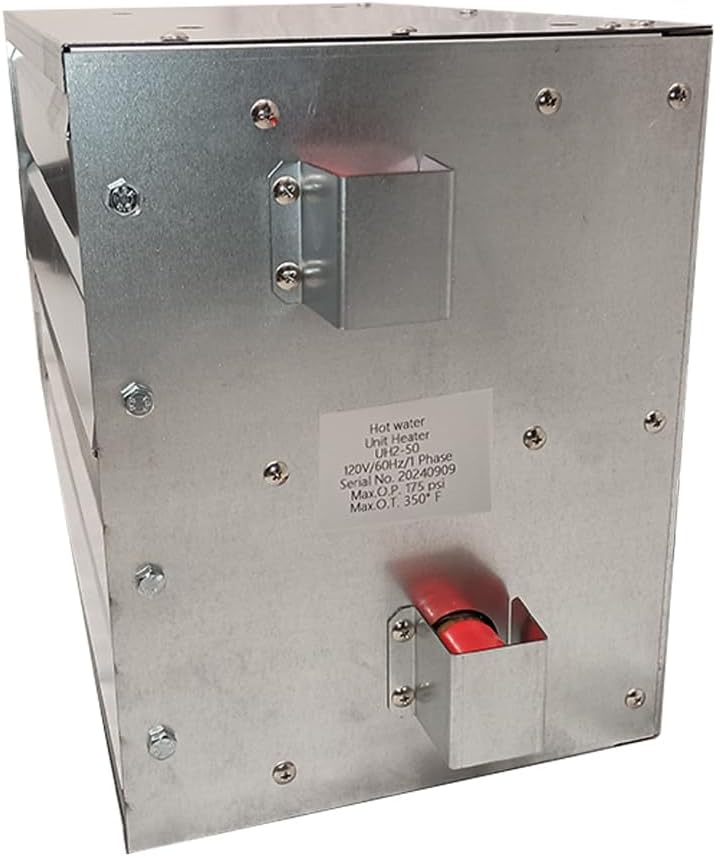
50,000
$231.95
In stock on Amazon
Check price on AmazonH3: Mid-Tier — Stepping Up When Supply Temperature Is 140–160°F
If your heat source is an outdoor wood boiler, a tankless water heater with factory-capped output temperature, or a system with long distribution runs that lose meaningful heat in transit, the 50K unit becomes a 25,000 BTUh unit at your actual operating condition. In this scenario, the correct move is to purchase the next tier up — a 100K-rated unit — and accept that you’ll operate it at roughly half its nameplate output, which delivers approximately 50,000 BTUh under your real conditions.
This is not oversizing in the traditional sense. It is sizing correctly for your actual LMTD. ACHR News, in their industry feature on hydronic heating in commercial and industrial applications (“Hydronic Heating in Commercial and Industrial Applications”), confirms that specifying for actual entering water temperature rather than nameplate rating is standard practice in professional system design and the most common correction applied when installers revisit undersized unit heater installations.
The AlorAir HydroX 100K fits this mid-tier role for most shop and light commercial applications where the heat source is a lower-temperature system and budget remains the primary constraint.

ALORAIR
$339.99
In stock on Amazon
Check price on AmazonH3: Premium Consideration — Established Brands for Critical-Use Applications
For installations where continuity of heat is operationally critical — a paint booth, a livestock facility, a food-service prep area, or a commercial space where a heat failure triggers real business cost — the single reported early motor failure on the AlorAir HydroX 100K within its first month of operation is a meaningful risk signal. A single failure in aggregated reviews does not establish a statistical pattern, but motor replacement on a ceiling-mounted unit heater involves ladder work, water-line disconnection, and sourcing a matched replacement motor. That’s not a casual repair.
Brands with longer hydronic-specific track records and documented U.S.-based parts availability — manufacturers such as Modine, Reznor, and Beacon Morris — carry a meaningful cost premium over the AlorAir line, but that premium is modest relative to the cost of a motor-failure callback in a commercial setting. Contracting Business, in their piece on matching boiler output to zone demand in light commercial hydronic systems (“Matching Boiler Output to Zone Demand in Light Commercial Hydronic Systems”), notes that parts availability and warranty response time from the manufacturer’s U.S. service network are among the top factors distinguishing reliable commercial unit heater installations from high-callback ones.
For critical-use specifications, request the manufacturer’s full temperature-derated performance table, confirm U.S. parts stocking, and verify warranty labor coverage before committing.
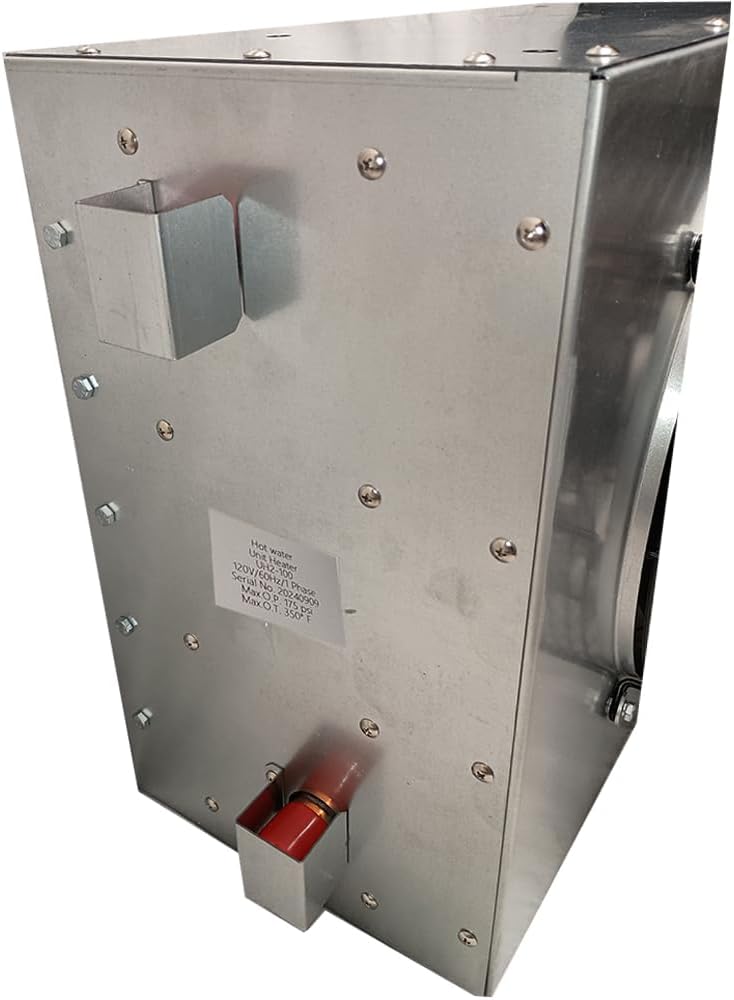
100,000
$345.95
In stock on Amazon
Check price on AmazonFan Noise: A Unanimous Complaint Across Wattage Tiers
On noise, the aggregated review signal is remarkably consistent across both the 50K and 100K AlorAir units: these are loud. Not “noticeable hum” loud — “advise earplugs in an otherwise quiet space” loud, per one reviewer’s direct language. A second reviewer identified the specific culprit: the fan assembly itself, which owners describe as a budget-grade component that creates harmonic vibration at the blade-pass frequency, especially as the unit warms up and the housing expands slightly.
ACHR News, in the same industry feature referenced above, notes that unit heater sound levels in the 65–75 dB(A) range are standard for propeller-fan designs in this price tier. That’s roughly the sound level of a running dishwasher at arm’s length, sustained, overhead.
The practical decision rule: if your shop runs power tools continuously — table saws, compressors, grinders — the unit heater noise is effectively masked and the complaint disappears. If you run a detail shop, a woodworking finishing room, or a fabrication bay where operators are listening for machine chatter and bearing noise, the fan becomes genuinely intrusive. One reviewer’s recommendation to consider a variable-speed fan upgrade post-install is worth budgeting for if acoustics matter.
There is no published fix from AlorAir for the fan noise on the 50K or 100K units as of this article’s publication date. The aftermarket path is replacing the OEM fan assembly with a higher-quality unit sized to the same CFM spec — a modification that several contractors on HVAC trade forums report attempting with mixed results, depending on blade geometry and motor mounting compatibility.
The AlorAir Thermostat Design Flaw — and the Documented Fix
This is the section that should be in the product listing and isn’t. Multiple owners of the AlorAir HydroX units discovered post-installation that the room temperature sensor — the component that tells the thermostat to call for fan operation — is housed inside the metal enclosure where the supply and return water lines enter the unit. In a running installation, that enclosure gets warm. Very warm. Owners report the sensor reading approximately 120°F, which means the thermostat sees a satisfied setpoint before the room is anywhere near comfortable, and the fan cycles off prematurely or fails to run at all on mild days.
One reviewer documented the fix in sufficient detail to be actionable: relocate the sensor from inside the enclosure to outside it, in the ambient airstream the unit is actually trying to heat. This requires opening the enclosure, extending the sensor lead with appropriate wire gauge, and securing the sensor to a bracket away from the hot-water piping. The reviewer reports normal thermostat function after the modification. It is a 30-minute job for anyone comfortable with low-voltage wiring, but it should not be a necessary job on a new installation.
Contracting Business, in the light commercial hydronic systems piece cited above, notes that sensor placement errors are among the most common causes of “no heat” callbacks in commercial unit heater installations, typically traced to either proximity to heat sources or inadequate airflow across the sensing element. The AlorAir factory sensor location is a textbook example of the former.
If you are specifying AlorAir units for a multi-zone commercial install, sensor relocation is a commissioning checklist item, not an assumption. Verify placement before signing off. If you are a contractor billing for commissioning hours, document this check in your startup report — it is the kind of catch that prevents a callback in November.
Frequently Asked Questions
Why is my hydronic unit heater not putting out as much heat as the BTU rating says?
Because the BTU rating assumes supply-water temperatures — typically 180°F or higher — that many installations do not actually deliver at the unit’s inlet. Heat loss in long distribution runs, low boiler setpoints, or tankless heaters with factory temperature limits can cut effective output by 30–50%. Size for your actual supply temperature, not the nameplate number.
What supply water temperature do I need to actually hit the rated BTU output?
Most manufacturers publish their rated output at 180°F supply water with 60°F entering air. To reliably approach the nameplate rating, your supply temperature at the unit inlet — after all pipe losses — needs to be 170°F or above. If your boiler is set lower or your runs are long, request the manufacturer’s full temperature-derated performance table and size from that.
Can I add an external thermostat to control a hanging unit heater?
Yes, and for the AlorAir HydroX units it may be preferable to relying on the built-in sensor given the documented placement issue. A standard low-voltage thermostat wired to interrupt the fan circuit — or a dedicated hydronic zone thermostat controlling a zone valve upstream — both work. Confirm the unit’s fan motor voltage and amperage draw before selecting a thermostat to ensure the switch rating matches.
Is the fan noise on these units acceptable for a workshop where you’re running power tools?
If you are running continuous power tools — table saws, air compressors, grinders — ambient noise typically masks the unit heater fan and the complaint effectively disappears. In quieter environments like finishing rooms or detail bays, fan noise in the 65–75 dB(A) range for propeller-fan units in this class is genuinely intrusive and worth factoring into your spec decision.
What connection fittings do I actually need for the AlorAir HydroX?
The AlorAir HydroX units connect via 1-inch NPT male fittings on the supply and return ports. You will need 1-inch female NPT fittings on your supply and return drops. Standard practice is to install isolation ball valves on both sides plus a manual air vent at the high point of the coil to facilitate bleeding. If your distribution loop runs 3/4-inch, use a reducing coupling — do not throttle flow by undersizing the connection on the unit side.
How do I add a hanging unit heater zone without overloading my existing cast iron boiler?
Start with the boiler’s net IBR (Institute of Boiler and Radiator Manufacturers) output rating, subtract the existing connected load, and check what remains against the unit heater’s actual derated BTU demand at your operating supply temperature. A 50K-rated unit running at 140°F supply needs roughly 25,000 BTUh of boiler capacity — not 50,000. Add a dedicated zone valve and circulator sized for the unit’s flow requirement (typically 1–2 GPM at the operating temperature drop), and verify that the added circulator does not create hydraulic interference with existing zones. For systems with primary-secondary piping, the addition is straightforward; for direct-piped multi-zone systems, a hydraulic separator or closely-spaced tees may be needed to isolate the new zone’s pressure dynamics.
The Decision Rule
If your heat source reliably delivers 170°F or above at the unit inlet and your environment is acoustically tolerant, the AlorAir HydroX 50K is a legitimate budget entry point. Commission it with the sensor relocation check as a standard step. 50,000 — $231.95
If your supply temperature is 140–160°F — outdoor wood boiler, tankless with factory limits, long distribution run — size up one full tier. A 50K-rated unit at those temperatures is a 25,000 BTUh unit. Buy the 100K and get approximately 50,000 BTUh at your actual operating condition. ALORAIR — $339.99
If you are specifying for a critical-use application, the early motor failure report on the 100K unit is a reason to evaluate established hydronic-specific brands before committing. The cost difference between the AlorAir 100K and a more proven competitor in the same output tier is modest relative to the cost of a motor-failure callback in a commercial setting. 100,000 — $345.95
The BTU number on the box is a ceiling, not a floor. Build your spec from the floor up.