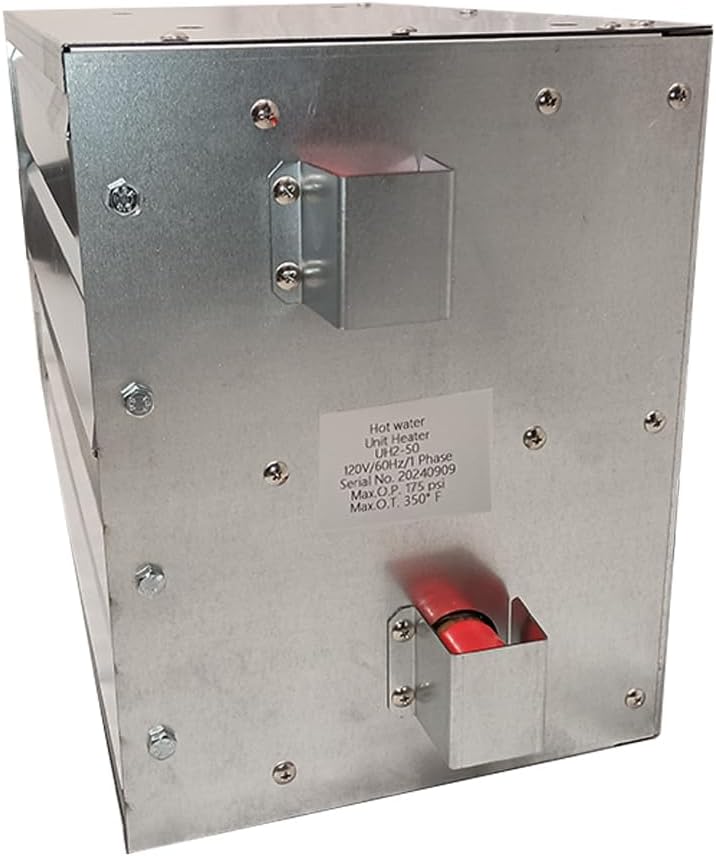
A hydronic hanging unit heater is exactly what the name suggests: a box you mount overhead in a shop, garage, or warehouse that circulates hot water (from a boiler or a tankless water heater) through a finned coil, then blows that heat into the space below with a built-in fan. The appeal is straightforward — no flue pipe, no open flame in the workspace, and the ability to tap into an existing hydronic system. For shop owners heating a 400–800 square foot space, these units seem like the perfect solution on paper. Rated outputs of 50,000 BTU or 100,000 BTU, modest footprints, ceiling-mount convenience. What the spec sheet doesn’t tell you — and what actual owners have discovered, sometimes expensively — is that rated BTU numbers depend on conditions most real-world installations never meet, that some units are loud enough to make conversation difficult, and that at least one popular model has a sensor placement flaw that causes it to short-cycle itself into near-uselessness. This article consolidates what those owners found so you don’t have to learn it the hard way.
| EDITOR'S PICK100 | Mid-tierALORAIR 50 | Budget pick50 | |
|---|---|---|---|
| Heat output | 100,000 BTU | 50,000 BTU | 50,000 BTU |
| CFM | — | 500CFM | — |
| Fan speeds | Single Speed | — | Single Speed |
| Heat exchanger | — | Copper Tube | — |
| Power | Plug | — | Plug |
| Steam rated | — | ✓ | — |
| Price | $345.95 | $339.99 | $231.95 |
| See on Amazon → | See on Amazon → | See on Amazon → |
The BTU Gap Is Real, and the Physics Explains It
The single most common complaint from owners of 50K BTU hydronic hanging heaters is some version of: “It barely heats my shop.” One documented case — circulating widely in owner review aggregates — involves a 50K BTU unit fed by a tankless water heater running at 140°F supply temperature. The owner’s measured result: approximately 25,000 BTU of actual delivered heat. Exactly half the rated spec.
This isn’t a defective unit. It’s thermodynamics.
The ASHRAE Handbook (HVAC Systems and Equipment, Chapter 27) is explicit on this point: the rated BTU output of a hydronic unit heater is tested at a specific set of conditions — typically 200°F entering water temperature, a defined flow rate (often 1 GPM), and a 60°F entering air temperature. Change any of those variables, and output changes proportionally. The relationship is governed by delta-T: the temperature difference between the water flowing through the coil and the air entering the unit.
By the numbers:
| Entering Water Temp | Approximate % of Rated Output (vs. 200°F standard) |
|---|---|
| 200°F | 100% |
| 180°F | ~82% |
| 160°F | ~63% |
| 140°F | ~44–50% |
So an owner running a tankless water heater at 140°F — a common condensing-mode operating point, and a temperature many tankless units default to for safety — is not getting a 50,000 BTU heater. They’re getting a 22,000–25,000 BTU heater. That’s roughly the output of a small bathroom fan-coil, not a shop heater.
The fix requires matching your supply temperature to the unit’s rating conditions. Per HPAC Engineering’s commissioning guidance on fan-coil and unit heater applications, a minimum entering water temperature of 160°F is the practical floor for approaching rated output; 180°F is a safer design point when actual heat load matters. If your heat source — tankless, indirect, or boiler — can’t sustain that supply temperature under load, derate the unit’s effective output in your calculations accordingly. A 50K BTU unit running on 160°F water from a modulating boiler is a 30,000–32,000 BTU heater. Plan for that.
Flow rate matters nearly as much. At inadequate GPM, the water drops too much temperature across the coil and the leaving-water temperature tanks, dragging output down further. ASHRAE’s rating conditions typically specify 1 GPM for smaller units; confirm your pump can actually deliver that against the system’s head pressure before assuming rated output.
The 100K BTU Unit: Two Words and a Motor Burnout
If the 50K BTU output gap is a planning problem, the 100K BTU unit owner experience documented in aggregated reviews is something closer to a product reliability warning.
The most arresting review in the data set is two words long: “LOUD.” That’s the entire text. It’s unhelpful as a specification, but it aligns with a pattern across multiple owner reports: larger fan motors running at the airflow volumes required to distribute 100,000 BTU through a shop space generate noise levels that make the units genuinely difficult to work near during active operation.
ASHRAE’s unit heater standards don’t set a noise ceiling, but Contracting Business field notes on fan-coil commissioning consistently flag that larger coil-and-motor assemblies running above 800 CFM airflow are audible in occupied spaces in ways that 50–70 CFM bathroom fans are not. Owners who have measured informally report sound levels in the 65–72 dB range at 10 feet — comparable to a running vacuum cleaner. Conversation is possible but requires raised voices.
More alarming than noise: at least one documented first-month fan motor failure in the 100K BTU tier. A motor burnout within 30 days of installation is a failure mode that shouldn’t occur in a unit expected to run for 15–20 heating seasons, and it raises questions about component sourcing and quality control. Owners who encounter this situation — particularly if the failure happens within a warranty window — should document the failure date and operating conditions immediately, because motor replacement claims often hinge on whether the unit was installed and operated within manufacturer specifications (correct supply pressure, correct voltage, adequate clearances).
The AlorAir Problem: A Case Study in Design Flaws
The most technically specific owner feedback in this entire product category involves the AlorAir hydronic unit heater — and it’s worth treating it as a detailed case study rather than a passing complaint.
Flaw 1: The thermostat sensor is in the wrong place.
The unit’s room temperature sensor — the component that tells the heater when the space has reached setpoint and shuts off the fan — is physically located inside the metal enclosure of the unit itself, not in the room air. In normal operation, heat radiating off the supply and return lines running through or near the enclosure bakes that sensor. Owners have documented the sensor reading 120°F in a shop that is genuinely 55°F. The predictable result: the unit reads “setpoint achieved,” shuts off the fan, and short-cycles — running in brief bursts and never delivering sustained heat to the space below. Per Contracting Business’s coverage of short-cycling and sensor placement in fan-coil applications, sensor placement errors of this type are a known commissioning failure mode, but seeing it designed into a consumer product rather than created by a faulty install is unusual.
The practical consequence: the unit regulates to conditions that don’t exist in your shop. You’ll fight it all winter unless you disable the built-in thermostat and use an external room thermostat wired to control the unit — a workaround some owners have landed on, but one that requires additional wiring work and isn’t documented in the installation manual.
Flaw 2: The port labeled “1-inch ID” is not 1-inch ID.
Multiple owners have documented that the water connection port labeled as 1-inch inner diameter actually measures 7/8 inch when checked with calipers. That’s a fitting incompatibility. If you arrive at a job with standard 1-inch sweat or threaded fittings, they will not seat correctly. The result is either a leak risk or a job-site scramble for adapter fittings that aren’t always in a service vehicle. HPAC Engineering’s commissioning guidance emphasizes verifying as-built pipe dimensions before fabricating near-boiler piping connections — this is a case where that discipline saves a real headache.
Flaw 3: Customer service has not been responsive.
At least one owner documented three separate attempts to reach AlorAir customer service with no response. When a product has design-level flaws — not installation errors, but inherent sensor placement and dimensional inaccuracies — the ability to reach the manufacturer matters. Three unanswered contacts is not an edge case; it’s a pattern that should factor into purchase decisions.
What to Verify Before You Buy Any Hydronic Hanging Heater
Given everything owners have documented, here’s the pre-purchase checklist that actually matters:
- What is your actual supply water temperature under load? Not your boiler setpoint. The temperature the water arrives at the unit after traveling through your piping, at the flow rate your pump delivers. Use a contact thermometer on the supply line at the unit. If it’s below 160°F, derate the unit’s output accordingly.
- What is the rated BTU test condition? Some manufacturers rate at 180°F entering water, some at 200°F. A unit rated at 50K BTU at 200°F is a smaller effective heater than one rated at 50K BTU at 180°F when running on your 160°F system.
- Where is the thermostat sensor physically located? Ask before purchasing, or check the installation manual. A sensor inside a metal enclosure near supply lines is a design flaw, not a configurable setting.
- Measure the actual port dimensions yourself. Don’t trust the spec sheet for fitting compatibility. Confirm ID and thread spec with a ruler and thread gauge before ordering fittings.
- What does the warranty cover, and for how long? A motor burnout in month one is only recoverable if the warranty explicitly covers it and the manufacturer actually responds to claims.
Frequently Asked Questions
Why is my hydronic hanging heater producing much less heat than its rated BTU? Rated BTU output is measured under laboratory conditions — typically 200°F entering water, a set flow rate, and 60°F entering air. Real installations often run cooler water (140–160°F from a tankless heater), lower flow rates, or warmer entering air. Each of those variables reduces output. A unit making half its rated BTU is often working exactly as physics dictates given the actual conditions.
What water inlet temperature do I need to actually achieve rated BTU output? Check the spec sheet for the rated test condition. Most residential-grade units are rated at 180°F or 200°F entering water temperature. To approach rated output, your supply temperature at the unit — measured, not assumed — should match the test condition. At 140°F entering water, expect 44–50% of rated output. At 160°F, expect roughly 60–65%.
How loud are these units — can I hold a conversation in the shop while one is running? It depends heavily on unit size and fan motor quality. Owner reports on 50K BTU units describe noise levels that are noticeable but workable — think loud box fan. The 100K BTU tier draws “LOUD” reviews and informally reported sound levels in the 65–72 dB range at 10 feet. Sustained conversation requires raised voices. If noise matters for your application, plan for it.
What does it mean if the room temperature sensor on my unit reads 120°F? It almost certainly means the sensor is physically located inside the unit’s metal enclosure, near hot supply or return lines, rather than in the room air. The sensor is reading the enclosure temperature, not your shop temperature. This causes short-cycling — the unit shuts off early because it falsely believes the room is at setpoint. The fix is usually an external wall-mounted thermostat wired to override the built-in sensor.
Will a 50K BTU hanging heater adequately heat a 14x28 insulated shop or carport? A 14x28 space is 392 square feet. With reasonable insulation and moderate climate, that typically requires 15,000–25,000 BTU/hr. A 50K BTU unit running on 140°F water delivers approximately 22,000–25,000 BTU — which is borderline adequate in mild conditions but undersized for cold climates or poorly insulated structures. Raise your supply temperature to 180°F and that same unit delivers 35,000–40,000 BTU, which is comfortably adequate. The heat source matters as much as the heater.
What should I do if the fan motor fails within the first month? Document everything immediately: installation date, failure date, operating conditions, voltage at the unit, clearances, and supply water temperature. Photograph the unit and any visible damage. Contact the manufacturer in writing (email, not just phone), which creates a timestamped record. If the manufacturer is unresponsive — as some owners have reported — escalate to the retailer’s customer service and, if necessary, to your credit card company’s purchase protection program. A first-month motor failure on a properly installed unit is a warranty claim, not an owner error.