A hydronic hanging unit heater is exactly what it sounds like: a metal box suspended from the ceiling of a garage, shop, or warehouse that contains a finned hot-water coil and a fan. Hot water from your boiler or water heater circulates through the coil; the fan blows room air across it and pushes warmth into the space. Think of it as a large, industrial version of a car’s heater core. The appeal is real — no combustion inside the conditioned space, relatively low maintenance, and the ability to tap an existing hydronic system. But owner reviews in the 50,000 and 100,000 BTU classes tell a more complicated story: nameplate output numbers are often aspirational rather than operational, fan noise can be punishing, and at least one popular model has a sensor design flaw that undermines thermostat accuracy. This article pulls apart what aggregated owner reports actually show across three performance tiers, so you can size the unit correctly, set inlet temperature expectations before the purchase order goes in, and avoid the most common commissioning surprises.
| EDITOR'S PICK100 | Mid-tierALORAIR 50 | Budget pick50 | |
|---|---|---|---|
| Heat Output | 100,000 BTU | 50,000 BTU | 50,000 BTU |
| Heat Exchanger | — | Copper Tube | — |
| Connection Types | — | Multiple | — |
| Fan Speed | Single Speed | — | Single Speed |
| Power Cord | w/Plug | — | w/Plug |
| Blower Output | — | 500CFM | — |
| Price | $345.95 | $339.99 | $231.95 |
| See on Amazon → | See on Amazon → | See on Amazon → |
The BTU Gap: Why Rated Output and Delivered Output Aren’t the Same Number
The single most consistent finding across owner reviews of 50K and 100K BTU hanging unit heaters is that measured heat delivery falls well short of the nameplate rating — sometimes by half. One owner running a 50,000 BTU unit off a tankless water heater at 140°F measured approximately 25,000 BTUh of delivered output and reported that even reaching 55°F in the target space took far longer than expected.
This is not a defect. It is a rating-condition mismatch, and understanding it is foundational before you specify or purchase any hydronic unit heater.
The AHRI/Hydronics Institute Rating Standard for Unit Heaters, Standard 1340 governs unit heater output ratings and specifies a test condition of 200°F entering water temperature (EWT) and a 60°F entering air temperature (EAT). Most residential and light-commercial hydronic systems — and virtually all tankless water heater setups used as heat sources — operate well below 200°F. A modern condensing boiler running a reset curve might deliver 140°F on the coldest days and 120°F in mild weather. A tankless water heater pressed into space-heating duty is typically capped around 140°F for safety and equipment reasons. As ACHR News has reported in coverage of tankless water heaters used as space-heating sources, capacity realities at those temperatures are significantly reduced compared to dedicated boiler plants.
The heat output of a finned coil is governed by the temperature differential between the water and the incoming air. Drop the entering water temperature from 200°F to 140°F against 60°F room air, and you have cut the driving delta from 140°F to 80°F — a 43% reduction in the thermal gradient. Output does not fall linearly with that delta, but the correction factor is severe. Published coil performance curves from manufacturers show that a unit rated at 50,000 BTU at 200°F EWT typically delivers 55–65% of that rating at 140°F EWT, depending on coil design and air-side configuration. That puts real-world output for a “50K BTU” unit closer to 27,500–32,500 BTUh under tankless-sourced conditions — consistent with the owner measurement of approximately 25,000 BTUh reported in aggregated reviews.
As Plumbing & HVAC has noted in coverage of hydronic coil applications, matching entering water temperature to the actual application load is the single most important sizing variable — more consequential than coil size or fan speed.
The practitioner takeaway: When sizing a hanging unit heater, always request the manufacturer’s performance table at your actual EWT, not the nameplate number. If the spec sheet doesn’t include a 140°F EWT column, request the engineering submittal data or apply the correction factor tables published in the ASHRAE Handbook, HVAC Systems and Equipment, Chapter 27: Unit Ventilators, Unit Heaters, and Makeup Air Units.
Comparing Units by Performance Tier: Budget, Mid-Tier, and Premium
The hydronic hanging unit heater market in the 50K–100K BTU range spans a wide spectrum of build quality, control sophistication, and real-world reliability. Owner reviews cluster into three recognizable tiers. Each is evaluated below against the same criteria: thermal output at real-world EWT, noise level, control accuracy, and plumbing interface quality.
H3: Budget-Tier Units — High Nameplate, Low Assurance
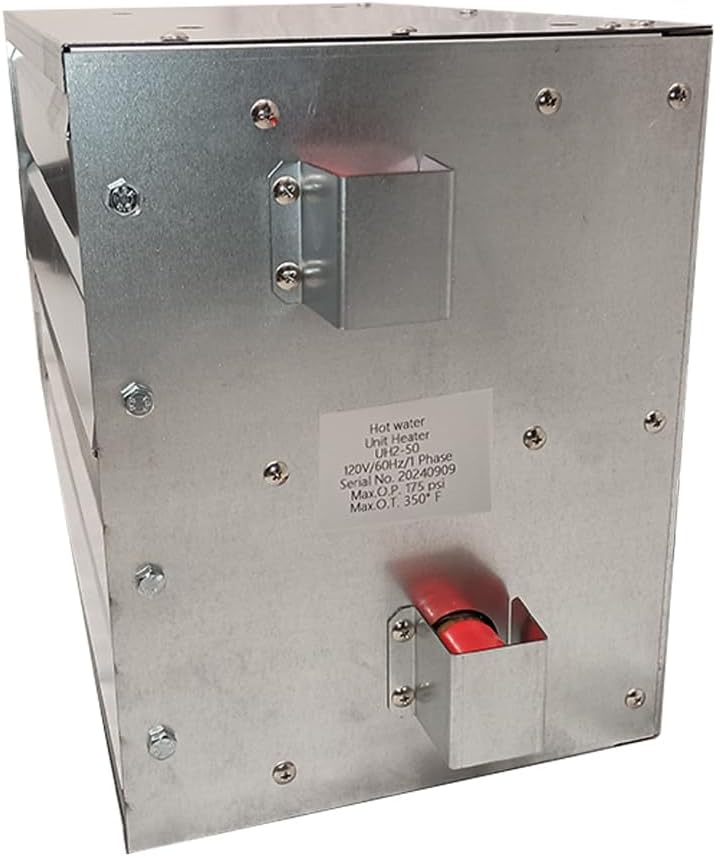
Budget-tier hydronic unit heaters typically arrive with attractive nameplate BTU figures, minimal engineering documentation, and control systems that are afterthoughts rather than engineered components. The AlorAir H50A is the most thoroughly reviewed example in this class.
Thermal output: When plumbed with adequate water temperature and flow, owner accounts credit the coil with meaningful heat delivery. The coil itself is not the primary failure point. The problem is that the unit’s built-in thermostat sensor is mounted inside the metal enclosure rather than sampling ambient room air. Because the enclosure absorbs radiant heat from the coil and traps warm air from the fan, the sensor reads significantly higher than actual room temperature — owners report readings as high as 120°F when the room is substantially cooler. The unit shuts off prematurely, convinced the space has reached setpoint when it hasn’t.
Noise: Consistent with budget construction; fan bearing quality varies by unit.
Plumbing interface: Multiple owner reports document that the advertised 1-inch port dimensions do not match actual fittings at rough-in, requiring adapters. For a mechanical contractor cutting a hydronic loop to exact lengths, a port-size discrepancy is a genuine irritant. Verify actual port dimensions before the job.
Contractor fix: Wiring in a remote thermostat with its sensor positioned in the room’s breathing zone, away from the unit’s heat plume, resolves the control problem. Standard low-voltage thermostat wiring — not a complex task, but an out-of-box shortcoming that adds cost and labor.
50,000
$231.95
In stock on Amazon
Check price on AmazonH3: Mid-Tier Units — Acceptable Noise, Honest Documentation
Mid-tier units in the 50K BTU class generally provide more complete engineering documentation, including performance tables at multiple entering water temperatures. Buyers who pull those tables before purchase avoid the output-surprise problem that plagues budget-tier buyers. Contractingbusiness.com coverage of hydronic unit heater sizing has emphasized that entering water temperature data at multiple set points — not just the 200°F AHRI condition — is the mark of a manufacturer that understands how its products are actually installed.
Thermal output: At 140°F EWT, expect 55–65% of nameplate. A unit labeled 50,000 BTU delivers approximately 27,500–32,500 BTUh under real-world conditions — adequate for a well-insulated two-car garage if sized accordingly from the start, not if the buyer assumed full nameplate delivery.
Noise: Noticeably quieter than budget-tier units running comparable airflow. Acceptable for a detached shop. Borderline for an attached garage with shared walls to living space.
Control accuracy: Mid-tier units in this class typically use wall-mounted thermostat connections rather than embedded sensors, eliminating the enclosure-heat contamination problem documented in the AlorAir H50A.
Plumbing interface: Standard 1-inch NPT ports that match common hydronic supply lines. No adapter surprises at rough-in.

ALORAIR
$339.99
In stock on Amazon
Check price on AmazonH3: Premium-Tier / Commercial-Grade Units — 100K BTU Class
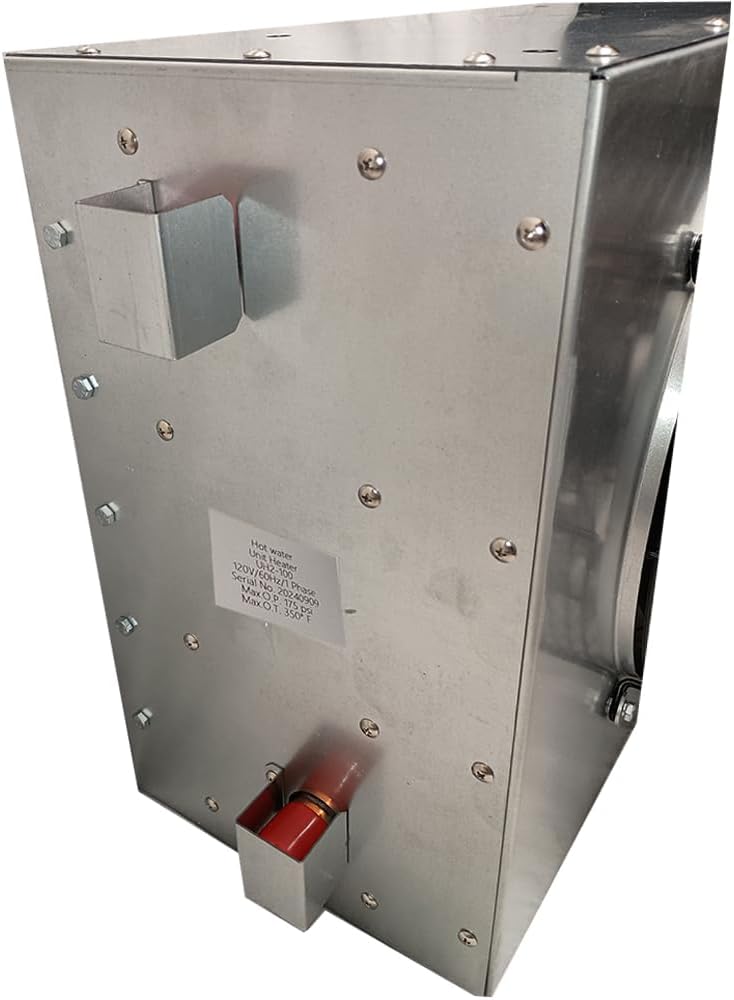
The 100K BTU class draws sharp owner criticism for fan noise, and the criticism is earned. A representative owner account describes the fan output as requiring hearing protection — not an exaggeration for units in this class running at full speed. Across aggregated owner reports, the pattern is consistent: buyers sourcing these units for attached garages or workshops adjacent to living space are frequently caught off guard by the sound level.
Thermal output: Premium commercial-grade units provide detailed performance tables and factory-certified output at multiple EWT conditions. At 180–200°F EWT from a properly operating boiler, these units earn their nameplate ratings. At 140°F EWT, the same 55–65% correction applies. A 100K BTU nameplate unit delivers approximately 55,000–65,000 BTUh at realistic tankless supply temperatures.
Noise: The engineering reason is straightforward: a 100K BTU coil requires high air-side flow to extract heat efficiently. At rated output conditions, these units move several hundred CFM of air across relatively dense fin arrays. The result is a combination of motor noise and high-velocity airflow noise characteristic of commercial-grade equipment. In a loud open shop with elevated ambient noise, owner reviews report the sound level as a non-issue. In an attached garage adjacent to a home office or bedroom, it is a serious constraint.
Motor reliability: A separate and more serious failure mode appeared in owner reviews of certain 100K BTU units: motor burnout within the first month of operation. Early motor failures almost always point to one of three causes — thermal overload from inadequate airflow clearance, supply voltage issues (low-voltage conditions stress motor windings), or a manufacturing defect in the motor or its run capacitor. Contractors should verify clearances match the installation manual exactly and measure supply voltage at the unit terminals under load, not only at the panel.
Plumbing interface: Commercial-grade units use standard ¾-inch or 1-inch NPT ports depending on BTU class. HPAC Engineering has covered the consequence of undersizing supply lines in fan coil and unit heater applications: a ¾-inch supply line feeding a 100K BTU unit at design flow generates enough velocity head loss to starve the coil and undercut output materially.
100,000
$345.95
In stock on Amazon
Check price on AmazonFrequently Asked Questions
What water temperature do I need to get close to the rated BTU output?
The nameplate rating assumes 200°F entering water temperature — a condition most residential boilers on an outdoor reset curve reach only on design-day conditions, and that tankless water heaters typically cannot reach at all. To achieve 80–90% of rated output, EWT must be in the 180–200°F range. At 140°F EWT, expect 55–65% of rated output. Always pull the manufacturer’s performance table at your actual operating temperature before sizing.
Why does my hanging unit heater blow cool air even when the boiler is running hot?
The most common causes, in rough order of frequency: (1) inadequate flow rate through the coil — water moving too fast to transfer heat, or too slowly to deliver enough BTUs per minute; (2) air trapped in the coil causing partial blockage; (3) a zone valve or check valve that is not fully open; (4) entering water temperature is lower than expected because the boiler is still warming up or the tankless unit cannot maintain setpoint under sustained load. Verify flow rate and EWT at the unit before assuming a coil defect.
Is the fan noise acceptable for an attached garage?
For most attached-garage applications with adjacency to living areas, the 100K BTU class is unsuitable without acoustic mitigation. The 50K BTU class is somewhat quieter but still louder than a residential forced-air air handler. If noise is a hard constraint, radiant in-floor heat or panel radiators will serve an attached garage far more quietly. In a detached shop or commercial bay with elevated ambient noise, the fan noise is reported as acceptable by the majority of owners.
What circulation pump flow rate do I need?
The standard hydronic design target is a 20°F temperature drop across the coil (supply to return). Using Q = BTU ÷ (500 × ΔT): a 50K BTU unit at full rated output requires approximately 5 GPM; a 100K BTU unit requires approximately 10 GPM. At reduced EWT and real-world output, those flow requirements drop proportionally. HPAC Engineering’s coverage of fan coil pump selection identifies undersizing the circulator — or undersizing the supply line — as a leading cause of underperformance in unit heater installations.
How do I fix the AlorAir H50A thermostat sensor problem?
Wire in a remote thermostat with its sensor positioned in the room’s breathing zone, away from the unit’s heat plume. The enclosure-mounted sensor reads localized heat from the coil housing — owners report readings as high as 120°F — rather than actual room air temperature, causing premature cutoff and chronic under-heating. A remote sensor in the correct location restores accurate control. This is a standard low-voltage wiring task for a service technician.
The Decision Frame: If X, Then Y
If your heat source is a tankless water heater or a condensing boiler on aggressive outdoor reset, size for 140°F EWT and multiply the nameplate by 0.60 before comparing to your heat loss calculation. A room that needs 50,000 BTUh of delivered heat requires roughly an 83,000 BTU nameplate unit under those supply conditions.
If your installation is an attached garage or any space with noise sensitivity, the 100K BTU class is likely unsuitable without acoustic mitigation. Step down in BTU class, raise water temperature, add a second smaller unit, or switch terminal device type.
If you are specifying the AlorAir H50A, budget for a remote thermostat and verify port dimensions at rough-in. The coil delivers heat when properly plumbed; the control interface and plumbing connections require contractor attention before the system performs as expected.
If your application is a loud open shop with a properly operating boiler delivering 180°F or higher water, the noise criticism largely disappears and these units earn their keep. Negative reviews cluster almost entirely around mismatched supply conditions and residential-adjacency noise sensitivity — not fundamental coil failure.