Every hydronic heating system — the kind where a cast iron boiler heats water that circulates through pipes to radiators or baseboard heaters — contains water that expands as it warms up. Cold water at 50°F takes up less space than the same water heated to 180°F; the difference is roughly 3–4% of total system volume. That extra volume has to go somewhere. An expansion tank — a small pressure vessel, usually the size of a soccer ball to a large watermelon, mounted near the boiler — absorbs that expansion using a pressurized air bladder. Size it too small and the system overpressurizes, the pressure relief valve opens, and you’re losing water every heating cycle. Size it correctly and the system runs quietly within its design pressure band for years. This guide walks through the sizing math and then compares the three brands contractors reach for most: Amtrol, Watts, and Bell & Gossett.
Why Expansion Tank Sizing Fails in Practice
Undersizing is the dominant failure mode, and it’s more common than it should be on replacement jobs. Installers sometimes swap a new tank in at the same nominal size as the old one without accounting for changes in system volume — added zones, longer pipe runs, a converted radiant slab — or without verifying that the pre-charge pressure matches the system’s fill pressure.
The core relationship to internalize: the tank’s acceptance volume (the actual space available to absorb expanded water) is not the same as the tank’s total volume. A 4.4-gallon tank pre-charged at 12 psi and installed on a system filled to 15 psi has very little acceptance volume available at startup. Raise the fill pressure to 20 psi without adjusting the pre-charge and the bladder is already compressed — your effective tank is now much smaller than the nameplate suggests.
Per John Siegenthaler’s Modern Hydronic Heating, third edition, the pre-charge pressure should equal the static fill pressure of the system at the tank’s location — typically the cold fill pressure set at the pressure-reducing valve (PRV), usually 12–15 psi for a two-story residence, higher for taller buildings. This is a commissioning step many installers skip on retrofit jobs, and it is the single most common root cause of nuisance PRV discharge callbacks in year one.
ACHR News, in its hydronic troubleshooting coverage, identifies expansion tank sizing errors and mismatched pre-charge as among the top-five callback drivers for residential hydronic contractors — ahead of circulator failures, behind only controls issues.
The Sizing Math: Walk Through It Once, Use It Every Time
The ASHRAE Handbook — HVAC Systems and Equipment provides the industry-standard formula for closed hydronic systems. You don’t need to memorize it, but you must understand the inputs.
Variables you must know before you spec the tank:
- Vs — System water volume in gallons (pipe volume + boiler water content + terminal unit volume)
- T_supply — Maximum supply water temperature (typically 180°F for cast iron baseboard, 140°F for radiant)
- P_fill — Cold fill pressure at the tank location (psi)
- P_max — Maximum allowable system pressure, typically the PRV setting minus a 5 psi safety margin (e.g., 25 psi on a 30 psi PRV)
A simplified working formula (drawn from Siegenthaler’s Modern Hydronic Heating, third edition, practical residential version):
V_tank = Vs × (e_f) / (1 − P_fill / P_max)
Where e_f is the expansion factor for water — approximately 0.034 for a system cycling between a 50°F fill temperature and 180°F supply temperature.
Quick-reference sizing table for common residential conditions:
| System Volume (gal) | Max Supply Temp | Fill / Max Pressure | Min Acceptance Volume | Typical Tank Size |
|---|---|---|---|---|
| 15 gal | 180°F | 12 / 25 psi | ~1.7 gal | 4.4 gal nominal |
| 30 gal | 180°F | 15 / 25 psi | ~4.1 gal | 7.6 gal nominal |
| 60 gal | 180°F | 15 / 30 psi | ~7.5 gal | 14–21 gal nominal |
| 100 gal | 140°F | 20 / 30 psi | ~8.2 gal | 14–21 gal nominal |
These figures represent minimum acceptance volumes, not tank total volumes. Always select a tank whose rated acceptance volume at your fill/max pressure pair meets or exceeds the calculated minimum — with at least a 10–15% margin to accommodate future zone additions.
Amtrol’s Extrol Sizing and Application Guide technical bulletin includes a printed sizing chart that makes this lookup fast once you have Vs and your pressure pair. Bell & Gossett’s expansion tank engineering bulletin provides a comparable nomograph. Both are worth obtaining from your distributor.
Brand Comparison: Amtrol vs. Watts vs. Bell & Gossett
These three brands cover the overwhelming majority of hydronic expansion tank installations in North America. Here is how to evaluate each for different project profiles.
Amtrol Extrol — The Default for a Reason
Amtrol’s Extrol line is the market reference point. The bladder-style design and color-coded sizing chart have made it the default spec on countless residential and light commercial jobs. Bladders are replaceable on larger commercial units; on residential sizes the tank is not field-serviceable, but longevity is well-documented across a large installed base.
What the spec sheets show: Extrol tanks ship pre-charged at 12 psi from the factory. The residential line runs from the Extrol 15 (2.0 gal total, approximately 0.5 gal acceptance at a 12/30 psi pressure pair) through the Extrol 90 (14.0 gal total) and into commercial sizes above that. The ASME-rated commercial Extrol SX series handles systems up to 125 psi.
Where Amtrol wins: Ubiquity. Supply houses across North America stock the full residential Extrol line with reliable same-day or next-day availability on common sizes. Field installers know the product; Amtrol’s sizing bulletin is the clearest in the category for less-experienced crews.
Where to be careful: The residential Extrol bladder is not replaceable. A failed bladder — most often caused by bladder separation from the shell, which destroys the air charge — means full unit replacement. In systems with aggressive water chemistry (low pH, high dissolved oxygen), bladder life can be shorter than expected. Per Amtrol’s Extrol Sizing and Application Guide technical bulletin, systems should be treated with an appropriate corrosion inhibitor protocol before the tank is placed in service. Water treatment is not optional here.
Decision rule: Residential or light commercial job, well-characterized system volume, single-zone or multi-zone baseboard system, need for the easiest sizing path and best parts availability.
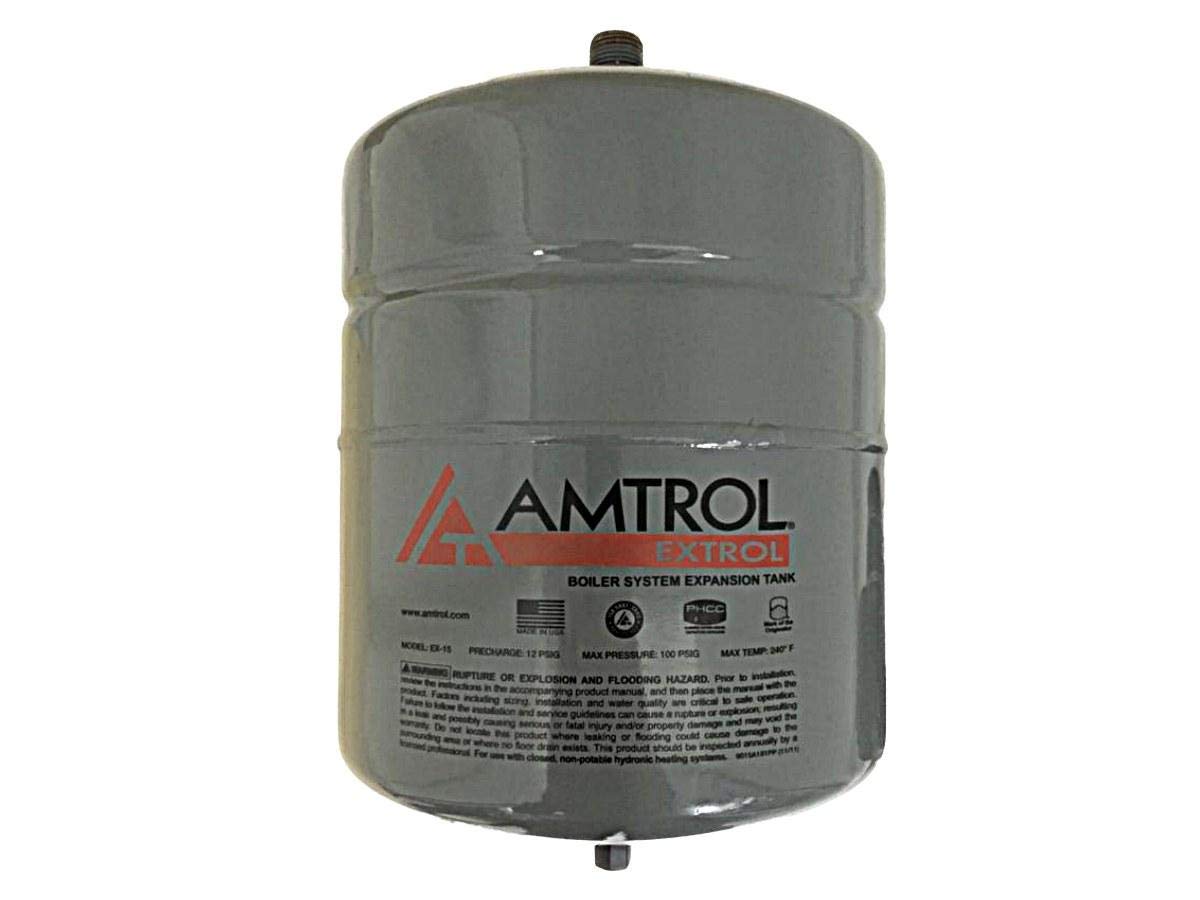
AMTROL
$59.99
In stock on Amazon
Check price on AmazonWatts PLT Series — The Value-Tier Contender with a Strong Warranty Story
Watts Water Technologies positions its PLT and PLT-LF (lead-free) expansion tanks as the value-competitive alternative to Amtrol, and the specification comparison largely holds up across the residential and light commercial range.
What the spec sheets show: Per Watts Water Technologies’ PLT/PLT-LF Series Expansion Tank Installation Instructions product document, the PLT series ships pre-charged at 12 psi and matches Amtrol size-for-size through the common residential range. The PLT-LF variant is NSF 61-certified — relevant in jurisdictions where lead-free components are required even on closed hydronic systems (requirements vary; verify against your local amendment to the International Plumbing Code). Watts lists a 5-year warranty on the PLT series, placing it on par with Amtrol’s residential warranty coverage.
Where Watts wins: Price. Across typical distributor pricing in the residential range, the PLT series runs 10–18% below comparable Amtrol Extrol sizes. On a multi-unit residential job involving 12–20 tank installations, that gap becomes meaningful in the bid. Watts also offers diaphragm-style options in the mid-commercial range. The PLT installation instructions, as noted in the Watts product document, include explicit pre-charge verification steps — a minor but useful detail for training junior technicians.
Where to be careful: Distributor depth on Watts expansion tanks is thinner than Amtrol at many local supply houses. For emergency same-day sourcing on a no-heat call in February, availability routinely beats price. The PLT line has a smaller documented long-term track record in residential hydronics simply because its installed base in that segment is less deep than Amtrol’s.
Decision rule: Multi-unit residential or light commercial bid, local distributor stocks the PLT line, price sensitivity is a real bid constraint, and same-day emergency sourcing is not an immediate concern.
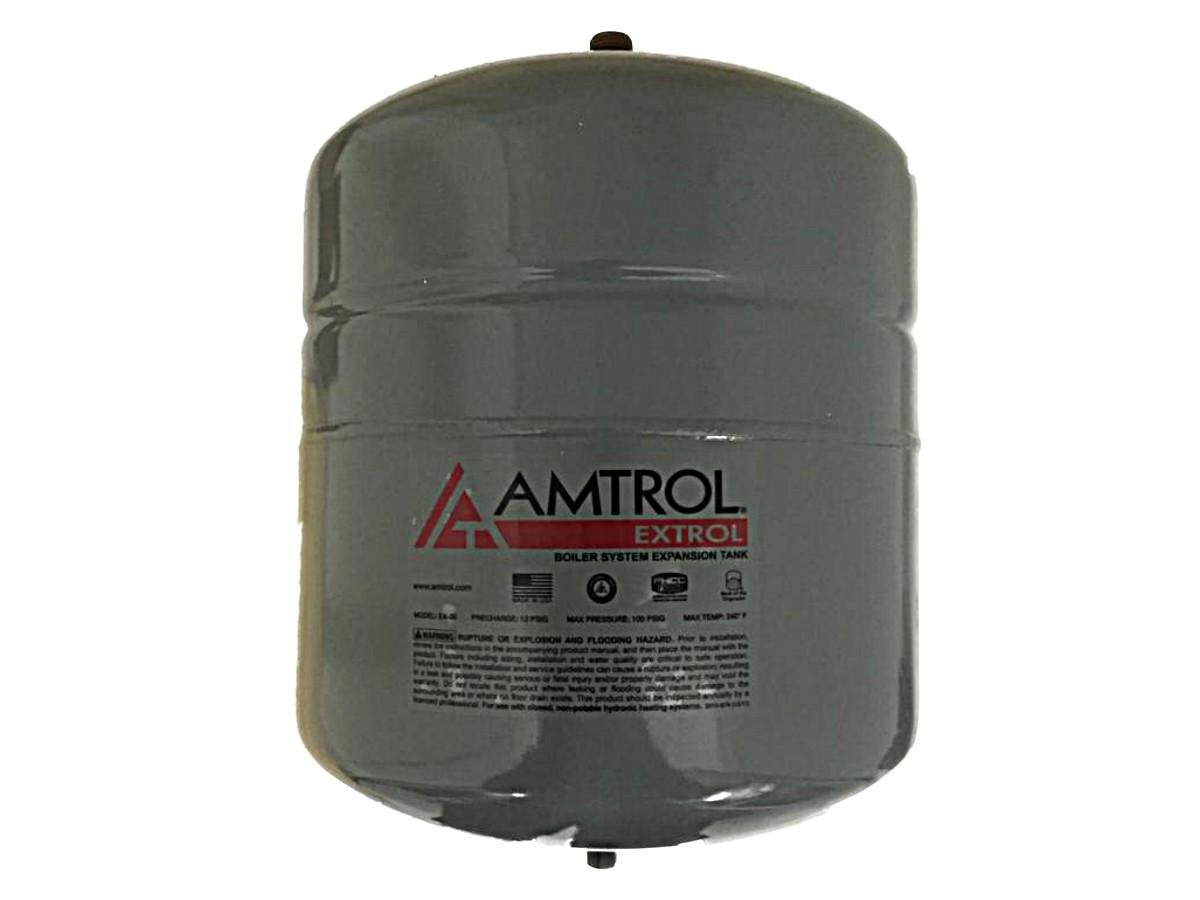
AMTROL
$71.25
In stock on Amazon
Check price on AmazonBell & Gossett Series HFT / Tank-Trol — The Engineering-Forward Spec for Commercial Projects
Bell & Gossett, a Xylem brand, occupies a different market position than Amtrol or Watts. It is the preferred specification when the expansion tank is one component in a fully engineered hydronic system — paired with Bell & Gossett circulators, air separators, and system-matched near-boiler piping. Mechanical engineers specifying commercial or institutional boiler installations frequently remain in the Bell & Gossett product ecosystem for all accessories.
What the spec sheets show: Per Bell & Gossett’s Expansion Tank Selection Guide engineering bulletin, the Tank-Trol and HFT series span a wide range from small residential through large commercial, with ASME construction on commercial sizes. Bell & Gossett’s sizing methodology uses the same ASHRAE Handbook — HVAC Systems and Equipment formula basis documented by Amtrol, but presents it in an engineering-oriented format that aligns naturally with mechanical engineer workflow rather than contractor-oriented chart lookup.
Where Bell & Gossett wins: Commercial and institutional projects where the tank is specified alongside other Bell & Gossett components. Single-source responsibility and coordinated system warranties carry real value to institutional building owners. For multi-zone radiant systems serving multi-family residential or light commercial buildings with system volumes in the 60–150+ gallon range, Bell & Gossett’s commercial product depth and engineering support resources are meaningful competitive advantages. Bell & Gossett’s technical literature is cited in ASHRAE Handbook — HVAC Systems and Equipment discussions of closed hydronic system design — an indicator of how deeply embedded the brand is in the engineering specification community.
Where to be careful: Bell & Gossett tanks carry a price premium in the residential and light commercial range — sometimes 20–30% above comparable Amtrol units. For a straightforward residential expansion tank replacement, that premium is difficult to justify unless the installation is already within the Bell & Gossett component ecosystem. SKU availability through broad-market distributors is more limited than Amtrol’s listing depth at comparable channels.
Decision rule: Commercial-scale job, fully engineered hydronic system, Bell & Gossett circulators and air handling components already specified. For residential-first jobs where the tank is a standalone decision, the Bell & Gossett premium is a harder sell.
Amtrol
$151.89
In stock on Amazon
Check price on AmazonThe Pre-Charge Step You Cannot Skip
Regardless of brand, the tank pre-charge must be verified and adjusted before installation — never assumed to be correct from the factory. Use a standard tire pressure gauge. With the system fully depressurized and the tank isolated from the system (or before initial connection), confirm that the air charge equals the system cold fill pressure. For a 15 psi fill system, the tank must read 15 psi on the air side before connection. If the factory charge is 12 psi and your fill pressure is 15 psi, add air before hanging the tank. This step takes under two minutes and prevents the most common year-one callback in residential hydronics.
Watts Water Technologies’ PLT/PLT-LF Series Expansion Tank Installation Instructions product document calls this step out explicitly. Amtrol’s Extrol Sizing and Application Guide technical bulletin likewise identifies pre-charge verification as a required installation step. Bell & Gossett’s Expansion Tank Selection Guide engineering bulletin frames it as part of formal commissioning documentation. All three manufacturers are aligned on this requirement. The disagreement in the field is between installers who perform it and installers who don’t.
ACHR News’ hydronic troubleshooting coverage has consistently flagged skipped pre-charge verification as a contributing factor in premature PRV discharge callbacks — one of the most avoidable service calls in residential hydronic work.
If X, Then Y — The Decision Matrix
- Residential replacement, single or multi-zone baseboard, standard sizing, same-day availability required: Amtrol Extrol. Default choice, lowest friction, deepest distributor coverage. AMTROL — $59.99
- Multi-unit residential or light commercial bid, distributor stocks Watts, price matters: Watts PLT. Legitimate value alternative — verify local stock depth before committing to the spec. AMTROL — $71.25
- Commercial or institutional project, fully engineered hydronic system, Bell & Gossett components already specified: Bell & Gossett HFT or Tank-Trol. Stay in the ecosystem, use Bell & Gossett’s engineering support for sizing. Amtrol — $151.89
- Any project, any brand: Verify pre-charge equals cold fill pressure before connection. Run the sizing math with actual measured system volume — do not match the old tank’s nameplate size. Build in 10–15% acceptance volume margin for future zone additions.
The expansion tank is a $50–$300 part protecting a $3,000–$20,000 boiler installation. Size it on the numbers using the ASHRAE Handbook — HVAC Systems and Equipment methodology and the practical guidance in Siegenthaler’s Modern Hydronic Heating, third edition. Match the pre-charge to the fill pressure. Then select the brand that fits your distributor relationship and project scale. The physics don’t change — only the label on the tank does.