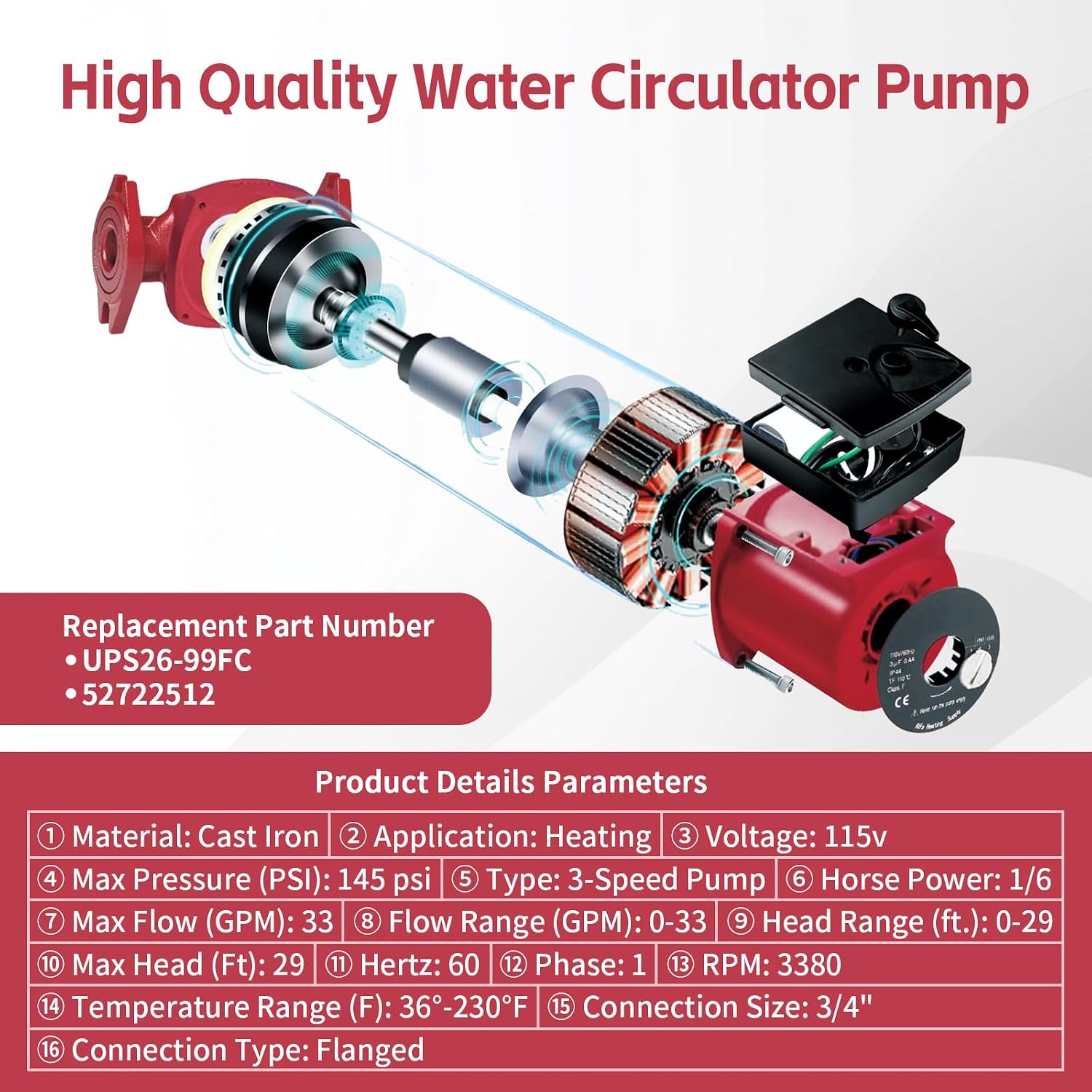
A cast iron boiler’s job is to heat water. The circulator pump’s job is to move that water where it needs to go — through baseboard fin-tube, radiant floor loops, or cast iron radiators — and back again. Without a properly sized circulator (the wet-rotor or dry-rotor pump installed in the boiler’s supply or return piping), all that BTU output sits in the heat exchanger going nowhere. For a homeowner, a failed circulator is the difference between a warm house and a very expensive paperweight. For an installer, a misspecified circulator is a callback waiting to happen — wrong head pressure, wrong flow rate, short-cycling complaints, or noise that clients will absolutely remember you by.
This guide focuses on the Grundfos UPS26-99FC — one of the most widely specified three-speed circulators in North American hydronic work — but it doesn’t stop there. We’ll cover what the spec sheet actually tells you, where the UPS26-99FC fits versus its closest competitors, how to sanity-check sizing for a typical cast iron boiler replacement, and the decision rules installers use in the field when they’re pulling a pump off a truck at 7 a.m. without time to re-run the math.
What the UPS26-99FC Spec Sheet Actually Tells You (And What It Doesn’t)
The Grundfos UPS26-99FC is a three-speed, wet-rotor circulator — meaning the motor rotor runs immersed in the system water, which simplifies sealing and cooling. It’s rated for hydronic heating applications up to 230°F (110°C), draws between 35 and 95 watts depending on speed setting, and produces a maximum flow rate of approximately 26 GPM at near-zero head, tapering to roughly 0 GPM at about 19 feet of head (per the Grundfos UPS26-99FC product data sheet).
The “26-99” nomenclature follows Grundfos’s internal convention: 26 is the flange-to-flange iron body size in millimeters (approximately 1-1/4” IPS flanged connections), and 99 is the maximum head in feet multiplied by a legacy factor — not a direct spec you’ll use for sizing. What you will use:
By the numbers — UPS26-99FC published specifications:
| Parameter | Value |
|---|---|
| Max flow rate | ~26 GPM |
| Max head | ~19 ft |
| Power draw range | 35–95 W (Speed 1–3) |
| Max fluid temp | 230°F (110°C) |
| Flange connection | 1-1/4” IPS |
The spec sheet tells you where the pump can operate. It does not tell you where it should operate. That’s the sizing judgment gap that trips up newer practitioners — and the reason callbacks happen.
The pump curve — the plotted relationship between flow rate and head pressure at each speed — is where selection actually lives. Grundfos publishes these curves in the UPS26-99FC data sheet. On Speed 3, you’re looking at roughly 15 GPM at 10 feet of head, which is a real-world operating point for a medium-complexity single-zone system with baseboard radiation and moderate pipe runs. At Speed 1, that same system might see 8–10 GPM at reduced head — useful for shoulder-season setback or low-mass radiant applications.
What the spec sheet genuinely cannot tell you: the actual pipe friction loss in the system you’re working on. That requires a system curve calculation, or at minimum a field measurement using manifold gauges or a differential pressure gauge across the circulator. Per the ASHRAE Handbook — HVAC Systems and Equipment (Chapter 44), the standard practice is to size the circulator so its operating point falls in the upper-middle portion of the pump curve, avoiding both near-shutoff (high head, low flow — noisy, erosive) and near-runout (low head, maximum flow — motor overload risk).
What Installers Actually Use: The Competitive Landscape in 2025–2026
The UPS26-99FC doesn’t operate in a vacuum. Three other circulators appear on nearly every installer’s truck alongside it, and understanding where each sits helps you avoid reflexive substitution errors.
Taco 0015-F3 and 0011-F4. The Taco 00-Series has been the default cast iron boiler replacement circulator for decades in the northeastern U.S. market. The 0015-F3 (1/25 HP, approximately 17 GPM max flow) is the go-to for single-zone residential systems with modest baseboard runs. The 0011-F4 is smaller still — appropriate for single-zone systems under 75,000 BTU/hr with short pipe runs. Per Taco’s application guide for the 00-Series, these pumps are specifically sized for cast iron boiler applications where system pressure drop is low and zone counts are one or two. Contractors who grew up on Weil-McLain Gold Series or Burnham ES2 installs often have a 0015 on the truck before they’ve even looked at the job.
The important comparison: the UPS26-99FC is a larger pump than a Taco 0015. It has higher maximum head and flow. On a straightforward single-zone baseboard system, you can overpower the loop with a UPS26-99FC on Speed 3 — producing velocity noise, increased system pressure, and premature air entrainment. Grundfos’s own application guidance suggests Speed 1 or 2 for most residential single-zone baseboard systems, which can feel like buying more pump than you need.
Grundfos UP15-42F. This is Grundfos’s answer to the Taco 0015 — a compact wet-rotor unit rated for approximately 10 GPM and 17 feet of head. For replacement on a single-zone Burnham ES2 or Slant/Fin Liberty installation, the UP15-42F is frequently the better spec than the UPS26-99FC. It’s smaller, draws less power (approximately 65W max), and its pump curve intersects real-world residential system curves at sensible operating points.
ECM variable-speed circulators (Grundfos MAGNA, Taco VR, Bell & Gossett e-circ). This is where the market is clearly moving. Per ACHR News’s staff report on variable-speed circulators, the ECM (electronically commutated motor) pump segment has seen consistent double-digit annual growth since 2021, driven largely by energy code adoption and the improving economics of delta-T and differential pressure control. For multi-zone systems — the kind of aging multi-zone hydronic work that shows up frequently on cast iron boiler replacements — a variable-speed pump that modulates based on zone demand is genuinely superior to a three-speed fixed pump. The Grundfos MAGNA3 and Taco VR series are the names appearing most consistently in installer discussions documented by Contracting Business.
The honest tradeoff: ECM variable-speed circulators cost $300–$600 versus $100–$200 for a UPS26-99FC. On a $4,000 boiler replacement, that’s a meaningful line item. On a $12,000 commercial cast iron installation, it’s noise. Know your job type before you spec.
Sizing a Circulator for a Cast Iron Boiler System: The Fast Math
You don’t need to re-derive the Darcy-Weisbach equation on a job site. You need a defensible starting point and enough intuition to know when you’re outside the safe zone.
The fundamental sizing relationship (per the Hydronics Institute / AHRI circulator selection guide):
- Flow rate (GPM) = System BTU/hr ÷ (500 × ΔT)
- Where ΔT is the design temperature differential between supply and return water, typically 20°F for baseboard hydronic systems.
Example: A Weil-McLain Gold Series boiler rated at 120,000 BTU/hr input, net output approximately 95,000 BTU/hr, single zone, 20°F ΔT:
GPM = 95,000 ÷ (500 × 20) = 95,000 ÷ 10,000 = 9.5 GPM
At 9.5 GPM, you then need to know your system head — the resistance the water faces moving through all that pipe, fittings, and radiation. A rough field shorthand (used by experienced contractors, not a substitute for pipe friction tables): assume 2–4 feet of head per 100 feet of pipe in a residential baseboard system with moderate fitting counts. A 200-foot equivalent pipe run implies 4–8 feet of head.
Plot that operating point — 9.5 GPM, 6 feet of head — on a pump curve. The Taco 0015-F3 handles it. The Grundfos UP15-42F handles it. The UPS26-99FC handles it on Speed 1 with room to spare. Spec the smaller pump unless the system has multiple zones, long secondary loops, or a high-resistance distribution manifold that pushes your head requirement above 12–14 feet.
For multi-zone systems with a primary/secondary piping arrangement — which is the correct near-boiler configuration for any cast iron boiler serving three or more zones — each zone pump is sized independently for its zone loop, and a primary circulator is sized for the boiler loop alone. This is where the UPS26-99FC earns its place: primary loop duty on a 3–5 zone system with a Burnham Commercial or Peerless MI Series installation producing 150,000–300,000 BTU/hr will often land right in the UPS26-99FC’s operating sweet spot.
Failure Modes and What Installers Find in the Field
Circulator failures on cast iron boiler systems cluster around a short list of causes, documented consistently in Contracting Business’s hydronic troubleshooting coverage:
Bearing/impeller wear from dirty system water. This is the single most common cause of premature circulator failure on older cast iron systems. Cast iron boiler sections corrode, sediment accumulates, and abrasive particles chew through wet-rotor impellers and shaft sleeves. A system inhibitor (Fernox F1, Sentinel X100, or Rhomar Hydro-Solv 9100 as a pre-flush) before circulator replacement is not optional maintenance — it’s the reason your new pump lasts 15 years instead of 4.
Air binding. When an air bubble lodges at the pump impeller, the circulator runs but moves no water. Cast iron systems with old cast iron radiators are especially prone to air accumulation. Automatic air vents at high points and a properly positioned air separator (near the boiler on the supply side) are the fix — not pump replacement.
Wiring and capacitor failures. On older UPS26-99FC units and comparable Taco three-speed pumps, the run capacitor (on models that use one) and terminal block connections are the first electrical failure points. Installers in contractor forum threads compiled by Contracting Business note that a circulator that hums but doesn’t start is almost always a capacitor, not a dead motor.
The Decision Rule: If X, Then Y
After reviewing published specifications, installer guidance from ASHRAE and the Hydronics Institute, and aggregated field experience from trade publications, here is a defensible decision framework:
- Single-zone residential, under 100,000 BTU/hr, baseboard radiation, under 200 ft equivalent pipe: Spec the Taco 0015-F3 or Grundfos UP15-42F. The UPS26-99FC is oversized and will need Speed 1 throttling — buy less pump.
- Single-zone with long pipe runs (200–400 ft equivalent) or fan-coil radiation: UPS26-99FC on Speed 2 is a defensible spec. Confirm with a pump curve crosscheck.
- Multi-zone (3+ zones), primary/secondary piping, cast iron boiler 120,000–300,000 BTU/hr: UPS26-99FC or equivalent for the primary loop; zone pumps sized individually per zone flow and head.
- Any new installation where energy code requires or client budget allows: ECM variable-speed (Grundfos MAGNA3, Taco VR) replaces the three-speed conversation entirely for zone and primary duty. The energy savings are real, the delta is $150–$400 per pump, and the callbacks for velocity noise and short-cycling drop sharply.
- Replacement on an unknown legacy system: Before ordering, check system water. If it’s dark, orange-tinged, or carries visible sediment, flush and treat before the new pump goes in. A $140 circulator inside a contaminated system is a warranty void waiting to happen.
The UPS26-99FC is a competent, proven pump for the right application. The right application is medium-to-large residential or light commercial hydronic systems where its head and flow capacity are actually needed — not every cast iron boiler job that crosses your bench.