If you’ve just inherited a house with a cast iron boiler — a large metal box in the basement that heats your home by circulating hot water through pipes and radiators — you’ve also inherited a system with its own logic, its own failure modes, and its own vocabulary. Hydronic heating (from the Greek for water, referring to any system that moves heat through liquid) is reliable, efficient, and long-lived when it’s understood. The problem is that most homeowners, and even some newer technicians, were never taught that logic. They just know the thermostat goes up and heat happens — until it doesn’t. The books reviewed here are the fastest honest path from “I don’t understand this system” to “I can evaluate what my contractor is telling me.” They range from accessible narrative histories to dense engineering references, and the reviewers who matter most — working technicians, mechanical engineers, and experienced homeowners who have actually troubleshot systems using these books — have strong opinions about which one to read first, which one to keep on the truck, and which one comes with a hidden cost you should know about before you order.
Why the Reviewer Pool Matters More Than the Star Rating
Aggregate ratings on books like these are only useful if you know who’s doing the rating. For general-audience home improvement books, a five-star average can mean the cover photo is nice. For hydronic heating references, the reviewers skew heavily toward licensed HVAC technicians, mechanical engineers, building operators, and homeowners who have personally bled air from a system at midnight. That changes the signal entirely.
The pattern that emerges across verified purchaser feedback is striking: these books are not described as merely informative. They’re described as perspective-changing. A contractor reviewing Modern Hydronic Heating writes that they warn clients against hiring anyone who hasn’t read it. A civil engineer says the same book convinced them to hire a professional — not because it was discouraging, but because it clarified what a properly designed system actually requires and what questions to ask. An owner of Pumping Away reports finally understanding why the circulator pump belongs on the supply side of the boiler after years of being told “it just does.” These are not casual reads. They are calibration tools.
As ACHR News has noted in its coverage of hydronic contractor education, the shortage of qualified hydronic technicians in many regional markets traces partly to inadequate foundational training — making self-directed reading from authoritative sources more valuable, not less, for both homeowners and early-career technicians trying to close that gap.
By the numbers — the core reading list at a glance:
| Title | Author | Best For | Approachability |
|---|---|---|---|
| Pumping Away | Dan Holohan | First-time owners, technicians needing fundamentals | High |
| Classic Hydronics | Dan Holohan | Older systems, cast iron gravity and conversion | High (4.9★ avg) |
| Lessons Learned Troubleshooting | Dan Holohan | Entry-level troubleshooting, new techs | Very High |
| Modern Hydronic Heating | John Siegenthaler | Engineering-grade design reference | Moderate–Low |
Dan Holohan’s Books: What They Actually Teach and Who Benefits
Dan Holohan is, by any reasonable measure, the most widely cited writer in the American hydronic heating trade. He spent decades as a manufacturers’ representative, then as a writer and educator, and his books are not textbooks in the traditional sense — they read more like extended conversations with someone who has seen every failure mode and wants you to avoid repeating it.
Pumping Away: The Entry Point for Every Cast Iron Boiler Owner
Pumping Away and Other Really Cool Hydronic Heating Tips by Dan Holohan (HeatingHelp.com publishing) is the shortest and most immediately actionable entry point in this list. The title refers to a fundamental concept: in a correctly designed hydronic system, the circulator pump should be positioned to pump away from the expansion tank — a small pressurized vessel that absorbs volume change as water heats and expands. When the pump is placed incorrectly relative to the expansion tank, it creates pressure problems that manifest as air in the system, banging pipes, and radiators that refuse to heat evenly. Holohan explains this in plain language with supporting diagrams.
Technicians who have reviewed this book consistently note that it resolves a category of misunderstanding that trade school does not cover adequately. For a homeowner with an older cast iron hot-water system that has recurring air problems or uneven heat distribution, this book frequently identifies the root cause before a service call is ever placed. Contracting Business, in its coverage of hydronic training and contractor development, has highlighted near-boiler piping literacy as one of the competency gaps most commonly identified by senior technicians reviewing junior work — exactly the gap Pumping Away addresses.

Hydronic
$25.00
In stock on Amazon
Check price on AmazonClassic Hydronics: The Highest-Rated Book in the Group
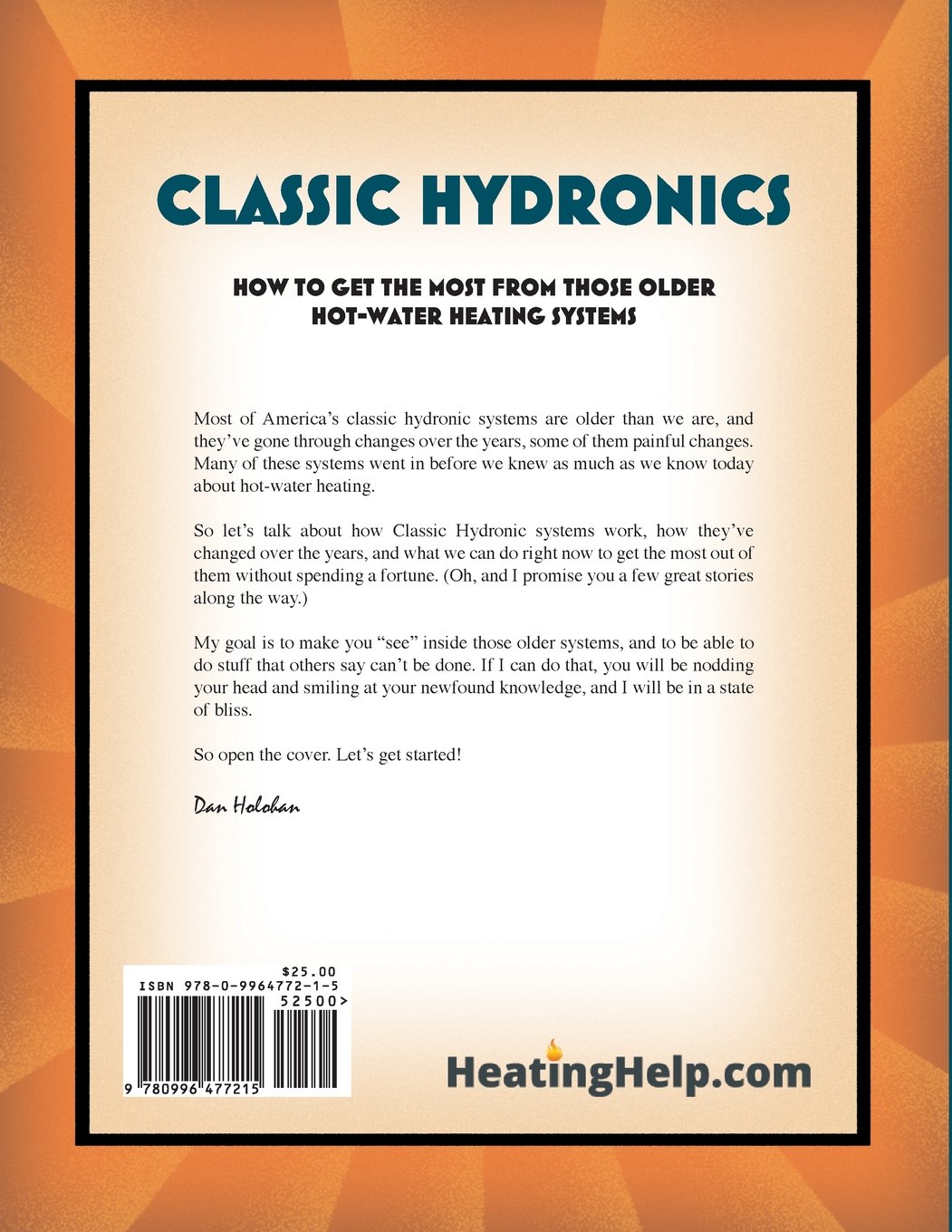
Classic Hydronics: How to Get the Most from Those Older Hot-Water Heating Systems by Dan Holohan (HeatingHelp.com publishing) carries the highest reader rating in this group — 4.9 stars across aggregated reviews — and draws the most emotionally engaged feedback. One reviewer writes they couldn’t put it down. Another calls it “the book I wish I’d had twenty years ago.” The subject matter is older hot-water systems: gravity-fed designs, early circulator retrofits, systems engineered before modern controls became standard. If your house was built before 1970 and still has its original distribution piping, this book explains why it behaves the way it does and how to work with that behavior rather than against it.
Importantly, “classic” does not mean “obsolete.” Cast iron radiators and baseboard elements installed in earlier eras are still in service across millions of homes, and the thermal mass principles Holohan describes — how cast iron stores and releases heat, why oversized systems short-cycle — apply to any cast iron system regardless of installation date. Reviewers with systems installed in the 1990s and 2000s report finding it directly applicable to their situations.
Classic
$25.00
In stock on Amazon
Check price on AmazonLessons Learned Troubleshooting: The Newest and Most Accessible Entry
Lessons Learned Troubleshooting Heating Systems by Dan Holohan (HeatingHelp.com publishing) is the newest entry in Holohan’s catalog. It draws briefer but consistently positive reviews, and reviewers frame it as the most accessible starting point — particularly for homeowners and new technicians who want a structured diagnostic framework before calling a service company. The reviews note it works well as a companion to Pumping Away rather than as a standalone reference, reinforcing the physics while adding pattern-recognition for common failure sequences.
HPAC Engineering, in its coverage of hydronic systems education, has consistently noted that structured troubleshooting frameworks — the kind that walk a technician through symptom-to-cause reasoning rather than relying on experience alone — shorten diagnostic time and reduce misdiagnosis on residential service calls. That is exactly the gap this book fills for first- and second-year technicians.
Classic
$25.00
In stock on Amazon
Check price on AmazonJohn Siegenthaler’s Modern Hydronic Heating: The Engineering Reference
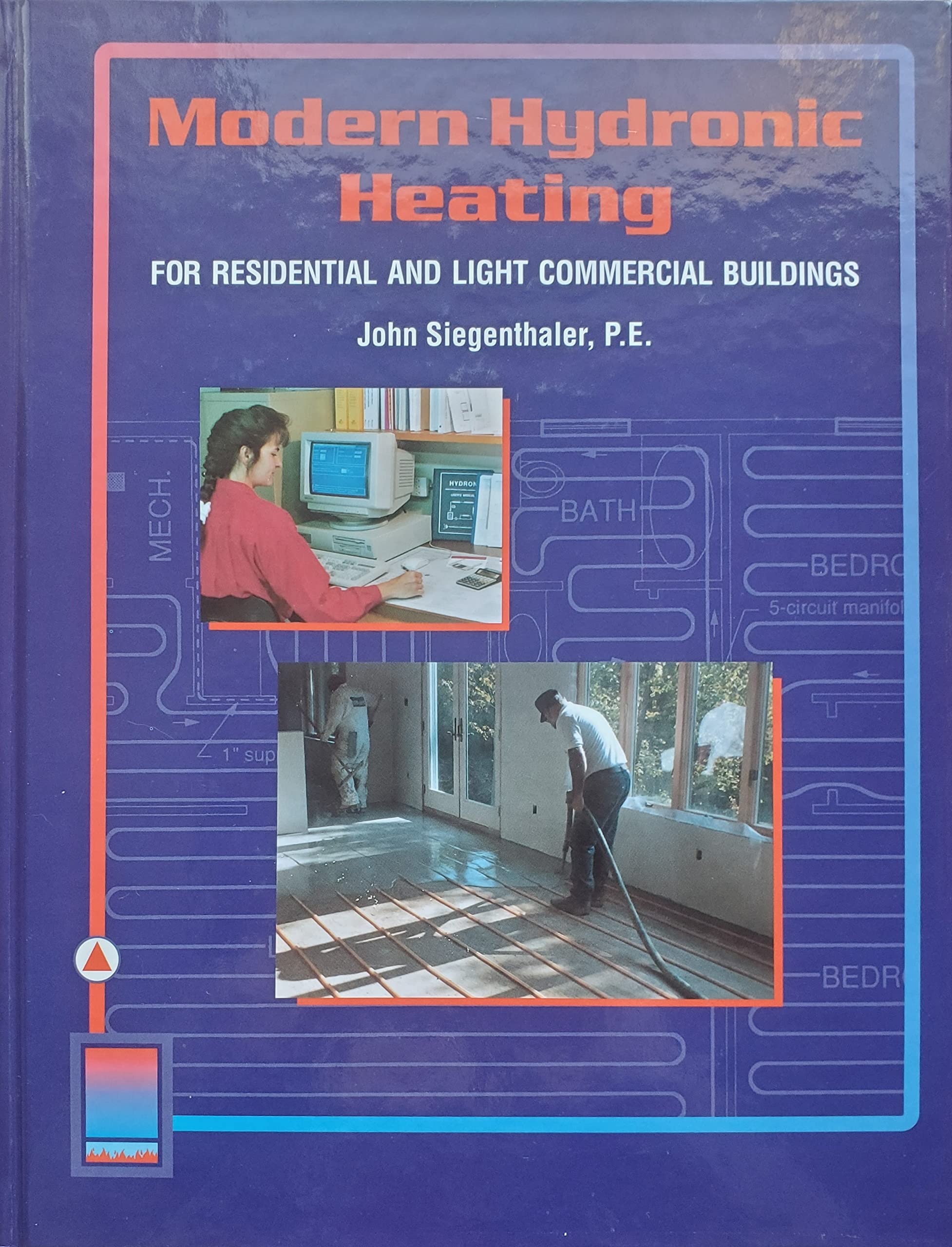
Modern Hydronic Heating for Residential and Light Commercial Buildings by John Siegenthaler (Cengage Learning) occupies a different tier entirely. Where Holohan writes for the trade generalist and the informed homeowner, Siegenthaler writes for the engineer and the serious practitioner. The book covers hydraulic circuit design, heat emitter sizing, radiant floor load calculations, buffer tank integration, and renewable energy system coupling — in the kind of mathematical depth that earns it a place on mechanical engineering firm bookshelves alongside ASHRAE handbooks.
Reviewers who rate this book most highly tend to be mechanical engineers, senior HVAC contractors, and homeowners with engineering backgrounds. But the civil engineer who reviewed it and concluded “this convinced me to hire a pro” is an equally instructive data point. The book doesn’t talk down to readers, but it makes clear what proper system design actually requires — and for many readers, that knowledge becomes a tool for evaluating contractor proposals rather than executing them personally. ACHR News coverage of hydronic training pathways has named Siegenthaler’s textbook among the most frequently recommended references by experienced mechanical contractors for junior engineers entering the hydronic specialty.
The Hydronics Design Kit issue is real and worth flagging before you order. The book references a companion package — the Hydronics Design Kit, sold separately — throughout its chapters. The kit includes worksheets, friction loss charts, and sizing tables that the text assumes you have in hand. Multiple reviewers note that it costs approximately $76 separately and functions more like a required supplement than an optional accessory. One reviewer’s exact framing: “Budget for both.” If you’re ordering Modern Hydronic Heating as a working design reference rather than a conceptual read, factor that additional cost in from the outset.
Modern
$143.85
In stock on Amazon
Check price on AmazonMatching the Book to Your Situation: Decision Rules
The question most buyers are actually asking isn’t “which is the best book” — it’s “which book is right for my situation right now.” Here is the honest framework based on aggregated reviewer profiles:
If you just bought a house with a cast iron hot-water boiler and have no prior system knowledge: Start with Pumping Away. It’s short enough to read in a weekend, immediately applicable to diagnosing common problems, and it resets your mental model of how these systems work at a fundamental level. Follow it with Classic Hydronics if your system predates 1980.
If you’re a first- or second-year HVAC technician working on residential hydronic systems: Lessons Learned Troubleshooting gives you a diagnostic framework faster than field experience alone. Stack Pumping Away underneath it for the physics foundation. Reviewers consistently report that reading both before a first solo service call changes the quality of their diagnostics.
If you’re an HVAC contractor, mechanical engineer, or building specifier evaluating or designing multi-zone hydronic systems: Modern Hydronic Heating is the reference. Budget for the Hydronics Design Kit. Per Contracting Business coverage of hydronic training and contractor development, contractors who have studied Siegenthaler’s text report materially better outcomes on complex zoning and radiant integration projects.
If you’re trying to evaluate whether a contractor’s proposed work is reasonable: Any of Holohan’s books will build enough conceptual vocabulary to ask better questions. Pumping Away in particular gives you the framework to evaluate near-boiler piping proposals — a category where homeowner-visible decisions (where the pump mounts, where the expansion tank hangs) often signal whether a contractor genuinely understands the system’s hydraulics.
Frequently Asked Questions
Which Dan Holohan book should I read first if I just bought a house with a cast iron boiler? Pumping Away is the consensus starting point across reviewer profiles. It’s short, it addresses the most common misunderstanding in residential hydronic systems — circulator placement relative to the expansion tank — and it pays off in diagnostic clarity almost immediately.
Is Modern Hydronic Heating accessible to someone without an engineering background? Partially. The early chapters on heat emitter types and system concepts are readable by a motivated layperson. The hydraulic circuit design and load calculation sections assume comfort with algebra and unit conversion. Most non-engineer reviewers report reading it for conceptual grounding rather than executing the calculations themselves — and finding that valuable on its own terms.
What is the Hydronics Design Kit and do I really need it? The Hydronics Design Kit is a companion package of worksheets, friction loss tables, and sizing charts that Siegenthaler’s text references repeatedly throughout. It is sold separately for approximately $76. If you are using the book as a working design reference, reviewers treat it as effectively required. If you are reading for conceptual understanding only, you can follow the text without it — but you will encounter friction at the calculation chapters.
Is Classic Hydronics useful if my system is newer, or is it only relevant to old gravity and steam systems? It is relevant beyond older systems. The thermal mass principles Holohan describes — how cast iron radiators store and release heat, how to balance distribution in oversized systems — apply to cast iron components regardless of installation date. Reviewers with systems installed in the 1990s and 2000s consistently report finding it directly applicable.
Can these books help me evaluate whether a contractor’s proposed work is reasonable? Yes — this is one of the most consistent use cases described across reviewer feedback. Holohan’s books give homeowners enough vocabulary and conceptual grounding to ask specific questions about near-boiler piping, expansion tank placement, and zone valve selection. The civil engineer reviewer of Modern Hydronic Heating describes exactly this outcome: the book made them a better client, not a DIY installer.
Are any of these books available as digital editions? Holohan’s titles through HeatingHelp.com publishing have historically been available in both print and digital formats, including Kindle editions. Siegenthaler’s Modern Hydronic Heating through Cengage Learning is available in print; digital availability varies by edition and distributor. Verify current availability at time of purchase, as digital editions of technical books sometimes lag print by one edition cycle.