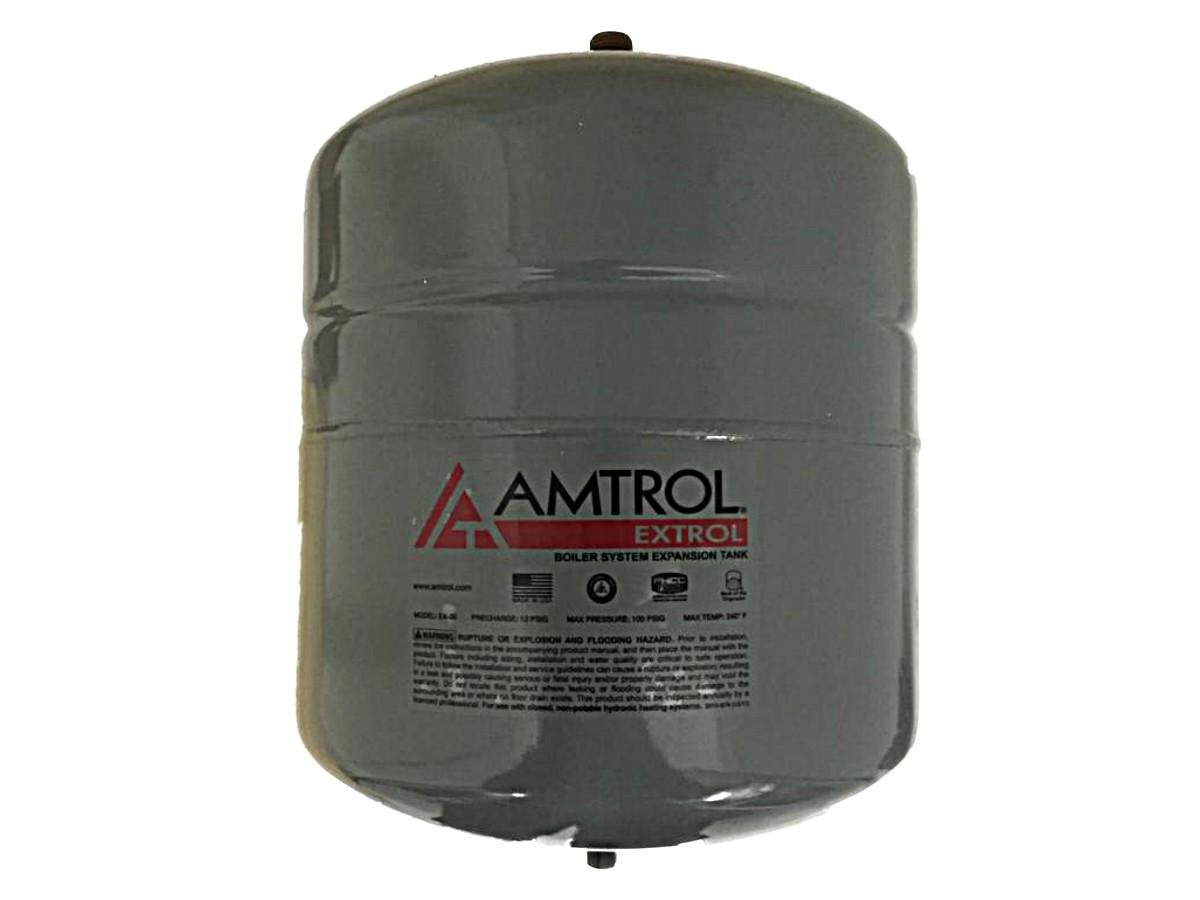
There’s a failure pattern that shows up in hydronic heating callbacks more reliably than almost anything else: a homeowner replaces a waterlogged expansion tank, the pressure relief valve (PRV) stops dripping for a few weeks, and then it starts weeping again. The contractor goes back, replaces the tank a second time — same model, same size — and the cycle repeats. The problem isn’t the tank. The problem is that the original tank was always undersized, and every replacement is just perpetuating a bad design.
An expansion tank is the pressure buffer in a closed hydronic system — the sealed loop of water that carries heat from your boiler to baseboard radiators or radiant floor circuits. Water expands when it heats up (roughly 4% in a typical residential system), and without somewhere for that expanded volume to go, the pressure spikes until the PRV vents it. The expansion tank, a pressurized vessel with a rubber bladder inside, absorbs that expanding water so the system pressure stays stable. When the bladder fails — or when the tank was never big enough to begin with — the PRV becomes the pressure relief of last resort. Understanding when to upsize, not just replace, is the real skill here.
| EDITOR'S PICKAmtrol 110-1 Fill-Trol Expansio… | Mid-tierAMTROL 102-1#30 EX-30 30 Extrol… | Budget pickWatts ETX-30 Non-Potable Water… | |
|---|---|---|---|
| Connection | — | — | 1/2" MNPT |
| Tank Volume | — | — | 4.7 gal |
| Max Pressure | — | — | 75 psi |
| Series | Fill-Trol | Extrol | ETX |
| Model Number | 110-1 | 102-1 | — |
| Price | $151.89 | $71.25 | $53.87 |
| See on Amazon → | See on Amazon → | See on Amazon → |
The Same-Size Trap: Why Like-for-Like Replacement Fails
The intuitive move when a waterlogged tank fails is to pull the model number off the old unit and order an identical replacement. It’s faster, it’s familiar, and it feels like a clean fix. Aggregated owner reports on the Amtrol EX-60 listing surface exactly this scenario in detail: one reviewer replaced a failed tank with an identically sized unit, saw only marginal pressure improvement, and continued dealing with a weeping PRV for months before finally stepping back and questioning the original sizing. Purchasing the larger EX-60 — a 6-gallon unit — finally stopped the PRV from weeping for good.
That review is worth sitting with for a moment because it represents a diagnostic trap that’s easy to fall into. The failed bladder explains why the tank stopped working. It does not explain why the system was overpressuring in the first place. If the original tank was installed by a technician who grabbed the most common residential size off the truck without running the numbers, the failure mode was baked in from day one. You’re not fixing a broken part — you’re inheriting a design error.
A parallel story shows up in Watts ETX-30 owner reports: a homeowner replaced a 2.1-gallon Flextrol with the ETX-30 after doing actual sizing research, explicitly naming undersizing as the root cause they were solving. The ETX-30 is a 4.4-gallon unit. That’s more than double the volume of what it replaced, and the reviewer’s PRV problem resolved. Two independent accounts, two different product lines, same diagnostic conclusion.
The takeaway for practitioners: When a customer calls back after a tank replacement with a still-weeping PRV, your first question isn’t “did the bladder fail already?” It’s “was the original tank ever sized correctly?”
How to Determine the Right Size — The Math That Actually Matters
Expansion tank sizing is not arbitrary. It’s a function of four variables: system water volume, the delta-T (temperature rise from cold fill to maximum operating temperature), system fill pressure, and maximum allowable system pressure. The ASHRAE Handbook of HVAC Systems and Equipment provides the governing formula, and it isn’t particularly complex — but it requires knowing your system’s actual water volume, which most residential installers have never measured.
By the Numbers — Residential Sizing Snapshot
| System Water Volume | Typical Residential Boiler Temp | Recommended Expansion Tank Size |
|---|---|---|
| 10–20 gallons | 180°F operating / 12 psi fill | 2–4 gallons |
| 20–40 gallons | 180°F operating / 12 psi fill | 4–7 gallons |
| 40–80 gallons | 180°F operating / 12 psi fill | 7–15 gallons |
These are ballpark figures, not substitutes for the calculation. The formula from Watts Water Technologies’ ETX Series installation instructions uses the expansion factor for water at your operating temperature, the system volume, and the ratio of fill pressure to relief pressure to arrive at the minimum required acceptance volume. Run the math; then size up by at least 20% to account for air cushion degradation over time.
A practical field shortcut that HPAC Engineering’s hydronic system coverage has referenced: estimate system water volume by counting your radiator sections and baseboard linear feet, assigning roughly 1 gallon per 20 feet of 3/4-inch baseboard and 1 gallon per 8 cast iron sections, then adding pipe volume. It’s imprecise, but it gets you into the right order of magnitude before you commit to a tank size.
The critical number most installers underweight is the system fill pressure. A system filled to 15 psi with a 30 psi PRV has much less pressure headroom than one filled to 12 psi. Lower fill pressure means the tank can absorb more expansion before the PRV lifts — so if your customer has a habit of bumping up their fill pressure to stop air noise, they’re directly reducing their expansion tank’s effective capacity.
Bladder Lifespan, Maintenance Windows, and When to Plan Ahead
One of the most useful concrete data points in the aggregated owner literature is a single ETX-30 reviewer’s account of 16 years of service before the bladder finally split. Sixteen years is a meaningful benchmark for maintenance planning — it aligns with the kind of lifespan data that Contracting Business coverage of hydronic troubleshooting suggests: bladder-type expansion tanks in residential systems typically run 10–20 years depending on water chemistry and operating pressure cycling.
What that 16-year report also tells you is that bladder failure is not a random event — it’s a wear-out mechanism. Bladders flex with every heating cycle. In a system that cycles 4–8 times per day during heating season and runs year-round with a domestic indirect, you’re talking about tens of thousands of flex cycles over the tank’s life. Water chemistry accelerates this: low pH water (below 6.5) and chlorinated water attack the EPDM rubber that most bladders use. This is why Fernox and Sentinel inhibitor programs, which stabilize pH and reduce oxygen ingress, show up in the longevity literature — they’re protecting the bladder as much as they’re protecting the sections.
For practitioners advising clients on system maintenance schedules, the bladder lifespan data supports a 10-year proactive inspection interval. At 10 years, tap the Schrader valve on the tank: if water comes out instead of air, the bladder has already failed. Catching this before the PRV starts weeping saves a service call and, if the system has also been undersized, creates the natural opportunity to upsize while you’re there.
The Amtrol Fill-Trol series is worth distinguishing here from the standard Extrol line: the Fill-Trol includes an integrated fill valve that maintains system pressure automatically, eliminating the need for a separate pressure-reducing valve (PRV is also the acronym for “pressure-reducing valve” in fill circuits — different from the “pressure relief valve” discussed elsewhere). For systems that need both functions replaced simultaneously, This Old House’s expansion tank overview confirms that the Fill-Trol simplifies the installation by combining two components. Owner reports consistently describe the Fill-Trol install as a 10-minute job — a genuine simplicity advantage that practitioners can lean on when assessing DIY-friendliness for capable homeowners.
Reading the Tank: What the Indicator on the Amtrol EX-60 Actually Tells You
The Amtrol EX-60 ships with a visual condition indicator on the bottom of the tank — a small push-button Schrader valve with an indicator pin. The logic is simple: if the indicator pin is flush or depressed, the air pre-charge behind the bladder is still intact and the bladder is likely functional. If water weeps from the Schrader when you depress it, the bladder has failed and water has migrated into the air side of the tank.
This is not a precision diagnostic instrument — it tells you “failed” or “not obviously failed,” not the actual air pre-charge pressure. For a complete check, you want to isolate the tank, drain system pressure off the water side, and use a tire gauge on the Schrader to verify the air pre-charge matches your system’s cold fill pressure. Amtrol’s engineering documentation specifies that the pre-charge should equal the system cold fill pressure (typically 12 psi for a two-story system) — a pre-charge that’s too high prevents the bladder from accepting water expansion; one that’s too low causes the bladder to bottom out early and the tank to perform as if undersized.
That last point connects back to the core thesis of this article: a tank that is correctly sized on paper but running a mis-set pre-charge will behave like an undersized tank at the PRV. Three separate failure modes — wrong size, failed bladder, wrong pre-charge — all produce the same symptom: a weeping PRV. Practitioners who train themselves to check all three before ordering parts will catch the right problem the first time.
Frequently Asked Questions
Why is my pressure relief valve dripping again after I just replaced the expansion tank?
The most common reason is that the replacement tank was the same size as the failed original — and the original was undersized for the system. A second possibility is an incorrect air pre-charge: if the new tank’s pre-charge pressure doesn’t match the system’s cold fill pressure, it won’t absorb the full expansion volume. Check the pre-charge with a tire gauge at the Schrader valve before assuming the tank is defective.
How do I know if my expansion tank is undersized vs. simply failed?
A failed tank and an undersized tank produce identical symptoms (weeping PRV, pressure spikes), but the diagnostic differs. To check for failure, isolate and drain the tank, then test the Schrader: water coming out means the bladder has failed. To check for undersizing, calculate the required acceptance volume using your system’s water volume, operating temperature, fill pressure, and relief pressure — and compare it to the tank’s rated acceptance volume on the spec sheet. If the math shows the tank was never adequate, replacement-with-upgrade is the right call.
What is the difference between the Amtrol Extrol and the Amtrol Fill-Trol — do I need both?
The Extrol is a standalone expansion tank. The Fill-Trol is an Extrol with an integrated pressure-reducing fill valve built into the tank body, allowing it to serve as both the expansion vessel and the system fill/pressure regulator. If your existing fill valve is functional and appropriately sized, an Extrol replacement is sufficient. If the fill valve is aging or you’re replumbing near-boiler piping anyway, the Fill-Trol eliminates a fitting and simplifies the assembly.
How long should an expansion tank bladder last before it needs replacement?
Owner accounts, including one detailed ETX-30 report of 16 years before bladder failure, suggest a realistic service life of 10–20 years under normal operating conditions. Water chemistry is a significant variable: low pH or oxygen-rich water degrades EPDM bladders faster. Proactive inspection at 10-year intervals — Schrader valve check, visual inspection — is a reasonable maintenance cadence for residential systems.
Can I install an expansion tank myself, or does it require a licensed plumber?
For a straight swap on an accessible location — tank is on a threaded tee above the circulator, system can be isolated and drained — many capable homeowners manage the job in under 30 minutes. Owner accounts on the Fill-Trol consistently describe installs in the 10–15 minute range. That said, local codes vary: some jurisdictions require licensed work on any closed hydronic system. Check your municipal requirements. If upsizing involves rerouting pipe or requires re-commissioning pressure settings, a licensed contractor reduces the risk of introducing air or setting the pre-charge incorrectly.
What does the indicator on the bottom of the Amtrol EX-60 tell me about tank condition?
The EX-60’s bottom-mounted Schrader indicator tells you whether the bladder has failed. If water exits the valve when you depress the pin, the bladder is compromised and water has entered the air side of the tank — the tank is no longer functional. It does not tell you whether the air pre-charge pressure is correct; for that, you need to isolate the water side and check with a pressure gauge. Think of it as a pass/fail indicator, not a calibration tool.