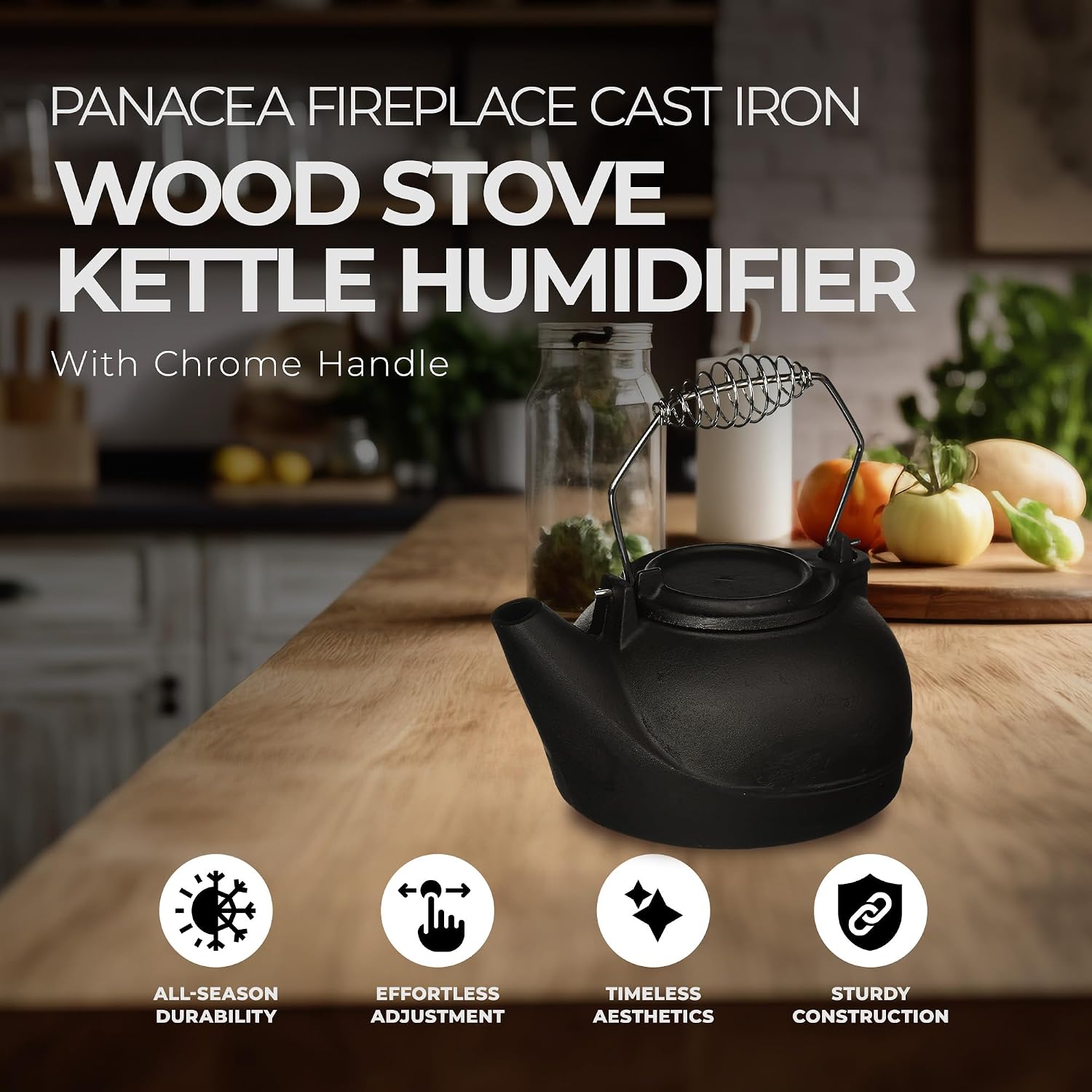
A cast iron steamer — sometimes called a wood stove kettle or wood stove humidifier — is a heavy, lidded pot designed to sit directly on the surface of a wood-burning stove and release water vapor as it heats up. Unlike a plug-in humidifier (an appliance that electrically forces moisture into the air), a stove steamer is entirely passive: the stove does the work, and the cast iron holds and radiates the heat evenly over hours. The practical payoff is meaningful. Wood heat is notoriously dry, and homes heated primarily by wood stoves can drop to relative humidity levels well below the 30–50% range that most building scientists and the editors at Home Energy Magazine identify as the comfort and health target for occupied spaces. A steamer running alongside your stove recaptures some of that lost moisture without adding a single appliance to your electrical load.
If you’ve already bought one — or you’re trying to decide between a handful of brands — this guide works through the questions that consistently surface in owner reviews and installer conversations: what to do about rust, whether to season the inside, how to add scents safely, and the food safety question that at least one manufacturer takes seriously enough to print on the box.
| EDITOR'S PICKPlow & Hearth Moose Wood Stove… | Mid-tierPlow & Hearth Dragon Wood Stove… | Budget pick[Panacea Products 15321 Humidify…](https://www.amazon.com/dp/B000VBDHFS?tag=greenflower20-20) | |
|---|---|---|---|
| Capacity | 3 QT | 2.75 QT | — |
| Shape/Motive | Moose | Dragon | — |
| Rust Resistant | ✓ | ✓ | — |
| Finish | Matte Black | Matte Black | — |
| Kettle Alt. | — | ✓ | — |
| Price | $119.99 | $117.99 | $33.95 |
| See on Amazon → | See on Amazon → | See on Amazon → |
Rust Is Not a Defect — But It Does Need a Response
The single most consistent owner observation across steamer brands, from the Panacea to the Moose to the Pinecone line, is that rust appears at the lid-to-body seam. This is not a quality failure. It is the predictable outcome of raw cast iron sitting in a permanently moist microenvironment. The contact point between lid and body traps condensation during cool-down cycles, and uncoated iron oxidizes when water and oxygen are present together. That is chemistry, not a warranty claim.
What you do with that rust matters more than the rust itself.
Surface rust (red-orange, powdery, shallow) is cosmetic and manageable. The standard approach reported across aggregated owner reviews is to run the steamer dry once — letting residual moisture fully evaporate on a hot stove — then wipe the seam area with a lightly oiled cloth (vegetable oil, flaxseed oil, or any food-safe oil works) before refilling. This isn’t full seasoning; it’s basic corrosion management, the same practice This Old House’s cast iron care guides recommend for any raw iron surface exposed to repeated moisture cycling.
Active pitting or deep rust is a different matter. If the interior of the steamer develops significant pitting after extended neglect or storage, the structural integrity of the casting is not at risk from surface rust alone — cast iron is thick by design — but heavy oxidation accelerating into pitting can eventually compromise the basin’s ability to hold water without weeping. Owners who catch this early report success with a brief soak in a 50/50 water-and-white-vinegar solution (no longer than 30 minutes; longer softens the iron surface and removes protective carbon layers), followed by a thorough rinse, a full dry-out cycle on a warm stove, and an exterior oil wipe.
One durability red flag that appears specifically in Moose steamer reviews is worth naming: at least one owner reported seam separation within three days of initial use, and a second owner observed that the exterior finish appears to be paint rather than a baked-on enamel or seasoning layer — and it peels accordingly. Neither issue is universal to the brand, and prompt replacement was reported in the seam-separation case, but it’s worth inspecting new units closely before committing to your first full heating season.
Seasoning: Outside Yes, Inside No
The instinct to season a cast iron steamer the same way you’d season a skillet is understandable — it’s the same material, after all. But the logic breaks down at the interior.
Exterior seasoning works and is widely practiced. Coating the outside of the steamer with a thin layer of oil and running it through a few heat cycles builds a patina that slows surface oxidation and improves the steamer’s appearance over time. The editorial guides at This Old House recommend this approach for any raw cast iron surface that will see repeated heating. Apply oil thin — visible pooling smokes excessively and doesn’t polymerize into a useful layer — and run the stove hot enough to bake it in. Repeat two or three times and you have a serviceable exterior finish.
Interior seasoning is not effective and may be counterproductive. The reason is simple: any oil you apply to the interior is either going to burn off at the water-to-iron interface before it polymerizes, or it’s going to disperse into the water you’re evaporating into your living space. Reviewers across multiple brands who have attempted interior seasoning consistently report that the oil either smokes, creates a film on the water surface, or simply disappears — none of which creates the durable carbonized layer that makes seasoning work on dry cooking surfaces. Save the oil for the outside.
A related practical note: don’t use cooking spray on any part of a stove steamer. The propellant additives in aerosol cooking sprays leave a sticky residue at high temperatures that is harder to remove than bare rust and doesn’t contribute to a seasoning layer.
Scents, Additives, and the Food Safety Boundary
Adding scent to a stove steamer is an underappreciated use pattern, and it’s one area where owner creativity genuinely outpaces manufacturer documentation. One widely circulated Pinecone steamer owner recipe — cinnamon sticks, allspice, cloves, and a few drops of vanilla — has appeared repeatedly in home and hearth communities and reflects real practice: whole spices and natural extracts release scent at steamer temperatures without degrading the iron or creating harmful combustion byproducts.
What works well: whole dried botanicals (cinnamon sticks, cloves, star anise, dried citrus peel), pure vanilla extract, and diluted essential oils intended for diffusion. The key with essential oils is dilution — a few drops in a full steamer basin, not a concentrated pour. At operating temperature the water acts as a carrier, vaporizing scent gradually rather than flashpoint-burning it.
What to avoid: synthetic fragrance oils not rated for heat, concentrated resinous additives that can leave gummy deposits, and anything marketed for candle or wax warmer use. These products are formulated for different temperature ranges and material compatibility.
Now the harder question. Several manufacturers include a warning that the interior of their cast iron steamers is not rated for consumption — the iron is unsealed, and at least one Bear steamer reviewer specifically called out believing the manufacturer on this point. This matters in the scent conversation because it means the steamer water is not potable, and anything you add to it should be evaluated with that framing. You’re not making a beverage; you’re making vapor. Most whole spice additives are safe in that context. But if you’re adding something and the question “is this safe to inhale over eight hours?” gives you pause, that pause is the correct response.
One separate and important note on the Bear steamer specifically: its documentation includes a warning that gas stove flames damage the finish. This is not a minor caveat. If you heat with a gas fireplace, gas log insert, or any open-flame gas appliance rather than a sealed wood-burning stove, the localized flame contact creates a fundamentally different thermal and chemical environment than radiant conduction from a cast iron stove top. The finish — and potentially the seams and casting integrity over time — are not engineered for that exposure.
Real-World Performance: What Humidity Change Actually Looks Like
By the numbers, a 3-quart steamer running continuously on an active wood stove operates in this approximate range:
| Variable | Typical range |
|---|---|
| Evaporation rate at moderate stove temp | 0.3–0.7 quarts per hour |
| Refill interval during a 10-hour heating day | 2–4 refills |
| Humidity lift in a well-sealed 1,200 sq ft space | 5–15% RH depending on infiltration |
| Effective humidity lift in a drafty older home | 2–8% RH (significant air leakage limits gain) |
These numbers are drawn from owner-reported observations and building science framing in Home Energy Magazine’s practitioner coverage of humidity management in weatherized homes — not from controlled lab testing. Actual results vary significantly based on stove output, room volume, air sealing quality, and outdoor temperature (colder outdoor air carries less moisture and will depressurize your indoor humidity faster on infiltration).
The most practical performance marker comes from a Panacea steamer owner who credited their unit with eliminating static electric shocks — that specific before-and-after signal (static discharge disappears when RH climbs above roughly 40%) is more intuitive and actionable than reading a hygrometer. If the doorknob stops shocking you, the steamer is contributing measurably to your indoor environment. If the static persists through a full heating season, your home’s air leakage rate is likely overwhelming a single steamer’s output.
Building Green’s technical brief on indoor air quality in tight homes identifies the 35–45% RH window as the sweet spot for occupant comfort, reduced respiratory irritation, and suppressed airborne pathogen transmission — context that makes even modest steamer-driven humidity gains worth taking seriously.
Frequently Asked Questions
Is rust inside a cast iron wood stove steamer dangerous or just cosmetic, and how do I manage it?
Surface rust in a steamer is cosmetic, not a health threat. The iron oxide that forms on raw cast iron is inert. Managing it is straightforward: dry the steamer fully between uses when possible, wipe the lid-body seam with a lightly oiled cloth periodically, and address any significant buildup with a short vinegar soak followed by a complete dry-out and oil wipe before returning to service.
Should I season the inside of my cast iron steamer the same way I season a cast iron skillet?
No. Interior seasoning doesn’t work in a steamer because the oil burns off or disperses into the water before it can polymerize into a protective layer. Season the exterior — it helps — and leave the interior alone beyond basic rust management.
How often will I need to refill the steamer during a typical heating day?
Based on aggregated owner reports, expect to refill a 3-quart steamer two to four times over a ten-hour heating day at moderate stove temperatures. Keep a dedicated heat-safe pitcher nearby and establish a refill habit tied to your regular stove tending routine.
Can I add essential oils, cinnamon, or other scents to the water without damaging the kettle?
Whole spices and diluted essential oils intended for heat diffusion are widely used without reported damage to the iron. Avoid synthetic fragrance oils, wax warmer additives, and anything not rated for heat diffusion. Remember that the steamer interior is not sealed or rated for consumption — evaluate any additive as something you’ll be inhaling as vapor over hours.
Can a cast iron wood stove steamer be used on a gas fireplace or gas log insert, or only on wood-burning stoves?
Most steamers are designed for radiant heat conduction from a wood stove top surface. The Bear steamer’s documentation explicitly warns that gas stove flames damage the finish — and that warning logically extends to gas fireplace and gas log insert environments where open flame contact is part of the operating condition. If you heat with gas, verify compatibility with the specific manufacturer before purchasing.
How much humidity does a 3-quart steamer actually add to a room, and how will I know it’s working?
In a well-sealed space of 1,000–1,500 square feet, a continuously running steamer can lift relative humidity by 5–15 percentage points. In older, draftier homes the gain is smaller. The most intuitive signal, credited to a Panacea owner’s long-run observation, is the disappearance of static electric shocks — a reliable indicator that indoor RH has climbed above the 35–40% threshold where static discharge becomes uncommon.