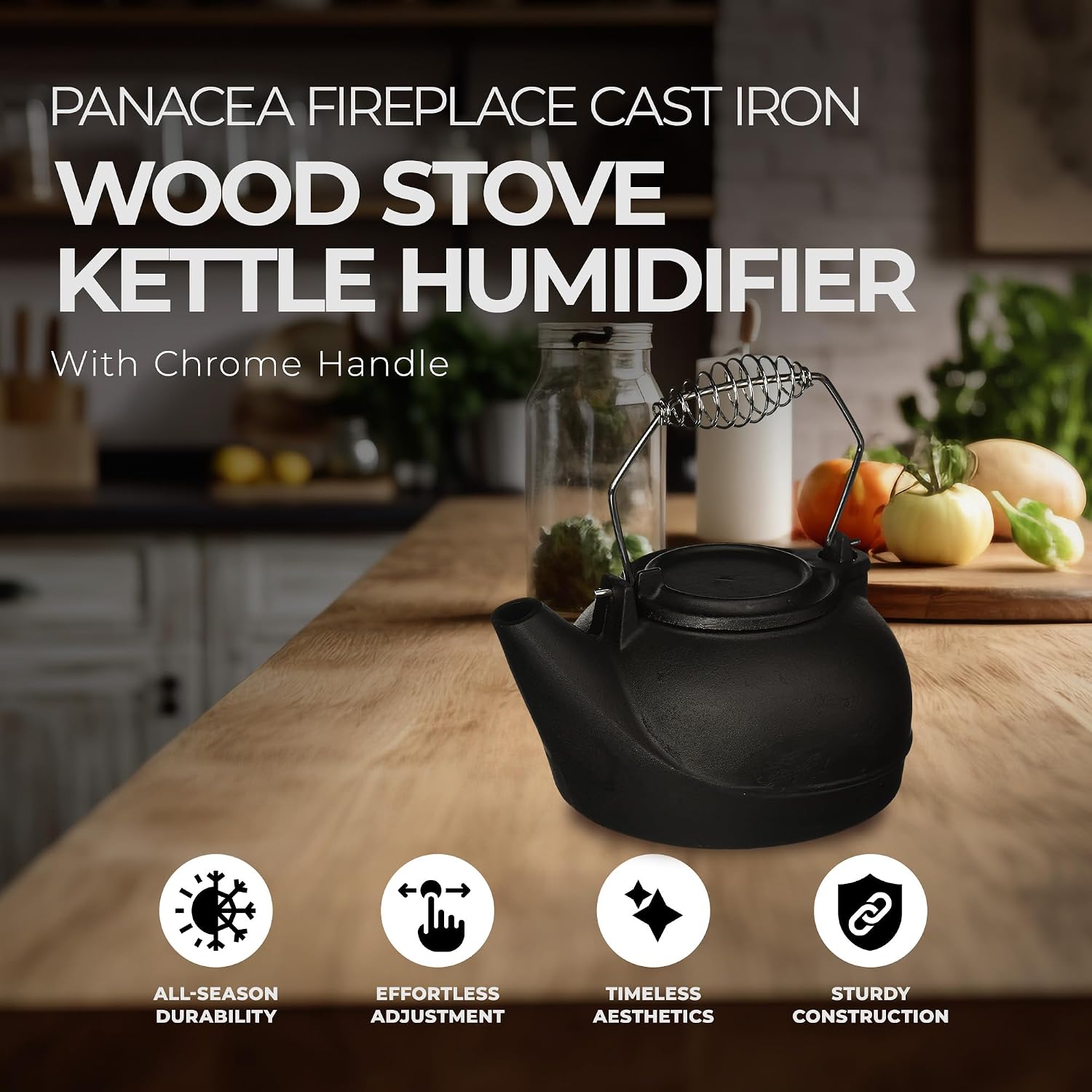
A cast iron steamer kettle is exactly what it sounds like: a heavy, lidded pot — usually holding 2 to 3 quarts of water — that sits directly on top of a wood stove and slowly releases steam as the stove heats up. Wood stoves are notoriously dry heat sources; they burn moisture out of the air while warming a room, which is why lips crack and wood furniture gaps in winter. A steamer is the low-tech fix. No electricity, no humidistat, no filter to replace — just cast iron, water, and convective heat doing quiet work in the background. If you’re new to wood stoves or supplemental heating, that’s the whole concept. If you’re already managing a wood-heated home and evaluating which steamer is worth buying — or replacing — this guide is built for you. We’ll cover the rust question honestly, walk through seasoning, address the smell on first use, and break down which product features matter in practice versus marketing copy.
| EDITOR'S PICKPlow & Hearth Moose Wood Stove… | Mid-tierPlow & Hearth Dragon Wood Stove… | Budget pick[Panacea Products 15321 Humidify…](https://www.amazon.com/dp/B000VBDHFS?tag=greenflower20-20) | |
|---|---|---|---|
| Capacity | 3 QT | 2.75 QT | — |
| Surface Finish | Matte Black | Matte Black | — |
| Rust Resistant | ✓ | ✓ | — |
| Kettle Shape | Moose | Dragon | — |
| Price | $119.99 | $117.99 | $33.95 |
| See on Amazon → | See on Amazon → | See on Amazon → |
Rust Is Normal — Here Is Why That’s Actually Fine
The single most common complaint in owner reviews of cast iron steamers is rust, and it is also the complaint that matters least once you understand the material. Raw cast iron — the kind used in virtually every steamer that doesn’t have a full enamel interior — is iron alloyed with carbon. It is porous at a microscopic level, and it oxidizes on contact with water and air. That’s rust. It is not a manufacturing defect, a sign of low quality, or a health hazard in the quantities involved.
Reviewers across multiple models — including the Panacea, Pinecone, and Honeycomb designs — frame this consistently: season it like a cast iron skillet. That analogy is exactly right, and it comes from the same metallurgical logic. This Old House’s guide to cast iron cookware care explains the seasoning process as building a polymerized oil layer that seals the porous surface and prevents oxidative contact with water. The same principle applies to your steamer’s exterior and any interior surface that isn’t enamel-lined.
What seasoning does not do is make the interior water-holding chamber rust-proof forever. Owners who use their steamer heavily and refill it daily will see some rust-colored residue in the water. One Panacea kettle reviewer makes an important and underappreciated point: you cannot season the interior by oiling it, because any oil you introduce burns off during the first heat cycle or disperses into the steam and enters your home’s air. The interior stays raw by design. Rust residue in the water is cosmetic, not toxic, and most owners report it diminishes significantly after the first few weeks of regular use as a thin mineral-and-oxidation patina stabilizes.
The practical decision rule: if visible rust residue in the water bothers you aesthetically or you live in a hard-water area where mineral scale compounds the issue, that’s the case for an enamel-lined model — discussed below.
First-Use Smell: What It Is and When It Goes Away
A chemical or “paint” smell on first use is reported by owners of nearly every raw cast iron steamer on the market. It is almost universally described as strong for the first one to two heat cycles, then gone. Family Handyman’s wood stove accessories guidance notes that new cast iron products — including stove accessories — are typically coated with a protective oil or wax at the factory to prevent shipping rust, and that coating burns off on first exposure to operating temperature.
The smell is the coating volatilizing, not the iron itself off-gassing. Best practice, reported consistently across owner reviews: do your first heat cycle with the steamer empty or with a small amount of sacrificial water, in a well-ventilated space. Open a window. Run it for 30–60 minutes. The smell will not persist into your second use.
If the smell continues past two full heat cycles, that’s worth contacting the manufacturer — but based on the aggregated review record, that scenario is rare. The vast majority of owners describe it as a one-time nuisance.
Seasoning a New Steamer: The Practical Steps
Seasoning a wood stove steamer is simpler than seasoning a skillet because you’re primarily protecting the exterior, not building a cooking surface. Based on manufacturer documentation and the consistent pattern across installer and owner reviews:
- Wipe the exterior with a lint-free cloth to remove any factory oil or dust.
- Apply a thin coat of food-grade flaxseed oil or plain vegetable shortening to all exterior surfaces, including the lid and handle.
- Place the empty steamer on the stove during a normal fire and let it reach operating temperature — typically 300–400°F surface temperature on an active wood stove.
- Let it cool completely, then wipe off any excess oil that hasn’t polymerized.
- Repeat once more before your first water use.
After that initial seasoning, the routine is simple: keep the exterior lightly oiled, don’t let it sit wet, and empty it when the stove goes cold for extended periods. Owners who report the most rust problems are those who left water sitting in the steamer between fires for days at a time.
The Spices-in-the-Water Question
Here’s something that doesn’t appear in any product listing but shows up repeatedly in real owner behavior: people add spices to the water. Multiple owners of Pinecone and Honeycomb model steamers describe putting cinnamon sticks, whole cloves, allspice, and vanilla into the reservoir. The logic is atmospheric — the steam carries trace aromatics into the room, producing the scent of a slow-simmering pot without the kitchen labor.
This works, but there are tradeoffs worth naming explicitly:
- Spice residue builds up on the interior walls faster than plain water mineral deposits. Expect to clean the interior more often.
- Essential oils are a different story. Adding concentrated essential oils to the water is not recommended for raw cast iron steamers. The oils don’t mix uniformly with water, can leave sticky residue that’s difficult to remove from porous iron, and at high temperatures can produce unpredictable volatilization products. Stick to whole spices or food-grade flavorings if you want scent.
- Sugar-containing additions (vanilla extract with sugar, mulled wine, etc.) will caramelize and are genuinely difficult to clean out of a cast iron interior.
The Panacea reviewer’s note about not oiling the interior applies here by analogy: anything you add to the water will either burn off, disperses into the steam, or leave a residue — plan accordingly.
How Much Humidity Does a 2–3 Quart Steamer Actually Add?
This is where expectation management matters most. Home Energy Magazine’s moisture management guidance establishes that a typical well-insulated 1,500 sq ft home in winter heating season operates at 20–30% relative humidity without any supplemental moisture. Comfortable indoor humidity is generally cited at 35–50% RH.
By the numbers:
- A 2-quart steamer running continuously on an active wood stove evaporates roughly 0.5–1 lb of water per hour at operating temperature.
- One pound of evaporated water raises the RH of approximately 1,000 cubic feet of air by roughly 2–4 percentage points, depending on starting conditions and building tightness.
- A 1,500 sq ft home with 8-foot ceilings contains approximately 12,000 cubic feet of air.
The math means a single 2–3 quart steamer is a modest humidity contributor in a full-sized home — meaningful, but not transformative. Building Green’s coverage of IAQ in tight homes notes that wood stove-heated spaces often have strong stack-effect air exchange, which constantly bleeds conditioned air (and its moisture) out of the building envelope. A steamer helps, but owners in large or leaky homes should not expect it to single-handedly solve winter dryness.
For a smaller room — a 200–400 sq ft living area tightly zoned around the stove — the effect is more pronounced and owners consistently report a perceptible improvement. For a whole-house solution, multiple steamers or a dedicated humidifier running in parallel is the realistic answer.
Enamel-Lined vs. Raw Cast Iron: The Hard-Water Decision
The enamel-lattice-top steamer exists primarily for one buyer: someone in a hard-water area who has watched mineral scale destroy a raw cast iron interior over one or two seasons. Enamel — a fused glass coating fired onto the iron substrate — doesn’t react with minerals the way raw iron does, and scale wipes off far more easily.
However, one reviewer’s experience with this product is worth quoting in spirit if not verbatim: the enamel stops exactly where they needed it most. Specifically, the interior enamel coverage is reportedly incomplete — the lid interior and upper sidewall near the rim remain raw iron, which is precisely where steam condensation and waterline deposits accumulate most aggressively.
The practical implication: the enamel-lined model is a partial solution to the hard-water problem, not a complete one. It reduces the scale and rust problem significantly in the main water reservoir, but you’ll still need to manage the uncoated surfaces. If your water is moderately hard (7–12 grains per gallon), the enamel model is probably worth the premium. If your water is extremely hard (above 15 gpg), consider pairing any steamer with a simple water softening step — filling from filtered or softened water — rather than relying on enamel alone.
One additional caution from the aggregated review record: the Bear steamer model, which can be tempting as a dual-use piece for occasional stovetop decorative use, should not be used on a gas stove with an open flame. One owner reports it damages the exterior finish irreparably. These steamers are engineered for the radiant surface heat of a wood stove, not direct open-flame contact.
Frequently Asked Questions
Will a cast iron steamer rust and is that actually a problem? Yes, raw cast iron steamers will rust, and no, it’s generally not a problem. Rust on the exterior is a surface oxidation issue managed by seasoning and light oiling. Rust-tinted water from the interior is cosmetic and diminishes with regular use. If rust residue in the water is a concern, the enamel-lined model reduces (but doesn’t eliminate) the issue.
How do I season a new cast iron wood stove steamer before first use? Wipe the exterior clean, apply a thin coat of food-grade oil (flaxseed or vegetable shortening), and heat the empty steamer on a hot stove for one full fire cycle. Let it cool and repeat once before adding water. This Old House’s cast iron care guidance covers the same polymerization process used for cookware and applies directly here.
What is the chemical smell on first use and how long does it last? It’s factory protective coating burning off — not the iron itself. It is strong for one to two heat cycles and then essentially gone. Run your first cycle with a window open and, ideally, without water in the steamer. If the smell persists past two full uses, contact the manufacturer.
Can I add essential oils or spices to the water in a cast iron steamer? Whole spices (cinnamon, cloves, allspice) work well and are a common owner practice. Essential oils are not recommended — they don’t mix with water evenly, leave residue in porous iron, and can produce unpredictable byproducts at high heat. Sugar-containing additions will caramelize and are difficult to remove.
How much humidity does a 2–3 quart cast iron steamer actually add to a room? In a large home, the effect is modest — roughly 2–4 points of RH per hour in a tightly bounded space. In a smaller room centered on the stove, the perceptible impact is real. For whole-house humidity control in a leaky or large home, a steamer is a supplement, not a primary solution.
Is the enamel-lined steamer better than raw cast iron for hard water areas? It’s better for the main reservoir, but owner reports suggest enamel coverage is incomplete — particularly near the lid and upper rim. For moderate hard water, the enamel model is a meaningful upgrade. For very hard water, filling with softened or filtered water is the more reliable fix regardless of which model you choose.