Your cast iron boiler is, at its core, a water-handling machine. The water — or more precisely, the fluid — circulating through its sections carries heat from the firebox to every baseboard fin and radiant loop in the building. When that fluid is clean, properly treated, and chemically stable, a cast iron boiler can genuinely last 25 to 40 years. When it isn’t, the same boiler can develop pinhole leaks in its sections, sludge-clogged heat exchangers, and failed circulator pumps well before the ten-year mark. This guide covers the two product categories installers and building engineers reach for most often to prevent that outcome: propylene glycol antifreeze (a non-toxic fluid added to the water to lower its freeze point and reduce corrosion) and magnetic dirt separators (inline devices that capture the fine metallic particles shed by corroding iron and steel components before they accumulate somewhere expensive). If you have a deal in progress — a seasonal startup, a multi-zone retrofit, or a new install in an unheated mechanical room — this is the decision framework you need.
What’s Actually Attacking Your Boiler From the Inside
Before evaluating any treatment product, it helps to name the failure modes they’re countering. Cast iron hydronic systems face four primary water-side threats:
1. Oxygen corrosion. Every time the system is opened — for a repair, a zone addition, or a fill — fresh oxygen-laden water enters. Oxygen reacts with ferrous components (cast iron sections, steel pipe, pump impellers) to form iron oxide, colloquially called magnetite or black sludge. Per ASHRAE’s Handbook of HVAC Systems and Equipment, oxygen ingress is the leading cause of premature section pitting in residential hydronic boilers.
2. Low-pH acidic water. Tap water chemistry varies significantly by region. In areas with naturally soft or slightly acidic water (pH below 7.0), the water will aggressively dissolve metal surfaces. The ACHR News piece “Water Quality and Boiler Life: What Installers Need to Know” documents contractor reports of sections eaten through in under eight years in aggressive-water markets — a failure mode that voids most manufacturer warranties when water chemistry logs aren’t kept.
3. Freeze damage in exposed piping. Mechanical rooms in unheated garages, crawlspaces, or additions can see ambient temperatures below 32°F. Water expands approximately 9% when it freezes; cast iron sections, which are brittle, crack rather than flex. A single freeze event can destroy a boiler worth $4,000.
4. Magnetite accumulation. The iron oxide sludge produced by oxygen corrosion doesn’t stay dispersed — it gravitates toward low-flow zones, heat exchanger passages, and pump volutes. HPAC Engineering’s reporting on glycol degradation in hydronic systems notes that sludge deposits as thin as 1mm on a heat transfer surface can reduce efficiency by 10–15%, accelerating the efficiency loss that drives replacement decisions.
These aren’t hypothetical edge cases. They’re the actual failure modes that show up in contractor forum threads, manufacturer technical service bulletins, and the warranty exclusion language on every major cast iron boiler brand. Understanding them is the prerequisite to evaluating the products designed to counter them.
Propylene Glycol: Freeze Protection Plus Chemistry Stabilization
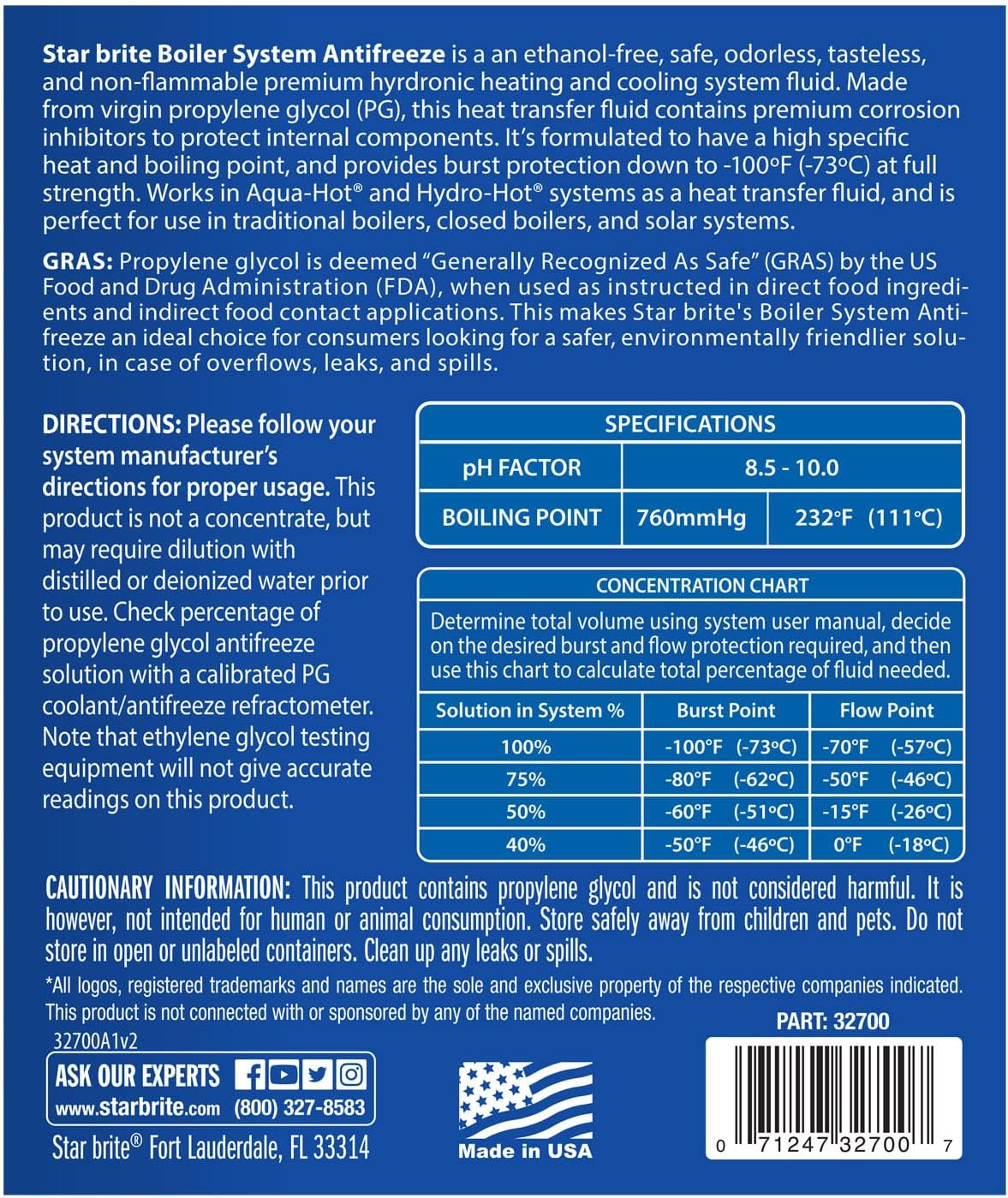
Propylene glycol is the standard freeze-protection fluid for occupied-building hydronic systems. (Ethylene glycol, used in automotive applications, is toxic and not acceptable where fluid could contact potable water supplies or where children and pets have access.) Star Brite manufactures a widely specified propylene glycol concentrate marketed specifically for hydronic and radiant heat applications, and it’s representative of what this product category does and doesn’t do.
What glycol concentration actually buys you
The relationship between glycol concentration and freeze protection is non-linear:
By the numbers — Propylene Glycol Freeze Protection
| Glycol Concentration (% by volume) | Freeze Point | Burst Protection Point |
|---|---|---|
| 20% | +15°F (−9°C) | +5°F (−15°C) |
| 30% | +5°F (−15°C) | −8°F (−22°C) |
| 40% | −8°F (−22°C) | −22°F (−30°C) |
| 50% | −28°F (−33°C) | −45°F (−43°C) |
Source: Manufacturer published data, representative of industry-standard formulations.
Most hydronic applications in the continental US land at 30–40% glycol by volume. Beyond 50%, glycol begins to reduce heat transfer capacity meaningfully (its thermal conductivity is roughly 25% lower than water), which matters in a system already sized to specific BTU outputs.
The corrosion inhibitor package is at least as important as the freeze point. Reputable hydronic-grade glycol products — including Star Brite’s formulation and the Fernox and Sentinel branded concentrates — include a buffering chemistry package that maintains system pH in the 8.0–9.5 range (slightly alkaline), suppresses oxygen corrosion, and protects both ferrous and non-ferrous metals including the brass and copper alloys common in circulators and zone valves. Per the Fernox Protector F1 Product Data Sheet, inhibitor depletion (not freeze point degradation) is the primary reason annual glycol testing is recommended — the freeze protection lasts longer than the chemistry protecting the metal.
When glycol is mandatory vs. optional
- Unheated mechanical rooms or exposed piping runs: Non-negotiable. Size the concentration to the lowest credible ambient temperature, not the average winter low.
- Snowmelt systems and radiant slabs with outdoor loops: Standard specification. Many manufacturers void warranties on outdoor-rated components if glycol documentation is absent.
- Fully interior residential systems with no freeze exposure: Glycol is optional. Some installers prefer straight inhibited water (see below) because glycol’s lower specific heat means slightly larger pumping energy for equivalent heat delivery, and glycol disposal adds a maintenance overhead.
- Systems with fresh-water makeup connections: Be careful. Auto-fill valves continuously dilute the glycol concentration. Systems with automatic makeup water should have annual refractometer testing to verify concentration hasn’t drifted below the design point. The Rhomar Pro-Guard 502 Hydronic System Treatment Guide specifically flags auto-fill as the leading cause of underconcentration failures in service calls.
Magnetic Dirt Separators: The Continuous Defense Against Sludge
A magnetic filter — the category that includes products from Spirovent, Fernox TF1, Sentinel MagnaClean, and comparable units — is an inline device installed on the boiler return (the pipe bringing cooled water back to the boiler for reheating). Internally, a powerful rare-earth magnet captures magnetite particles suspended in the circulating fluid. A secondary mesh screen captures non-magnetic debris including scale flakes and installation debris.
The operating logic is straightforward: if iron oxide sludge is forming in the system (and in any system with ferrous components, some formation is inevitable), you want to capture it before it deposits on heat transfer surfaces or enters the pump. A magnetic separator doesn’t stop corrosion — that’s what inhibitor chemistry does — but it intercepts the corrosion byproduct before it becomes a performance and reliability problem.
What the filter actually protects
- Circulator pump impellers. Magnetite sludge is abrasive. Pump impellers in high-sludge systems show visible wear within three to five years; in clean systems, the same pump runs a decade or more. Per Sentinel’s X100 Inhibitor Technical Bulletin, pump failures related to sludge contamination account for a disproportionate share of service calls on systems lacking magnetic filtration.
- Boiler section passages. Cast iron sections have relatively narrow water-side passages. Sludge accumulation in these passages reduces flow, increases localized temperature (hot-spotting), and in extreme cases causes section cracking — the most expensive single failure mode in the product category.
- Zone valves and thermostatic radiator valves (TRVs). These small-orifice devices are extremely sensitive to particulate contamination. A magnetic separator upstream protects the entire zone control infrastructure.
Sizing and placement rules of thumb
Most residential and light-commercial cast iron boiler applications (up to roughly 300,000 BTU/hr) are adequately served by a single 1-inch or 1.25-inch magnetic separator on the boiler return. HPAC Engineering’s coverage of hydronic system commissioning recommends placing the unit as close to the boiler return as practical — within 18 inches — to maximize capture of any particles shed directly from the boiler sections.
For multi-boiler or large-commercial configurations (Burnham Commercial, Peerless MI Series, Crown Boiler Phönix installations), specifiers routinely add individual separators on each boiler return and a central system separator at the primary loop. The incremental cost is small relative to the equipment value being protected.
Maintenance interval: Most magnetic separators should be cleaned annually at minimum — more frequently in the first two years on any system that wasn’t chemically flushed before the separator was added (the filter will capture the existing sludge load, which can be substantial). A filter that isn’t cleaned eventually becomes a flow restriction rather than a protection device.
The Decision Framework: If X, Then Y
If you’re working a specific project right now, here’s the clean decision logic:
If the system has any piping or equipment in an unheated space: → Glycol at 30–40% concentration is mandatory. Use a hydronic-grade propylene glycol with an inhibitor package (Star Brite, Fernox F1, Sentinel X500, or equivalent). Document the concentration and retest annually.
If the system is all-interior with no freeze exposure: → Skip glycol unless the owner has a specific reason to want it. Use an inhibitor-only treatment (Fernox Protector F1, Sentinel X100, Rhomar Pro-Guard 502) to maintain pH and suppress oxygen corrosion. This is cleaner, cheaper to maintain, and avoids the heat-transfer penalty.
If you’re installing on any system older than five years or one that has never had chemical treatment: → Budget for a power flush before adding treatment chemistry. Adding inhibitor to a sludge-loaded system doesn’t clean it; it just preserves the current state. A magnetic separator post-flush will then capture ongoing corrosion byproduct rather than acting as a catch-all for accumulated debris.
If the project involves any snowmelt, outdoor radiant, or exposed-piping application: → Magnetic filtration is standard specification regardless of glycol use. The thermal cycling and temperature differentials in these applications accelerate corrosion and particulate generation.
If the boiler warranty is a priority factor (and it should be): → Check the specific manufacturer’s water chemistry requirements. Weil-McLain, Burnham, and U.S. Boiler Company all publish water quality guidelines in their installation manuals. Warranty claims related to section corrosion are routinely denied when pH logs and treatment records are absent. A magnetic filter with a documented annual cleaning record is inexpensive warranty insurance.
The underlying principle connecting all of it: cast iron’s thermal mass and longevity advantages are only realized if the water-side chemistry supports them. A $4,500 boiler that fails at year nine because of preventable corrosion is a worse outcome than a $3,200 boiler that runs cleanly for 28 years. The glycol and the filter are how you close that gap.