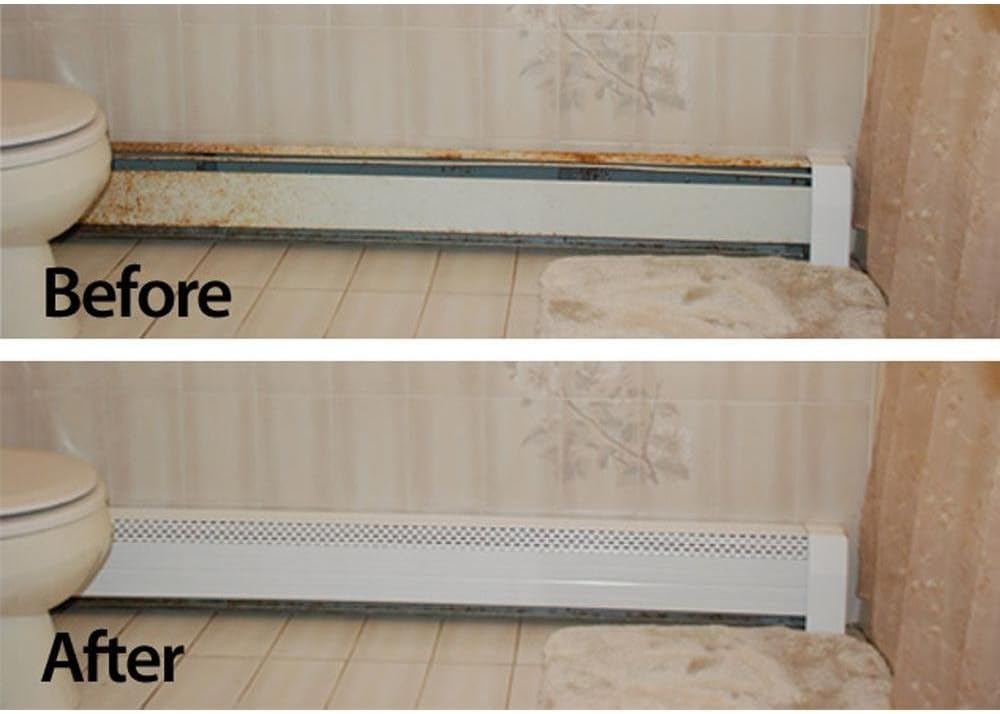
Hydronic baseboard heating works by running hot water through a pipe — heated by your boiler — inside a long metal enclosure that runs along the base of your walls. That enclosure is called a baseboard cover or baseboard cabinet, and it has two jobs: protect the heating element (a finned copper tube called a “fin-tube element”) and direct warm air into the room through slots or vents. In most of the house, the standard steel cover does both jobs reliably for decades. In the bathroom, it frequently fails at the first job before it has a chance to finish the second. Moisture, cleaning spray, and — let’s just say — imprecise aim from younger household members combine to turn a once-clean steel cover into a rust streak on your tile floor. This guide breaks down the replacement options, explains when plastic wins on merit rather than just convenience, and gives you the decision framework to spec the right cover the first time.
| EDITOR'S PICK5ft Steel Easy Slip-On Baseboar… | Mid-tier*TALL*NeatHeat TALL 6ft Baseboa… | Budget pickNeatHeat 6ft Baseboard Heat Fro… | |
|---|---|---|---|
| Length | 5ft | 6ft | 6ft |
| Material | Steel | — | — |
| End Caps | ✓ | — | — |
| Type | Slip-On | TALL | Front |
| Bathroom Use | ✓ | — | — |
| Hydronic | ✓ | — | — |
| Price | $74.39 | $48.43 | $39.98 |
| See on Amazon → | See on Amazon → | See on Amazon → |
Why Bathrooms Destroy Metal Baseboard Covers Faster Than Anywhere Else
Standard hydronic baseboard covers are made from stamped steel, usually with a thin layer of baked-on paint. That finish holds up fine in a living room. In a bathroom, you’re introducing three failure accelerants that the original designers arguably didn’t prioritize:
Humidity cycling. Every shower sends a wave of condensation across every surface in the room, including the lower six inches of wall where your baseboard lives. Plumbing and HVAC Magazine’s coverage of hydronic baseboard maintenance notes that bathrooms represent a disproportionate share of premature cover corrosion relative to element lifespan — the fin-tube element itself (copper tube and aluminum fins) typically outlasts two or three generations of the steel enclosure around it.
Cleaning chemicals. Bleach-based bathroom cleaners are aggressive on thin steel finishes. The paint flakes, the bare metal is exposed, and rust follows within one or two seasons.
Directional accuracy problems. This is the one that generates the most colorful product feedback. Households with young boys — and sometimes adults with optimistic confidence in their aim — find that the base of the toilet-adjacent baseboard cover takes the first hit. Rust on the bottom rail of a steel cover near a toilet is one of the most commonly cited triggers for a cover replacement purchase, appearing in detailed buyer accounts with a frequency that makes it effectively its own use-case category.
The underlying hydronic element is almost certainly fine. The cover is the sacrificial component, and in bathrooms it’s being sacrificed faster than expected.
Plastic vs. Metal: The Honest Tradeoff Analysis
The case for plastic replacement covers — NeatHeat being the dominant brand in this category — is stronger in the bathroom context than anywhere else. Metal’s only genuine advantage over plastic in this application is thermal conductivity. Every other characteristic of metal — weight, corrosion susceptibility, paint adhesion requirements, noise from thermal expansion and contraction — is a liability. In a bathroom, where corrosion is the primary failure mode, you’re trading away the one advantage metal has while keeping all its disadvantages.
That said, let’s be precise about what “thermal conductivity advantage” means in practice, because it is real and worth quantifying.
By the numbers:
- Steel thermal conductivity: approximately 50 W/m·K
- Polypropylene (NeatHeat cover material): approximately 0.2 W/m·K
- Effective heat output difference in a typical baseboard installation: roughly 3–8% reduction, per NeatHeat LLC product documentation and manufacturer testing summaries referenced in Family Handyman’s baseboard heater coverage
- Practical significance in a bathroom zone: minimal
The efficiency gap is real but modest. This Old House’s overview of hydronic baseboard systems notes that the dominant variables in baseboard heat output are water temperature and fin-tube condition — not cover material — which further reduces the practical significance of the conductivity gap. In a single bathroom zone that cycles on and off rather than running continuously, the plastic cover’s thermal disadvantage is at its most negligible.
Where you’d care about conductivity is in a long continuous baseboard run in a primary living space doing heavy heating work for hours at a time. A bathroom with three to six feet of baseboard heating a small room that already traps warmth is not that scenario.
Comparing Your Three Replacement Options
The market for bathroom baseboard cover replacement breaks into three meaningful tiers. Understanding where each sits helps you match budget and durability expectations without over- or under-specifying for the job.
Snap-On Plastic Covers (NeatHeat and equivalents)
NeatHeat
$39.98
In stock on Amazon
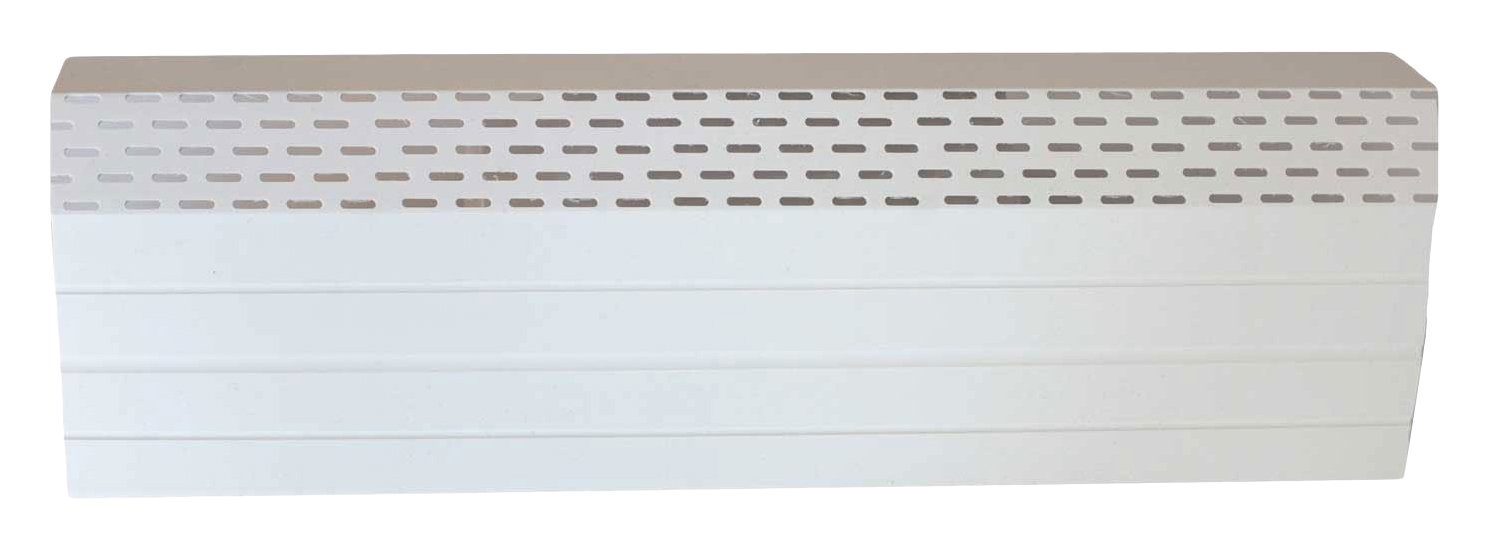
Check price on AmazonSnap-on plastic covers install over your existing metal enclosure without removing it. You leave the old cover in place, strip any caulking that was run along the edges — reviewers and installation guides consistently identify old caulk as the main prep step — and the plastic cover clips directly over the top. No tools, no fasteners beyond the clips built into the cover profile.
This works well when the underlying metal cover is structurally intact but cosmetically ruined: rust-stained, dented, or paint-peeling. NeatHeat LLC’s installation documentation confirms that the snap-on system is designed specifically for this over-existing-cover application, with the polypropylene construction rated to handle surface temperatures produced by standard residential hydronic systems without warping.
The limitation: snap-on covers add a small amount of depth and height to the profile. If your existing cover is already sitting in a tight space — close to a door swing, adjacent to a vanity cabinet, or against an irregular tile edge — measure before ordering. Buyers occasionally note fit surprises in constrained bathroom layouts, particularly in older homes where the baseboard runs close to a toilet tank.
Best for: Cosmetically failed covers that are still structurally sound; buyers who want the fastest possible installation; bathroom zones where corrosion is the primary problem.
NeatHeat
$39.98
In stock on Amazon
Check price on AmazonGalvanized Steel Slip-On Covers
*TALL*NeatHeat
$48.43
In stock on Amazon
Check price on AmazonGalvanized steel slip-on covers serve a different buyer: someone who wants to fully remove the old cover before installing the replacement. The clean-removal approach is often the deciding factor — not wanting to snap over a rusted cover, but wanting it gone entirely. Galvanized steel resists corrosion significantly better than painted steel, making it a legitimate middle-ground option for buyers who prefer metal but need better bathroom durability than the original cover delivered.
ACHR News coverage of hydronic system maintenance best practices notes that galvanizing — the zinc coating process — substantially extends corrosion resistance in high-humidity applications, with properly galvanized steel outperforming painted steel by a wide margin in wet-zone environments. The tradeoff is installation complexity: you’re removing end caps, possibly dealing with painted-over fasteners, and sliding the new cover onto the element track rather than clipping over the old assembly.
Best for: Buyers who prefer metal aesthetics or are completing a renovation where plastic would look inconsistent; situations where the old cover has physically deteriorated beyond snap-over use (bottom rail rusted through, end caps cracked, sections warped); historic or period-appropriate interiors.
*TALL*NeatHeat
$48.43
In stock on Amazon
Check price on AmazonFull-Profile Plastic Slip-On Covers (Tall or Custom-Height Profiles)
5ft
$74.39
In stock on Amazon
Check price on AmazonFor taller baseboard enclosures — typically in the nine-to-ten-inch height range rather than the standard seven-to-eight-inch profile — NeatHeat and comparable manufacturers offer extended-height plastic slip-on covers that require full removal of the old enclosure before installation. These combine the corrosion immunity of plastic with the clean-start installation of a slip-on approach, and they’re the right call when the original cover is physically deteriorated rather than just cosmetically failed.
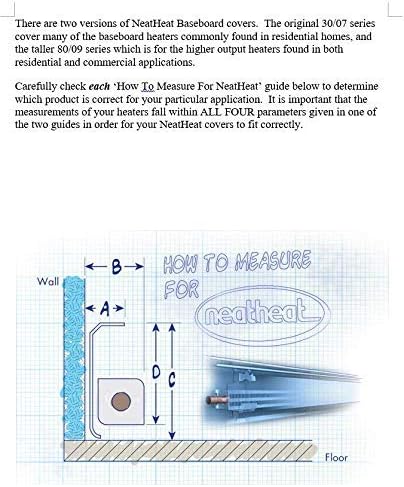
NeatHeat LLC’s product line documentation covers both standard and TALL profiles; verify current dimensions against their specification sheets before ordering, as product lines update periodically. If you’re between sizes, err toward the taller profile — a cover that’s slightly taller than the original looks intentional; one that’s visibly short looks like a mistake.
A recurring note in buyer accounts for longer covers (above four feet) is shipping damage: dents and creases from freight handling. The consistent follow-up finding is that replacement claims are handled without friction, with new units typically arriving in better packaging. ACHR News coverage of HVAC product distribution logistics notes that this pattern — damage in transit, smooth replacement — is common for longer extruded or molded products across the category. Practical implication: inspect packaging immediately on delivery, photograph any damage before opening fully, and initiate a replacement claim within 24–48 hours rather than discovering damage at installation time.
Best for: Taller enclosures that don’t fit standard profiles; situations where the old cover is physically deteriorated and snap-over installation isn’t viable; buyers who want the cleanest possible finished result and are willing to do the full removal work.
5ft
$74.39
In stock on Amazon
Check price on AmazonInstallation Decision Framework
Use snap-on plastic if: The old cover is structurally sound but cosmetically failed (rust staining, paint loss, surface damage). Installation is faster than any metal alternative, and you’re not disturbing the element or its mounting hardware.
Use galvanized slip-on if: You prefer metal, you’re removing the old cover entirely, and you want better corrosion resistance than the original painted steel without switching materials entirely.
Use full-profile plastic slip-on if: The old cover is physically deteriorated — bottom rail rusted through, end caps cracked, sections warped — or if you need an extended-height profile that snap-on covers don’t accommodate.
In all three cases, the fin-tube element itself is almost certainly not the problem. Plumbing and HVAC Magazine’s hydronic baseboard coverage consistently distinguishes between element lifespan (long, typically measured in decades) and cover lifespan in wet zones (much shorter). You are replacing the enclosure, not the heating system.
Frequently Asked Questions
Will plastic covers warp or melt from hydronic heat?
No, under standard residential operating conditions. NeatHeat LLC’s product documentation specifies that covers are manufactured from polypropylene rated to handle surface temperatures produced by typical residential hydronic systems. Supply water temperatures in residential systems generally run 140–180°F; the cover itself never reaches water temperature because it’s separated from the element by an air gap. Buyers reporting three or more years of use do not describe warping under normal conditions. The caveat: if your system runs above 200°F — atypical for residential applications — verify against the manufacturer’s rated temperature specification before installing.
Do I need to remove the old cover before snap-on installation?
No. Snap-on covers are explicitly designed to install over existing covers without removal. The main prep step is removing old caulking along the top or bottom edge of the original cover, since caulk can prevent the new cover from seating flush. If caulk is cleared and the existing cover isn’t physically bowed or distorted, snap-on installation proceeds as designed.
Are plastic covers as effective as metal at circulating heat?
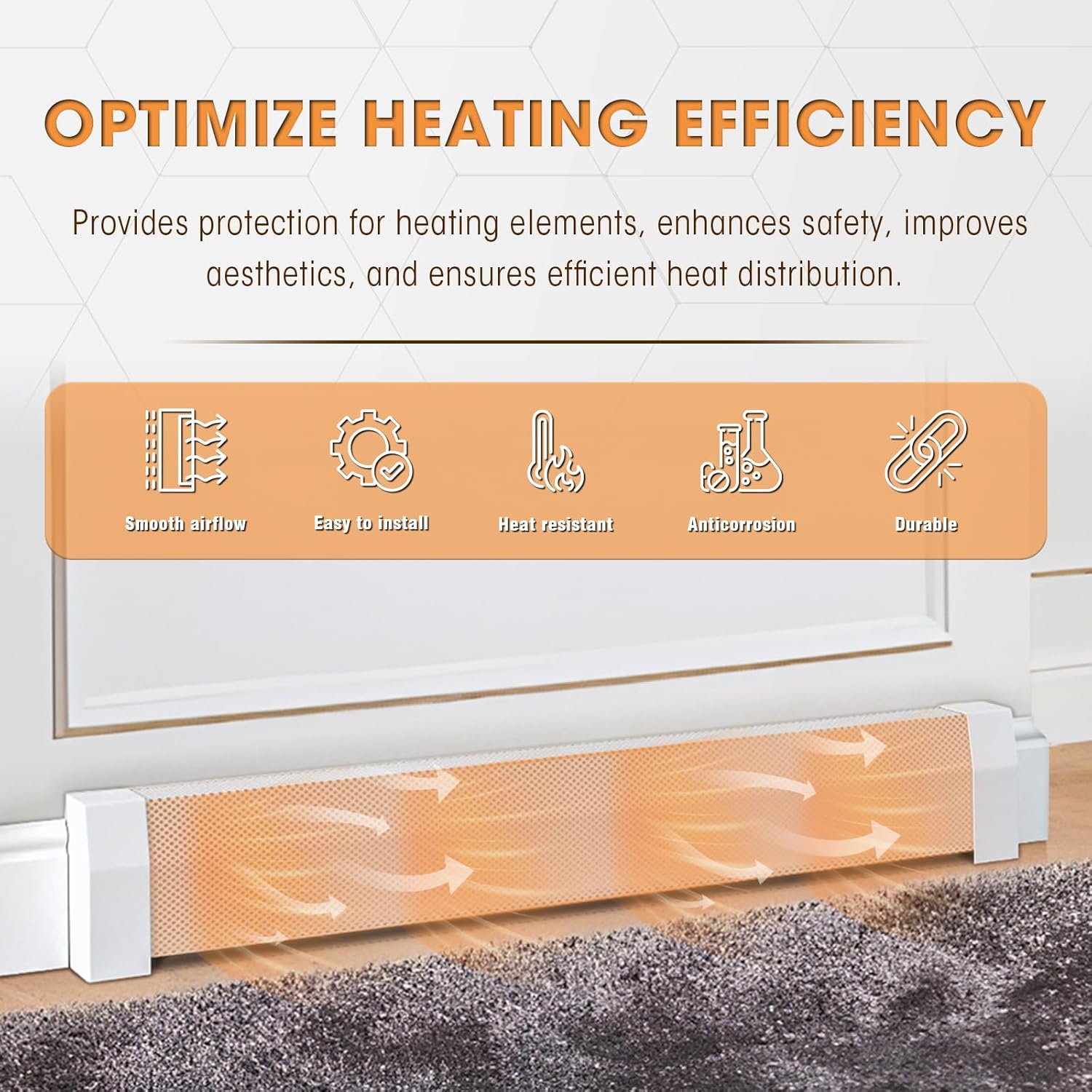
Functionally yes, with a small efficiency footnote. Both cover types rely primarily on convection: cool air enters through slots at the bottom, rises past the heated fin-tube element, and exits through the top. Family Handyman’s baseboard heater coverage confirms that convective airflow — driven by element temperature and slot geometry — is the dominant heat transfer mechanism, not conduction through the cover material itself. In a bathroom with small room volume and supplemental heating, the conductivity difference between plastic and steel is not perceptible in practice.
Can NeatHeat covers be painted to match wall color?
Yes. NeatHeat LLC’s published product documentation notes that covers can be painted with standard latex paint. Light sanding and a plastic-bonding primer as a first coat improve adhesion. Flat or eggshell finishes are more forgiving than gloss for color-matching. The result won’t be identical to a factory finish, but it’s serviceable in a bathroom where the cover may be partially obscured by a door or toilet tank.
The Bottom Line
In the bathroom, plastic snap-on covers win on merit, not just convenience. They eliminate the failure mode — corrosion — that makes metal covers a poor fit for wet zones, and they do so with the fastest installation path available. The thermal conductivity gap is real but negligible at bathroom scale. NeatHeat is the established name in the category with the review record and manufacturer documentation to back it up.
Galvanized slip-on is the right answer for buyers who need or prefer metal. Full-profile plastic slip-on handles deteriorated covers and non-standard heights. The fin-tube element underneath all three options is almost certainly fine — you’re solving a cover problem, not a heating problem, and the cover problem in a bathroom has a clear, durable solution.